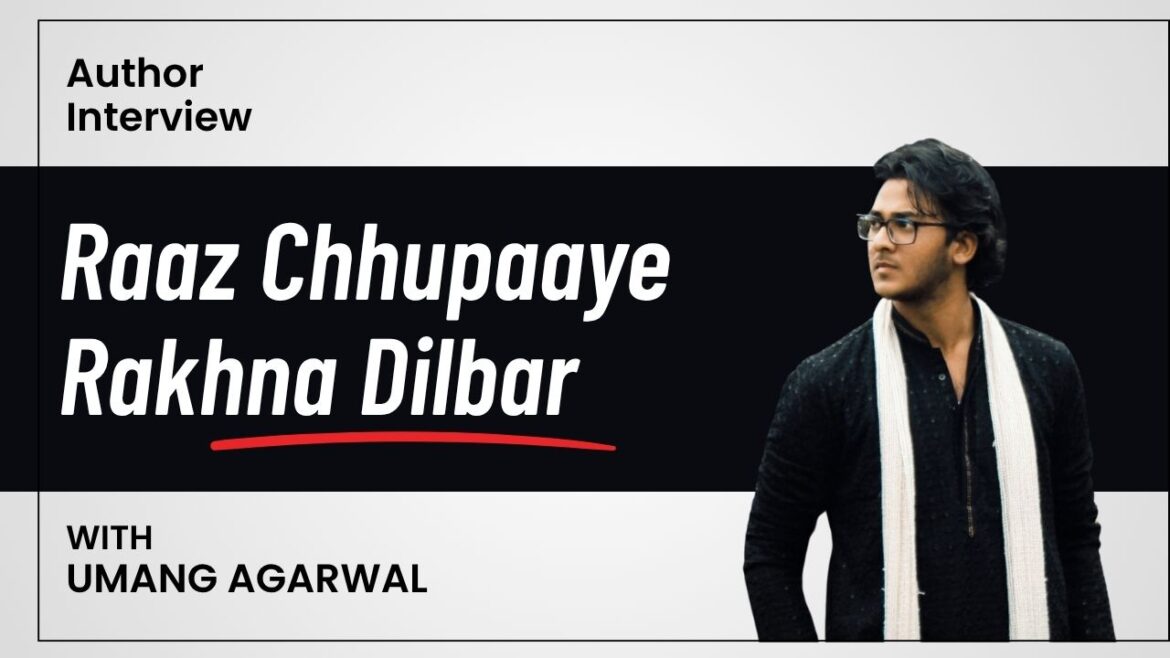
Title: Raaz Chhupaaye Rakhna Dilbar
Author: UMANG AGARWAL
ISBN: 9789373357829
Publisher: Evincepub Publishing
About the Book
“A Peaceful Sanctuary for Restless Dreamers”
Across 4 evocative segments; Raina, Dashamlav, Jheeni, and Aagaaz; this collection weaves together 50 Shers, Nazms, Ghazals, and Poems that capture the emotional landscape of modern youth. Written with a rare blend of simplicity and depth, the pieces sit beside the reader as a gentle companion through heartbreak, longing, and hope. To ensure the beauty of the verse is accessible to all, the book features clear explanations for difficult words and thoughtful transliteration, allowing the reader to experience the poetry in the language that resonates most with them. It also features a special chapter dedicated to the author’s debut song, ‘Reshmi’; including unreleased lyrics; and a curated ‘Mood Playlist’ to set the tone for the journey. By balancing raw honesty with artistic flair, the book provides high value for both time and heart, making it a rare keepsake for any reader, an invitation to own a piece of art that understands one’s unspoken truths and transforms them into a lasting companion.
About the Author
Umang Agarwal is a 23 y/o author from Kolkata. He is a Film & Music Director, Composer, Lyricist, Vocalist and Poet. He is also the Founder-Director of Mrigtrishna Productions Pvt. Ltd., a Film & Music Production company, with song releases available on:
Streaming Platforms: Spotify | YouTube | YouTube Music | JioSaavn | Apple Music | Amazon Prime Music
Social Media: Instagram | Facebook | LinkedIn | X (Twitter)
Sameer Gudhate: When did you realise that poetry is your way of expression?
Umang Agarwal: I haven’t yet realised that, and neither do I want to – to be honest. Poetry is anything for me but expression. It is an escape for me – escape from questions, escape from dilemmas, and escape from difficulties. They help me take some load off my heart, and yet remain mysterious, without revealing much directly. As for when I realised such escape was possible, there is no particular moment I can trace it all back to, but I do remember starting to write intensively during a certain phase in 2021, when there was just too much going around me. Poetry helped, and so I continued.
Sameer Gudhate: How do you capture real emotions in such a natural way?
Umang Agarwal: First of all, thanks – I’ll take it as a compliment! (laughs) Second – I just write what I feel, honestly. Rhyming helps, and so do similes and metaphors. Readers finding it natural is just an added bonus, and I’m grateful to Maa Saraswati for this.
Sameer Gudhate: Did you ever remove any poem from the book? Why?
Umang Agarwal: Did I ever, God. I can write a Chronicle with what I’ve removed from this book – and the reason is simple. I did not want to overdo things. Nor could I risk jeopardizing the effect of the (comparatively) good shers by letting the slightly not-so-good ones be. It’s not like I find them bad or anything, because I love them all, equally. Each of my shers come from memories dear to me, and I’d never undermine them. It’s just that, as an author putting a marketable book out there, I feel like I am responsible, towards my readers, to deliver the best that I can, with utmost honesty. So, in this exchange of artistry & audience, sometimes personal sentiments have to take a step back, and I have made my peace with the editing process.
Sameer Gudhate: What kind of environment helps you write better?
Umang Agarwal: Solitude & sleepy eyes – just me, wrapped in my comforter, on my corner of the bed.
Sameer Gudhate: How do you deal with emotional moments while writing intense poems?
Umang Agarwal: I deal with emotional moments BY writing intense poems.
Sameer Gudhate: Do you believe pain is necessary for good poetry?
Umang Agarwal: Only a pure intention is necessary for poetry! Good or bad, that’s for the people to decide. Why must pain inspire poetry and not pleasure?
Sameer Gudhate: How has your writing style changed over time?
Umang Agarwal: Explaining this in an answer would be a futile attempt, and rather weird because ‘nemo debet esse judex in propria causa’ – which basically means that one should not be the judge in their own case. Apologies for the latin maxim. The law student in me woke up. But on a serious note – I’d rather have people tell me if they find a change in my writing style, upon reading the next book – fingers crossed.
Sameer Gudhate: What makes a poem meaningful according to you?
Umang Agarwal: It’s reader. Beauty lies in the eyes of the beholder. A poem may be brilliant beyond praise, but it would still be devoid of any meaning or value, whatsoever, if its reader is unable to make sense of it.
Sameer Gudhate: How do you want readers to feel after finishing your book?
Umang Agarwal: I want them to feel like immediately reaching out to me and letting me know how they felt!
Sameer Gudhate: Do you think poetry is still relevant in today’s fast world?
Umang Agarwal: Art of any and every kind, will always be relevant – no matter how fast the world moves.
Sameer Gudhate: How do you connect your poetry with today’s generation?
Umang Agarwal: I myself belong to today’s generation (laughs). I’m happy that connecting with my readers isn’t much of a task, at this stage, at least.
Sameer Gudhate: What is more important for you: words or emotions?
Umang Agarwal: Intent. If you mean well, even silence will work more any word, to express any emotion.
Sameer Gudhate: Did you ever doubt your writing during this journey?
Umang Agarwal: I have no shame in saying that I love my writings. Why shouldn’t I, if I have learnt it all from the greats & legends of the world of Literature? If I doubt myself, it will bring discredit to my teachers, my inspirations. So no, I don’t doubt my art. Although I do fear the winds. They are sometimes harsher than one might expect. Apart from that, the journey has been mostly me trying to improve the draft with designs, and checking errors to give the readers a good experience.
Sameer Gudhate: How do you stay motivated to keep writing?
Umang Agarwal: There are many more nights to go. I’m sure motivation will come, that too when I least expect it. And even if it doesn’t – there are many more people left to connect with! This alone is fuel enough for the fire in me.
Sameer Gudhate: If you could talk to your younger self, what would you say about this book?
Umang Agarwal: My younger self wouldn’t believe me if I told him that he’d be a published author. But if I do have to tell him something, I’d just quote Shri Javed Akhtar Ji –
“Kyon darein zindagi mein kya hoga,
Kuch na hoga, toh tajurba hoga!”