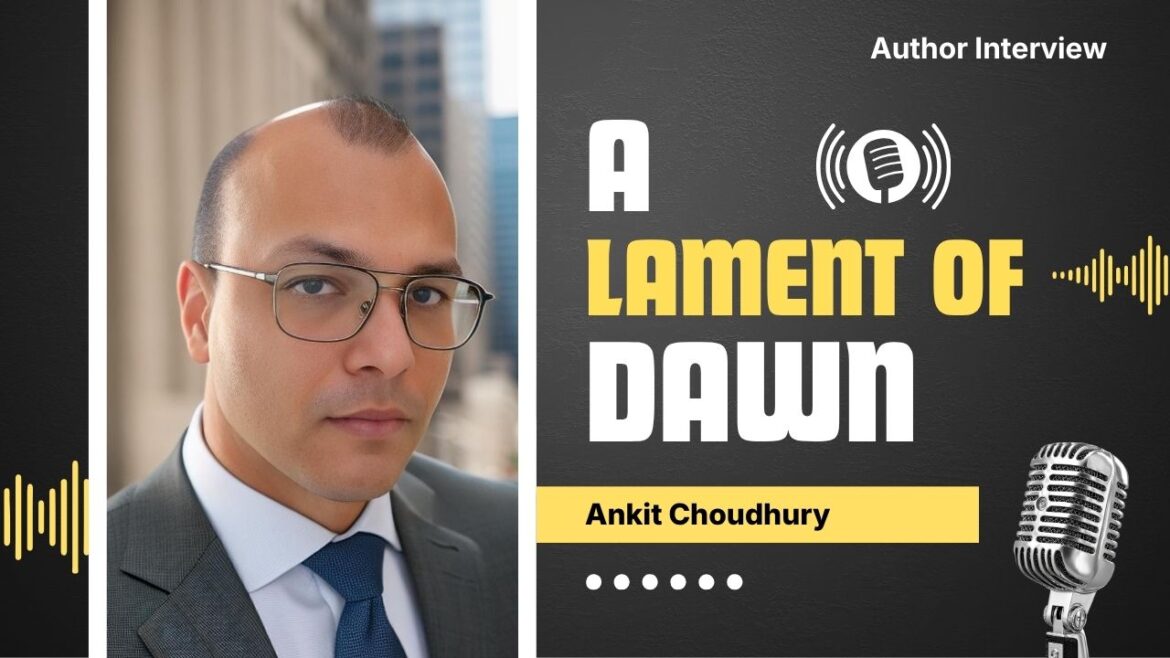
Title: A Lament of Dawn
Author: Ankit Choudhury
ISBN: 9789373357645
Publisher: Evincepub Publishing
About the Book
Some men save the world.
Some men understand it.
Very few survive that understanding.
A Lament of Dawn is the final movement of A Ballad of Chaos – a psychological, political, and deeply human reckoning set after the age of genius, ambition, and impossible order.
The world stands on the edge of perfect control.
Wars are prevented before they begin. Nations move in careful synchrony. Chaos has been tamed -not by conquest, but by intelligence so precise it leaves no room to breathe.
At the center of it all stands one man.
He sees the system completely.
He carries it alone.
And he knows it cannot last.
As past and present collide, A Lament of Dawn unfolds as a quiet catastrophe:
a prodigy who becomes the architect of global stability,
a woman who loves him without myth or illusion,
and a world that must decide what it inherits when brilliance finally collapses under its own weight.
This is not a story of heroes and villains.
It is a story of consequence.
Of power exercised too cleanly.
Of love that steadies – and destroys.
Of a final choice that is not made to win, but to rest.
Written with surgical restraint and emotional force, A Lament of Dawn closes the cycle where chaos does not end in fire or triumph, but in acceptance. Where peace arrives not through victory, but through letting go.
For readers of philosophical fiction, political thrillers, and character-driven epics, this is a devastating conclusion – one that lingers long after the final page.
Includes a special concluding chapter for readers of A Ballad of Chaos.
About the Author
Ankit writes at the fault line between myth and memory.
His work is driven by questions of identity, fracture, ambition, love, loss, and the uneasy truce between order and chaos that most people live with but rarely name. The characters in his stories are mirrors to be endured: minds under strain, hearts negotiating with purpose, intelligence colliding with longing. Power, in his writing, is never abstract – it is psychological, intimate, and costly.
Trained as a software architect, Ankit approaches storytelling the way he approaches systems: by dissecting how things fail, how they adapt, and what remains when structure collapses. He explores consciousness as a terrain – memory as architecture, love as destabilization, and meaning as something forged under pressure rather than discovered whole. The result is fiction that reads as myth on the surface and confession beneath it.
Ankit lives in Pune, India. He is an artist, reader, gamer, lifelong explorer of ideas – and a father, which, more than anything else, keeps him tethered to the human center of his work.
Sameer Gudhate: What inspired you to explore the idea of “understanding” as a burden rather than a strength in this book?
Ankit Choudhury: Understanding removes illusion. That sounds noble until you realize illusion is what allows many people to function. The more clearly you see patterns, consequences, and motives, the harder it becomes to participate in comforting narratives. In this book, understanding isolates before it liberates. It strips away hope that things will fix themselves. I wanted to explore what happens when intelligence stops feeling empowering and starts feeling heavy.
Sameer Gudhate: How did your background as a software architect influence the structure of this story?
Ankit Choudhury: Architecture teaches you that failure is rarely dramatic. It’s systemic. Small decisions compound quietly until something collapses. I structured the book the same way – alternating timelines, controlled pacing, cause and effect unfolding without spectacle. Even emotionally, the story behaves like a system under load. It doesn’t explode immediately. It degrades.
Sameer Gudhate: The world in your book is highly controlled. Do you see this as a warning for the future?
Ankit Choudhury: Not a warning – a reflection. We are already moving toward optimization in every domain: productivity, relationships, politics, even identity. The book asks what we lose when friction disappears. Control feels safe until it removes the unpredictability that makes growth possible. I’m less interested in dystopia and more interested in fragility.
Sameer Gudhate: How did you develop the central character’s emotional depth without making him overly expressive?
Ankit Choudhury: Restraint. Emotional depth doesn’t require confession. It requires pressure. I showed his interior life through hesitation, silence, strategic choices that reveal doubt. Some people don’t articulate what they feel; they carry it. That kind of quiet interiority felt more honest for him.
Sameer Gudhate: The love story in the book feels very real and quiet. What was your approach while writing it?
Ankit Choudhury: I avoided dramatization. Real love is often composed of pauses, glances, unfinished sentences. I focused on emotional asymmetry – what each character sees in the other that they can’t see in themselves. The power of their relationship comes from what it destabilizes, not from what it declares.
Sameer Gudhate: Why did you choose a slow and reflective pace instead of a fast-moving narrative?
Ankit Choudhury: Because the transformation in this story is internal. A fast pace would have disguised the discomfort. Slowness forces the reader to sit with decisions as they form. Reflection is not inertia; it’s tension without noise.
Sameer Gudhate: How important is silence and what is left unsaid in your writing process?
Ankit Choudhury: It’s essential. Silence is where meaning consolidates. If everything is explained, nothing resonates. I trust the reader to feel what isn’t articulated. In many cases, what remains unsaid carries more emotional weight than what is spoken.
Sameer Gudhate: Did you always plan the ending to be about acceptance, or did it evolve during writing?
Ankit Choudhury: It evolved. I initially imagined something more decisive, more triumphant. But as the characters matured, that kind of ending felt dishonest. Acceptance emerged naturally once I stopped trying to engineer resolution.
Sameer Gudhate: What challenges did you face while balancing philosophical ideas with storytelling?
Ankit Choudhury: The risk is abstraction. Philosophy can distance readers if it floats above lived experience. I anchored every idea in a personal cost. If a concept didn’t wound someone in the story, it didn’t belong.
Sameer Gudhate: How do you define “peace” after writing this book?
Ankit Choudhury: Peace isn’t the absence of chaos. It’s the absence of resistance to it. It’s the moment you stop negotiating with reality and start inhabiting it fully – even when it’s imperfect.
Sameer Gudhate: Do you believe that complete control is ever truly possible in real life?
Ankit Choudhury: No. At best, we manage variables temporarily. Control is contextual and fragile. The belief in permanence is what creates disillusionment.
Sameer Gudhate: How does this book connect emotionally and thematically to A Ballad of Chaos?
Ankit Choudhury: The earlier books explored cosmic conflict – order versus chaos at mythic scale. This one internalizes that tension. Lucifer retaliated. Manu internalized. The battlefield becomes psychological. Emotionally, it’s a continuation of the same question: what remains when certainty collapses? The scale changes, but the inquiry doesn’t.
Sameer Gudhate: Which character in the book was the most difficult for you to write and why?
Ankit Choudhury: Manu. Not because he’s complex, but because he’s restrained. Writing someone who thinks more than he speaks requires discipline. I had to convey evolution without overt confession. That subtlety was demanding.
Sameer Gudhate: What kind of readers do you think will connect the most with this story?
Ankit Choudhury: Readers who have outgrown simple victories. Those who understand that intelligence doesn’t prevent pain, and that sometimes stepping back requires more courage than pushing forward.
Sameer Gudhate: After finishing this book, what questions do you hope readers will carry with them?
Ankit Choudhury: What am I still trying to control?
What would happen if I stopped?
And is peace something I achieve – or something I allow?