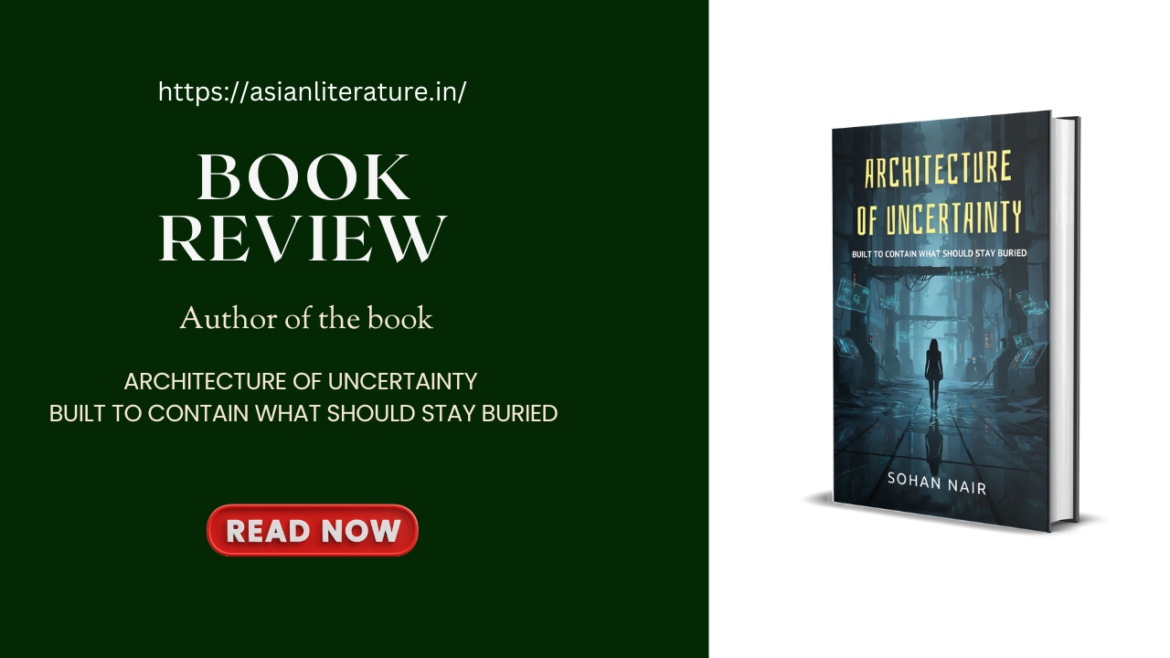
Author Name: Sohan Nair
Book Title: Architecture of Uncertainty
Book Subtitle: Built to contain what should stay buried
ISBN: 978-93-4726-313-2
Publisher: Inksight Publishers
In an era defined by volatility—economic instability, technological disruption, climate uncertainty, and shifting cultural paradigms—Architecture of Uncertainty emerges as a profoundly relevant and intellectually stimulating work. The book does not merely examine uncertainty as a condition to be managed; instead, it reframes it as a foundational principle shaping systems, structures, and human experience itself.
From the outset, the author challenges the traditional notion that architecture—whether physical, intellectual, or organizational—must aim for permanence and predictability. Instead, the book proposes that adaptability, responsiveness, and resilience are the true hallmarks of meaningful design. This conceptual pivot is both refreshing and timely. Rather than clinging to rigid frameworks, the text advocates for fluid models capable of evolving alongside changing realities.
One of the book’s greatest strengths lies in its interdisciplinary approach. Drawing from philosophy, systems theory, social sciences, and contemporary design thinking, it creates a layered understanding of uncertainty. The narrative moves seamlessly between theoretical reflection and practical implication. This makes the work accessible not only to architects and designers but also to thinkers, planners, and leaders navigating complex environments.
The author explores how uncertainty is often perceived as a threat—something to minimize, suppress, or eliminate. However, through compelling analysis, the book reveals that uncertainty is also a space of possibility. It is within ambiguity that innovation emerges. It is in unpredictability that creativity finds momentum. By examining case studies and conceptual models, the text illustrates how flexible structures outperform rigid systems in long-term sustainability.
A particularly compelling aspect of the book is its reflection on human psychology. The fear of instability is deeply ingrained in collective consciousness. We crave order and clarity. Yet, Architecture of Uncertainty suggests that growth requires embracing discomfort. The author argues that resilience is not about resisting change but about designing frameworks that can transform without collapsing.
Stylistically, the writing is thoughtful and reflective without being overly technical. While some sections require careful reading due to conceptual depth, the arguments remain coherent and logically structured. The prose maintains an academic seriousness but avoids unnecessary jargon, making it suitable for serious blog discussions and intellectual forums.
Another noteworthy dimension is the ethical undertone. The book subtly raises questions about responsibility in times of uncertainty. Who benefits from rigid systems? Who suffers when structures fail to adapt? By situating uncertainty within social and cultural contexts, the text extends beyond architectural metaphor and touches upon governance, economics, and community resilience.
If there is any limitation, it might be that readers looking for purely practical “how-to” solutions may find the text more philosophical than procedural. However, this is not a weakness but rather a deliberate design choice. The book aims to reshape thinking before prescribing methods.
Ultimately, Architecture of Uncertainty is not just a study of instability—it is a manifesto for adaptive intelligence. It invites readers to shift from control-based models to responsive frameworks. In doing so, it offers a powerful lens through which to understand our rapidly changing world.
For readers interested in systems thinking, innovation, and the future of design and decision-making, this book is both insightful and transformative.
Amazon : https://www.amazon.in/dp/9347263133