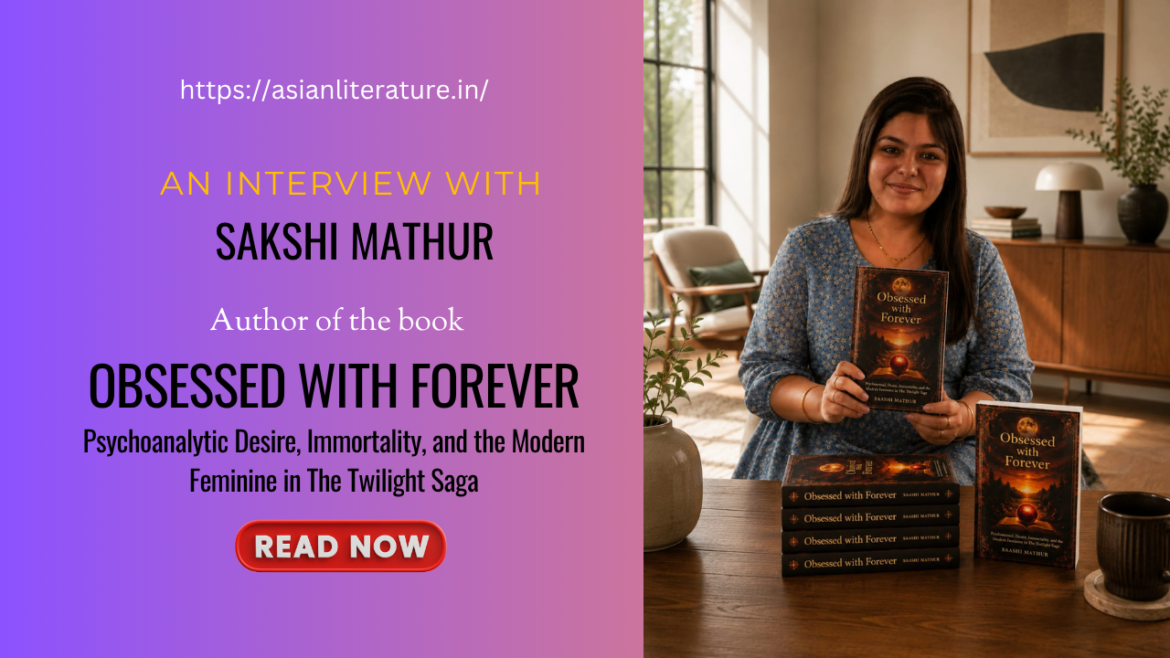
Title: Obsessed with Forever
Author: SAKSHI MATHUR
ISBN: 978-93-7900-787-2
Publisher: Inksight Publishers
About The Book
“Forever promises everything but asks for more than we realise.” Obsessed with Forever: Psychoanalytic Desire, Immortality, and the Modern Feminine in The Twilight Saga offers a fresh and engaging perspective on one of the most loved stories of our time. Moving beyond the romance of Twilight, this book explores a deeper question why are we so drawn to the idea of “forever”?
In today’s fast-changing world, where relationships feel uncertain and life moves quickly, the promise of eternal love feels comforting. But is it as perfect as it seems? This book invites readers to look beyond the fantasy.
Drawing on ideas from thinkers like Sigmund Freud and Jacques Lacan, it shows how desire is shaped by what we lack and fear losing. At the same time, feminist theorists such as Julia Kristeva, Luce Irigaray, and Judith Butler help explain how love and identity are influenced by social expectations, especially for women.
Through Bella Swan*s journey, the story becomes more than romance—it reflects a deep longing for stability, belonging, and permanence. Her transformation reveals how the desire to live forever can also be a way of escaping change, ageing, and uncertainty. Yet, there is a hidden truth. Immortality may promise safety and endless love, but it also stops growth and change. What feels like freedom can quietly become control.
Clear, engaging, and reflective, Obsessed with Forever encourages readers to reconsider love—and ask: is forever a beautiful dream, or a hidden compromise?
About The Author
Sakshi Mathur is a scholar of English literature with a keen interest in psychoanalysis, feminist theory, and cultural studies. Her work focuses on exploring the intersections of desire, identity, and modern femininity in popular narratives. Drawing on both classical and contemporary theoretical frameworks, she engages critically with texts that shape cultural imagination and emotional life.
Obsessed with Forever is her first published book (2026), reflecting her commitment to rigorous academic inquiry and accessible critical writing. Through her research, she aims to bridge the gap between theory and popular culture, offering new ways of understanding familiar stories.
Neel Preet: What inspired you to explore The Twilight Saga through the lens of psychoanalysis and modern femininity?
Sakshi Mathur: I was fascinated by the emotional intensity that The Twilight Saga created for an entire generation of readers, particularly young women. The series was never only about vampires or romance; it was about longing, identity, fear, and the desire to be seen completely by another person. Psychoanalysis offered a language for understanding those hidden emotional currents, while modern femininity allowed me to examine how Bella’s desires reflect contemporary anxieties about love, selfhood, sacrifice, and belonging. I wanted to explore why this story felt so emotionally addictive and culturally significant beyond its fantasy elements.
Neel Preet: How did Freud’s theories of desire, repetition, and loss shape your interpretation of Bella and Edward’s relationship?
Sakshi Mathur: Freud’s ideas helped me understand the relationship as more than an idealized romance. Bella and Edward are drawn together through cycles of desire and absence. Their love constantly moves between attraction and danger, fulfillment and deprivation. Freud argues that desire often intensifies through impossibility, and that dynamic is central to their relationship. Edward’s distance makes Bella pursue him more intensely, while Bella’s vulnerability deepens Edward’s obsession. Their love becomes a repetition of longing itself—an endless attempt to overcome separation, mortality, and loss.
Neel Preet: In your book, immortality appears both romantic and psychologically unsettling. What fascinated you most about this contradiction?
Sakshi Mathur: Immortality in Twilight is seductive because it promises permanence in a world defined by instability and change. Yet psychologically, eternity is also terrifying because it removes the natural rhythms that give life meaning—growth, aging, endings, and transformation. I was fascinated by how the saga presents immortality as a fantasy of emotional security while simultaneously revealing its emotional costs. The vampires are frozen not only physically but psychologically. Their eternal existence often feels melancholic, repetitive, and emotionally suspended. That contradiction gives the story its haunting power.
Neel Preet: You discuss how love in Twilight is deeply connected with fear, loss, and emotional dependency. Why do you think these themes resonate so strongly with readers?
Sakshi Mathur: Because those emotions are deeply human. Most people do not experience love as purely joyful or stable. Love often carries fear of abandonment, fear of inadequacy, and fear of losing oneself inside another person. Twilight amplifies these feelings through fantasy, but the emotional core remains recognizable. Readers connect with Bella because her love feels absolute, consuming, and emotionally risky. The saga gives form to the intensity many people secretly associate with “true love,” even when that intensity borders on obsession.
Neel Preet: How does Bella’s desire for immortality reflect larger anxieties about identity, time, and femininity in modern culture?
Sakshi Mathur: Bella’s desire for immortality reflects a modern cultural fear of impermanence. She fears aging, separation, and becoming ordinary or left behind. In many ways, her transformation into a vampire symbolizes the fantasy of escaping vulnerability itself. For women especially, contemporary culture often ties worth to youth, beauty, emotional devotion, and desirability. Bella’s longing to remain forever connected to Edward mirrors a larger anxiety about preserving identity and love against the passage of time. Her immortality becomes both empowerment and surrender.
Neel Preet: Your analysis presents eternal love as both comforting and dangerous. Do you think the saga ultimately supports or questions the fantasy of “forever”?
Sakshi Mathur: I think the saga does both simultaneously, which is why it remains so compelling. On the surface, it fulfills the fantasy of eternal love: Bella and Edward achieve permanence, unity, and transcendence together. But beneath that fantasy, the story repeatedly exposes the psychological dangers of wanting forever. Eternal love in Twilight often requires sacrifice of individuality, separation from ordinary human life, and emotional dependency. The saga seduces readers with the dream of forever while quietly questioning what must be lost to achieve it.
Neel Preet: How do concepts like narcissistic love, ego-ideal, and ontological union help us understand the emotional intensity of the characters?
Sakshi Mathur: These concepts reveal how Bella and Edward see each other not simply as partners, but as reflections of emotional completion. Narcissistic love emerges when someone loves another person as an extension of the self or as the embodiment of an idealized identity. Edward becomes Bella’s ego-ideal—the perfect figure through whom she imagines becoming more meaningful, beautiful, and complete. Their relationship also reflects what I describe as ontological union: the fantasy of erasing separation entirely. They do not merely want intimacy; they want fusion. That is why their connection feels overwhelming, transcendent, and at times psychologically dangerous.
Neel Preet: The book blends literary criticism, psychology, and cultural analysis. What challenges did you face while balancing these perspectives?
Sakshi Mathur: One of the greatest challenges was maintaining emotional accessibility while engaging with complex theoretical ideas. I did not want the analysis to feel overly academic or detached from the emotional experience readers have with the saga. At the same time, I wanted the arguments to remain intellectually rigorous. Balancing psychology, literary interpretation, and cultural commentary required constantly moving between emotional intimacy and analytical distance. The goal was to create a book that felt thoughtful without losing the emotional atmosphere that makes Twilight meaningful to readers.
Neel Preet: Do you believe The Twilight Saga changed the way popular culture portrays romance, desire, and female identity?
Sakshi Mathur: Absolutely. Twilight reshaped modern romance narratives by bringing female desire and emotional subjectivity to the center of mainstream fantasy culture. It normalized stories where emotional intensity, vulnerability, longing, and obsession were treated as central rather than secondary experiences. The saga also influenced how female identity became linked to transformation, emotional destiny, and self-sacrifice within romantic storytelling. Whether people admired or criticized the series, it undeniably altered conversations about femininity, desire, and romantic fantasy in popular culture.
Neel Preet: If readers take away one key insight from Obsessed with Forever, what would you want it to be?
Sakshi Mathur: I would want readers to understand that stories like Twilight endure not because they are escapist fantasies alone, but because they express profound psychological truths about human longing. The desire for eternal love is ultimately a desire to overcome loneliness, mortality, and emotional uncertainty. Obsessed with Forever invites readers to examine why we are drawn to fantasies of permanence and what those fantasies reveal about our fears, desires, and identities in the modern world.