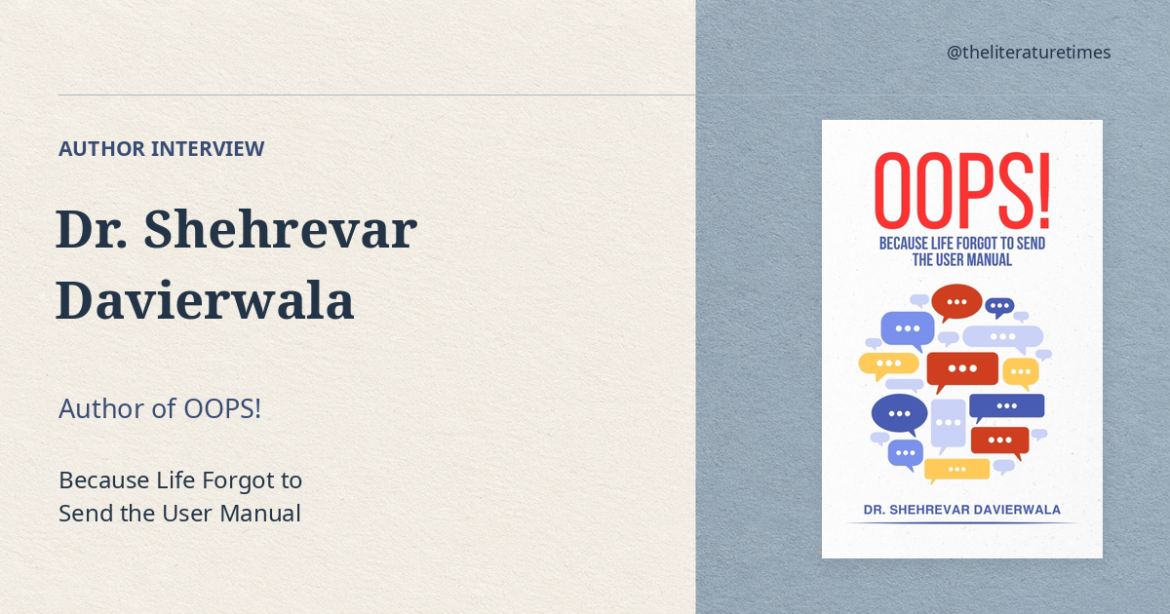
Dr. Shehrevar Davierwala’s work has taken him through boardrooms, classrooms and cross-cultural initiatives, engaging with diverse communities and institutions, including in conflict-affected environments. His supplied biography traces OOPS! to real conversations with people from different walks of life and to a recurring concern: finding perspective when clear answers are unavailable. He approaches unscripted experiences as opportunities to learn, with an emphasis on enough clarity to take the next meaningful step. In OOPS! Because Life Forgot to Send the User Manual, that outlook is brought to questions of work, ambition and everyday uncertainty through a proposed blend of corporate satire, stories, practical tools and wisdom drawn from Indian mythology. The following questions invite him to explain the choices and experiences behind the book.
The Literature Times: Your biography says OOPS! grew from real, unfiltered conversations. What recurring question first made you feel these conversations belonged in a book, and how did you choose its title?
Dr. Shehrevar Davierwala: I often noticed that people from different walks of life, including very successful professionals, were struggling with surprisingly similar questions: Why was I overlooked? Why did someone else get the credit? Am I in the wrong career? And why does everyone else seem to have life figured out? These conversations made me realise that life is full of unexpected situations, and most of us are learning while pretending to know what we are doing! That is how OOPS! came about. The title is a light-hearted reminder that making mistakes, facing disappointments and changing plans are all part of being human. Sometimes an OOPS moment is simply life asking us to look at things differently.
The Literature Times: Own, Observe, Pivot and Shine give the book its central framework. How did you arrive at that sequence, and which stage did you find most difficult to explain clearly?
Dr. Shehrevar Davierwala: I wanted four simple words that people could remember even when life was testing their patience! OWN means accepting your situation without blaming yourself for everything. OBSERVE means taking a breath before reacting, especially when an email, a meeting or a colleague has managed to spoil your day. PIVOT means having the courage to change direction, and SHINE means being comfortable with who you are without constantly seeking applause. The most difficult lesson is OWN. Taking responsibility for your next move does not mean accepting someone else’s mistakes, office politics or unfair behaviour as your destiny!
The Literature Times: The book addresses difficult bosses, stolen credit and missed promotions. How do you distinguish owning one’s next step from accepting blame for unfair treatment at work?
Dr. Shehrevar Davierwala: Professional life has its own interesting characters! Sometimes the person who does the work is not the person who presents the work, and the person who speaks the most in a meeting is not necessarily the person who knows the most. We have all heard stories of credit being borrowed without permission! My view is simple: learn from your mistakes, speak up when necessary and develop the courage to set boundaries. But never allow an unfair appraisal, a difficult boss or a missed promotion to become your personal definition of failure. Your job is part of your life, not your entire identity. And please don’t carry your office politics home every evening; your family did not attend that meeting!
The Literature Times: You bring corporate satire together with practical tools. What guided your decisions about when to let humour carry a scene and when a reader would need more direct guidance?
Dr. Shehrevar Davierwala: I believe humour is a wonderful way of making uncomfortable truths easier to accept. We all know the meeting that could have been an email, the colleague who says ‘we are one team’ but somehow keeps all the credit, and the boss who asks for an urgent report just before leaving for the weekend! Laughing at these situations helps us recognise their absurdity without allowing them to consume our peace of mind. But humour has its limits. When someone is dealing with rejection, anxiety, self-doubt or emotional exhaustion, they need understanding rather than another joke. My intention is to make readers smile at life’s situations while helping them think about how they respond to them.
Author Interview continued
The Literature Times: The description refers to wisdom from Indian mythology. How did you select those connections, and what challenges arose in making them meaningful for readers with different levels of familiarity?
Dr. Shehrevar Davierwala: Indian mythology has some wonderfully relatable characters, and I believe many of their experiences have interesting parallels with modern professional life. Take Shakuni, for instance. If office politics had an ancient case study, he would certainly qualify! His story gives us an opportunity to reflect on manipulation, hidden agendas and the consequences of playing games with people. Then there is Arjuna, who faced a crisis of clarity at a crucial moment. Even a highly capable person can become confused when responsibilities, expectations and emotions pull in different directions. That sounds familiar to anyone who has ever wondered whether they are in the right career! And Ekalavya reminds us of the cost of constantly trying to prove ourselves, particularly when recognition and fairness are not guaranteed.
I have approached these stories with respect, not to make fun of the characters or their traditions, but to find human lessons within them. My intention is simple: readers need not be mythology experts to recognise a little Shakuni, Arjuna or Ekalavya in everyday life!
The Literature Times: Your background spans boardrooms, classrooms and cross-cultural initiatives. Which differences between those settings most influenced the way you wrote about uncertainty, and what experiences did you decide to leave out?
Dr. Shehrevar Davierwala: Boardrooms teach you about decisions and power, classrooms teach you about curiosity and mistakes, while cross-cultural experiences teach you that not everyone sees the world through the same lens. But I have noticed one common thing everywhere: people want to feel respected, valued and heard. A senior executive may worry about losing relevance, a student may fear failure, and a young professional may wonder whether they belong in the room. Their circumstances are different, but their emotions are surprisingly similar. I have deliberately avoided turning private conversations into personal stories. There is a difference between sharing a lesson and sharing somebody else’s secret. Not every interesting story needs an audience!
The Literature Times: For a graduate or professional caught in comparison and self-doubt, what would you hope changes after reading OOPS!, and how would you recognise meaningful progress without promising a perfect outcome?
Dr. Shehrevar Davierwala: I would like readers to stop comparing their behind-the-scenes struggles with somebody else’s highlight reel. One person gets promoted at 28, another discovers their purpose at 45, and someone else decides to start again at 50. Who decided that life has a common timetable? Progress is not always a bigger designation, a better salary or more followers on social media. Sometimes progress is being able to sleep peacefully, say no without guilt, leave a toxic situation or enjoy Sunday evening without worrying about Monday morning! If readers become a little kinder to themselves and stop measuring their worth through other people’s opinions, I would consider that a meaningful achievement.
The Literature Times: What did writing OOPS! teach you about your own response to an unexpected turn, and which questions would you like to explore in your future writing?
Dr. Shehrevar Davierwala: Writing OOPS! reminded me that understanding a philosophy and practising it are two different things! Even when you know that you should observe before reacting, an unexpected email can still test your patience. I have realised that emotional maturity is not about never getting upset; it is about learning how long we allow a situation to occupy our minds. Sometimes we cannot change the people, the politics or the circumstances, but we can change how much of our peace we surrender to them. In my future writing, I would like to explore how we maintain our identity, relationships and emotional well-being while navigating a world that constantly demands more from us. After all, we have enough apps to manage our professional lives; perhaps it is time we learnt a little more about managing ourselves!