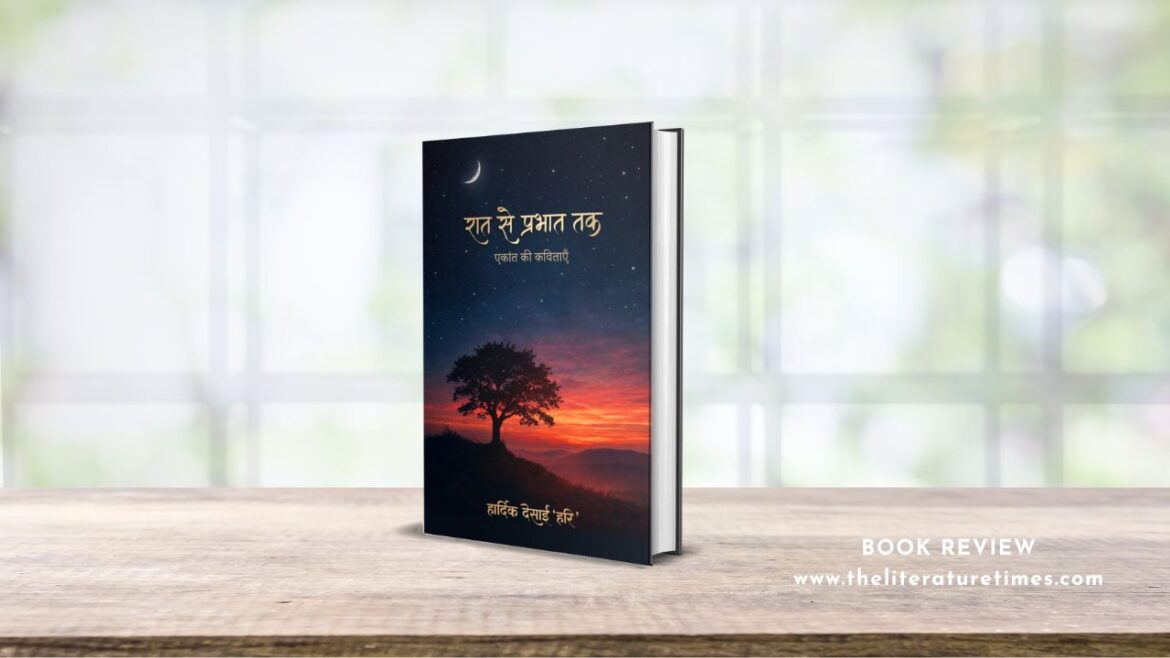
Raat Se Prabhat Tak: Ekant Ki Kavitaayen is a rare and valuable addition to modern Indian poetry—a book that does not rush to impress, does not attempt to dazzle with ornamentation, and does not seek applause through abstraction. Instead, it sinks quietly into the human experience, allowing readers to recognize themselves within its lines. Hardik Desai, writing as Hari, demonstrates an admirable artistic maturity, especially for a debut author. His poems reflect a lived wisdom that is introspective, grounded, and emotionally awake.
At its essence, the collection is an inner pilgrimage. The title—Raat Se Prabhat Tak—beautifully captures the thematic arc of the book. ‘Night’ represents confusion, heaviness, and the existential questions that torment the human mind. ‘Dawn’ represents awakening, clarity, and a softened understanding of life. The poems guide the reader across this spectrum in a way that feels organic and deeply personal.
One of the strengths of the collection lies in its engagement with solitude. Hari portrays solitude not as a burden, but as a space of transformation. Several poems unfold in a tone that suggests the poet is conversing with himself—slowly peeling away layers of thought and emotion until a truth emerges. Readers who have experienced similar inner conversations will find themselves deeply connected to these reflections.
Silence, time, and truth appear frequently throughout the book. Silence is portrayed as a teacher, time as a witness, and truth as something that often arrives quietly rather than dramatically. These concepts are not treated philosophically alone—they carry emotional weight and human relevance. Hari’s background in Sanskrit subtly enriches the metaphors and symbolic undertones, giving the poems a classical depth without distancing them from the modern reader.
Another remarkable quality of the book is how it blends social reality with personal introspection. Without being preachy or rhetorical, many poems acknowledge the complexities of society—human suffering, compassion, inequalities, and the longing for understanding. These reflections feel honest and empathetic, rather than analytical. They arise naturally from the poet’s own lived experiences and observations.
Nature becomes an integral part of the poetic landscape. Whether it is the calm of dawn, the darkness of night, the openness of the sky, or the quiet presence of trees and rivers—Hari uses nature not just as imagery, but as a companion in his emotional journey. This connection mirrors the tradition of many classical poets while keeping the tone contemporary and accessible.
The simplicity of language is one of the book’s most appealing characteristics. Hari avoids ornamental vocabulary, choosing instead to speak directly and clearly. This directness, far from being simplistic, carries an emotional resonance that lingers long after the reading. There is a rhythm of honesty in his lines, a softness that does not dilute the intensity of the experience.
From a literary perspective, the poems exhibit a balance between minimalism and depth. They do not overwhelm the reader with excessive detail, yet they evoke vivid inner landscapes. Several short poems carry profound meaning—revealing that brevity, when used skillfully, can sometimes reveal more than elaborate verses.
The emotional fabric of the book is woven with threads of pain, acceptance, hope, and compassion. Some poems feel like whispered confessions, while others resemble gentle reminders or philosophical insights. Together, they form a cohesive narrative of the human condition—its contradictions, its beauty, its confusion, and its capacity for renewal.
The influence of the author’s life is felt throughout the collection. His years working in government service, his involvement in education, and his engagement with music all shape his worldview. His musical sensitivity is especially visible in the lyrical quality of his poems—their flow, their pauses, and the emotional aftertaste they leave behind.
In a literary environment where much poetry seeks attention through complexity or experimentation, Raat Se Prabhat Tak stands apart by returning to poetry’s oldest purpose: to reflect the inner world with honesty. It is a book that readers will not only read once but revisit during moments of emotional contemplation. It offers comfort without trivializing pain, insight without arrogance, and clarity without force.
This debut collection announces Hardik Desai as a poet with both sensitivity and substance. His voice is gentle but steady, reflective but accessible. Raat Se Prabhat Tak is not merely a book of poems—it is a companion for anyone walking through their own night in search of dawn. It reminds us that self-awareness is not a destination but a journey, and in that journey, poetry becomes a bridge between what we feel and what we understand.