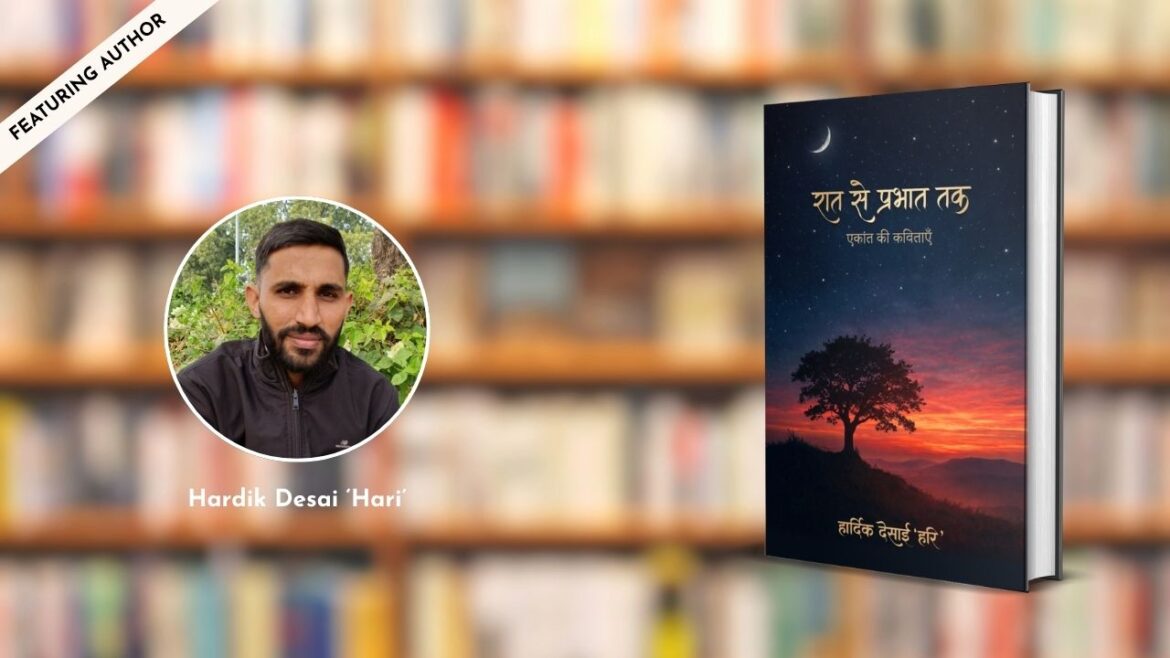
In the vast and ever-evolving landscape of Indian literature, new voices emerge every year, but only a few truly make readers pause, reflect, and reconnect with their inner world. Hardik Desai—known by his pen name Hari—is one such voice. With his debut poetry collection, Raat Se Prabhat Tak, he steps into the literary sphere not with noise but with depth, not with flamboyance but with sincerity. His presence is quiet yet unmistakably profound.
Hari’s journey as a poet is deeply intertwined with his personal experiences, academic grounding, and spiritual introspection. A graduate in Sanskrit, his understanding of language, grammar, and classical literature forms a subtle foundation beneath his verses. While his poems are written in simple, fluid language, they carry the weight of philosophical inquiry, cultural heritage, and emotional sensitivity. His education does not merely inform his craft; it shapes the tone of his entire creative expression.
Before entering the literary realm, Hari spent years working in various government departments. His interactions with diverse people—farmers, workers, students, and officials—left him with a nuanced understanding of society. Human struggles, the quiet dignity of ordinary lives, and the unspoken griefs and hopes of people form a backdrop to much of his writing. Currently working in the Agriculture Department of Gujarat, he remains connected to the rhythms of rural life, natural landscapes, and grassroots realities. These experiences gently permeate his poetry through metaphors of nature, reflections on time, and empathic observations of humanity.
Yet, what sets Hari apart is not simply his professional background or academic achievements; it is his inner life. Poetry, for him, is not an intellectual exercise but a contemplative practice. His poems emerge from silence—from those rare moments when the noise of the world fades and the mind begins to speak its own truth. This introspective quality gives his poetry a meditative tone, inviting readers into a space where they can hear their own thoughts more clearly.
Hari’s interest in education further expands his identity as a creator. During his free time, he teaches students from various societal backgrounds, providing free education. This act of giving—grounded in compassion and a sense of duty—mirrors the themes found in his poems. His writing repeatedly returns to questions of humanity, kindness, connection, and self-realization. The teacher in him listens deeply; the poet in him transforms those observations into verses that resonate with universal emotion.
Another aspect of Hari’s creative life is music. His YouTube channel, Hardik Desai Poems and Songs, features his self-written compositions. Music, like poetry, becomes a language for him—a way to express what cannot be fully articulated in ordinary speech. His musical sensitivity enriches the rhythmic undertones of his poetry, giving it a gentle lyrical flow. There is a natural cadence to his verses, a quiet musicality that soothes even when the themes are intense.
Raat Se Prabhat Tak reflects all these facets of the author’s life. It is a tapestry woven from personal introspection, philosophical inquiry, social awareness, and artistic expression. Each poem feels like a step on a spiritual journey—a movement from night toward dawn, mirroring the poet’s belief in the gradual unfolding of consciousness. Hari does not offer ready-made answers; instead, he creates poetic spaces where readers can explore their own emotions, memories, and questions.
What makes his voice especially significant today is the cultural moment into which he is writing. In a fast-paced world saturated with distractions, readers are increasingly seeking literature that brings them back to themselves. Hari’s work fulfills this need with remarkable elegance. His poems are neither loud nor dramatic; they are gentle reminders that transformation often begins in silence. His writing encourages stillness, introspection, and emotional honesty—qualities that resonate deeply with modern readers.
As an emerging poet, Hari holds the potential to become a meaningful voice in contemporary Indian literature. His work suggests that poetry need not be complicated to be profound, and that the simplest words often carry the deepest truths. Through his debut collection, he has already begun to build a literary identity rooted in authenticity, empathy, and contemplation.
Raat Se Prabhat Tak is only the beginning of Hari’s journey. If his first book is any indication, readers can look forward to a body of work that continues to explore human emotion, philosophical depth, and the transformative power of the inner world. With each poem, he reinforces a quiet yet compelling truth: dawn always follows night—both in the world outside and in the world within.