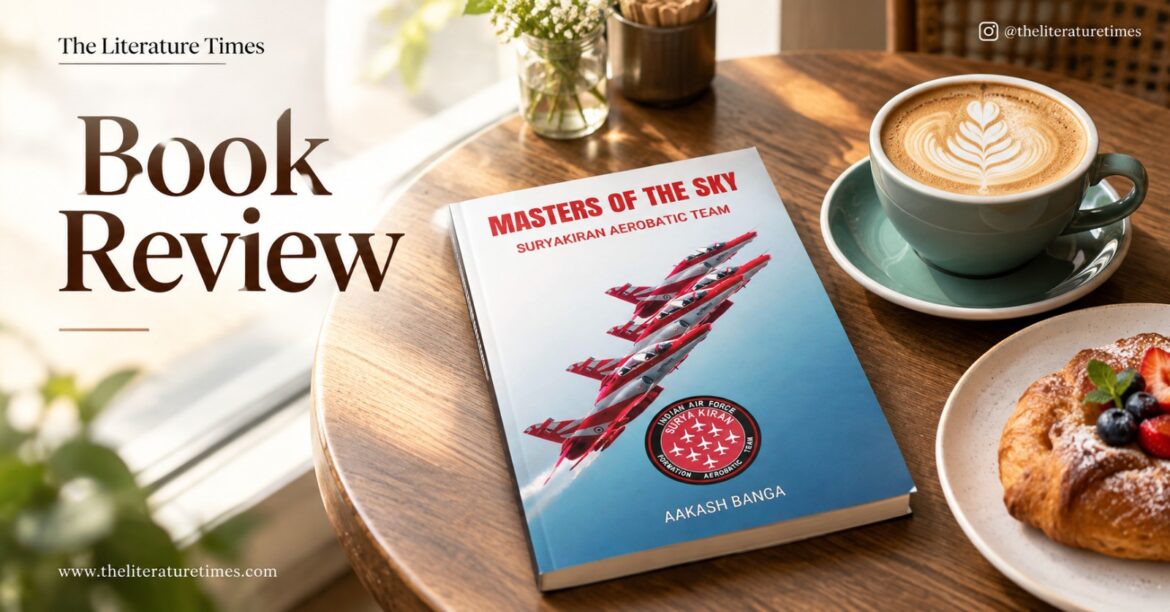
There are stories about aviation that focus on machines, speed, and spectacular manoeuvres, and then there are stories that look beyond the aircraft to understand the people who make those moments possible. Masters of the Sky: Suryakiran Aerobatic Team by Aakash Banga belongs to the latter category. Set against the demanding world of the Suryakiran Aerobatic Team (SKAT), the book explores what it takes to perform at the highest level when precision is not simply desirable but essential.
The premise is immediately compelling: nine aircraft, one formation, and virtually no margin for error. From the ground, an aerobatic display may appear effortless or choreographed, but the book invites readers to look behind that spectacle. What appears to be a few breathtaking minutes in the sky is built on years of practice, rigorous preparation, and absolute teamwork.
One of the book’s strongest qualities is its focus on the human side of aviation. Rather than presenting the pilots merely as highly skilled professionals operating advanced aircraft, the narrative explores the qualities that allow them to function under extraordinary pressure. Precision forms the foundation of their discipline, but it is courage, trust, brotherhood, and resilience that truly define the world of SKAT.
Courage in this context is presented as more than fearlessness. To enter the cockpit requires the ability to face uncertainty and pressure while relying on training. The book encourages readers to consider the mental state of a pilot before an aircraft leaves the runway and how they prepare to perform when even a small deviation can matter.
Trust is equally important. Formation flying is built around an extraordinary dependence on others. Individual brilliance cannot compensate for a lack of coordination; the success of the formation depends upon every member understanding their responsibility and executing it precisely. This makes the book relevant beyond aviation, particularly for readers interested in leadership, teamwork, organisational culture, and high-performance environments.
The theme of brotherhood adds emotional depth to the narrative. The pilots share risk, setbacks, and achievement. Their connection is not simply professional; it develops through experiences that require them to depend upon one another. The book recognises that behind the aircraft and uniforms are individuals who carry their own pressures and aspirations. This human dimension prevents the story from becoming solely an account of technical achievement.
The author’s interest in human behaviour, psychology, and emotional intelligence broadens the scope of the book. It considers the mindset and interpersonal dynamics that contribute to high performance. This perspective gives the narrative potential relevance for readers who may have little prior knowledge of aviation but are interested in how exceptional teams are formed and sustained.
Aakash Banga’s personal connection to aviation gives the narrative an additional sense of purpose. Growing up in an Air Force family, his fascination with flying began early through experiences around airbases and IAF flypasts. Over time, that curiosity developed into a deep respect for the Suryakiran Aerobatic Team and the discipline behind its performances.
What ultimately makes Masters of the Sky engaging is the balance between spectacle and substance. It reminds readers that extraordinary performances are rarely spontaneous. At its core, the book is a tribute to the people behind the formation. It presents the Suryakiran Aerobatic Team not simply as a group of pilots performing remarkable manoeuvres, but as an example of what can happen when individual expertise is united by a common purpose. For anyone fascinated by teamwork and human performance, the book offers an insightful journey into a world where excellence is measured not only by how high one can fly, but by how precisely, responsibly, and together one can do it.