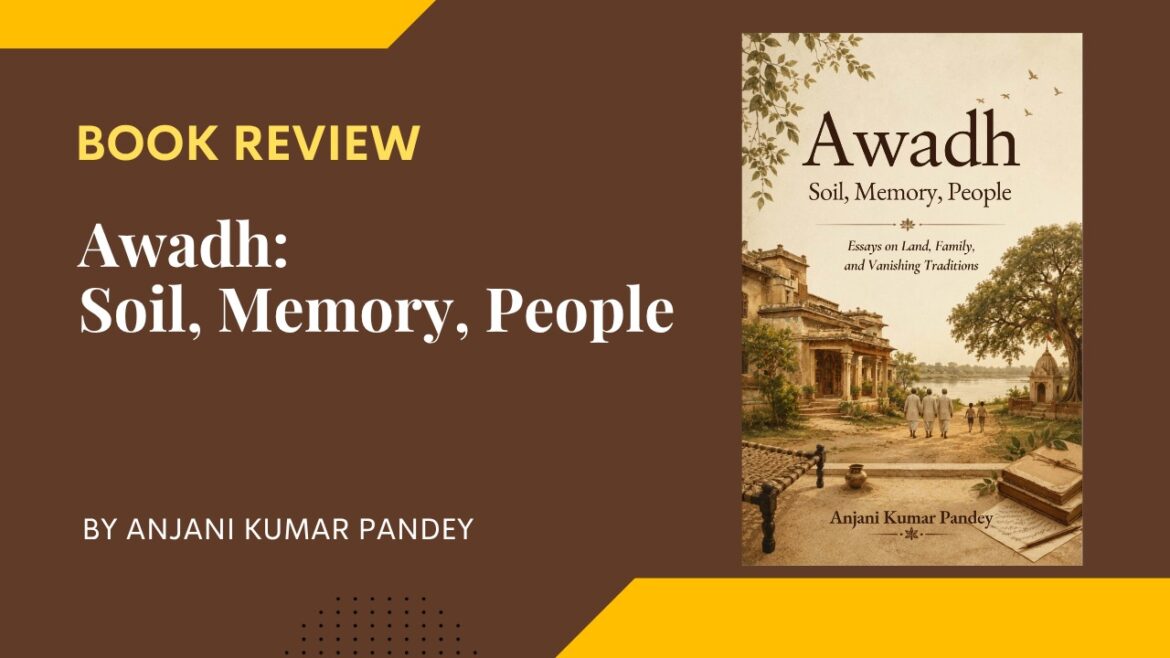
Title: Awadh: Soil, Memory, People
Author: Anjani Kumar Pandey
Publisher: Evincepub Publishing
Read as a work of cultural documentation, Awadh: Soil, Memory, People is unusually rich in everyday material. Across thirty-two essays, Anjani Kumar Pandey records practices that formal histories often overlook: how children went to school, what they carried, how fields were irrigated, how cattle fitted into domestic life, how women prepared for festivals, how village feasts were served, how folk songs circulated, how migrants left by train, how families welcomed them back, what foods marked winter, and how rituals structured the life of a child from birth onward. The book’s table of contents itself reveals the breadth of this journey—from ancestors, education and cattle to festivals, family figures, food, railway memories and rites of childhood.
The book’s value lies precisely in this accumulation of detail.
Food alone becomes a kind of cultural archive. Jaggery tea, kalewa, lai-chana, rasiyav, sweet potatoes roasted in a kaura, regional greens, homemade festival sweets, khichdi, village wedding menus, and seasonal preparations appear repeatedly. These are not decorative references. They show how agriculture, season, religion, labour, and community were connected. The chapter “Sweet Potatoes in Winter” is particularly effective because taste becomes a route into landscape: crops, rivers, fruits, vegetables, and dishes together create a sensory map of Awadh.
The book is equally attentive to ritual time. Dussehra, Diwali, Devutthani Ekadashi, Makar Sankranti, Tulsi worship, childbirth rites, mundan, village religious gatherings, folk songs, and household observances form a calendar through which community life is remembered. In this sense, the volume often reads like a personal ethnography. The author is not standing outside the culture describing it academically; he is describing practices from within, as someone for whom they carry emotional and spiritual meaning.
That insider position is both the book’s strength and its critical challenge.
Pandey does not pretend to neutrality. He openly believes that modernization, urbanization, consumer culture, and technological change have weakened many forms of collective life. In the foreword, the post-1990 period is presented as a major rupture in values, habits, language, and social relations. Throughout the essays, this thesis returns in different forms: fields shrink, orchards disappear, animals leave the household, festivals become commercial, extended families fragment, children lose contact with village traditions, and communication technology paradoxically coexists with emotional distance.
There is considerable truth at the level of personal experience in this pattern of loss, but the book sometimes moves too quickly from “this is what I remember” to “this is what society has become.” A memoir can legitimately make such judgments, but a reader should distinguish memory from social evidence. The book occasionally treats inherited beliefs, folk remedies, ritual claims, and broad statements about health, gender, education, technology, or pollution with more certainty than a critical social history would allow. Its documentary value is therefore highest when read as testimony: this is how a particular generation understood its world, what it valued, and what it feared losing.
The book also contains an important unresolved contradiction. It mourns the disappearance of traditional society while documenting the heavy burdens within that same society. Women rise before dawn, cook, grind, clean, fast, serve others first, observe purdah, and carry enormous domestic responsibility. Children face physical punishment at school. Widows can be excluded from auspicious occasions. Poverty is severe enough to shape food, travel, clothing, and medical access.
Yet these hardships are frequently placed beside memories of contentment and solidarity. Rather than weakening the book, this contradiction makes it more revealing—provided the reader notices it. The past was both intimate and unequal, secure and restrictive, communal and demanding.
Ecological memory is another major strength. The chapters on cattle, village land, the tamarind tree, and the peepal tree show how environment once functioned as social infrastructure. A tree is shade, school, shrine, landmark, meeting place, bird habitat, weather indicator, and repository of stories. Land is not merely property; it organises status, livelihood, ancestry, and belonging. The book’s description of cattle similarly connects animals with milk, cultivation, household prosperity, daily routine, and emotional attachment.
When Pandey writes about shrinking fields, cut branches, disappearing orchards, and packaged milk entering the village, environmental change becomes inseparable from cultural change.
The structure, however, would benefit from tighter editing. Because many essays end by contrasting “then” with “now,” the book sometimes feels circular. The same argument about lost relationships, modern haste, or fading traditions is restated after a new anecdote. A more selective use of these conclusions would allow the documentary material to speak more powerfully for itself.
Even with that repetition, the volume performs a meaningful act of preservation. It recognises that culture disappears not only when monuments vanish but when words, recipes, gestures, kinship roles, songs, routes, tools, and seasonal habits stop being remembered. The glossary reinforces this archival impulse by preserving local vocabulary that might otherwise be flattened or forgotten.
As cultural memory, then, Awadh: Soil, Memory, People is compelling, affectionate, and valuable. It should not be mistaken for detached sociology, nor does it need to be. Its real contribution is more personal: it records how one person’s Awadh was lived. In doing so, it gives future readers a textured record of a world changing faster than memory can hold it.