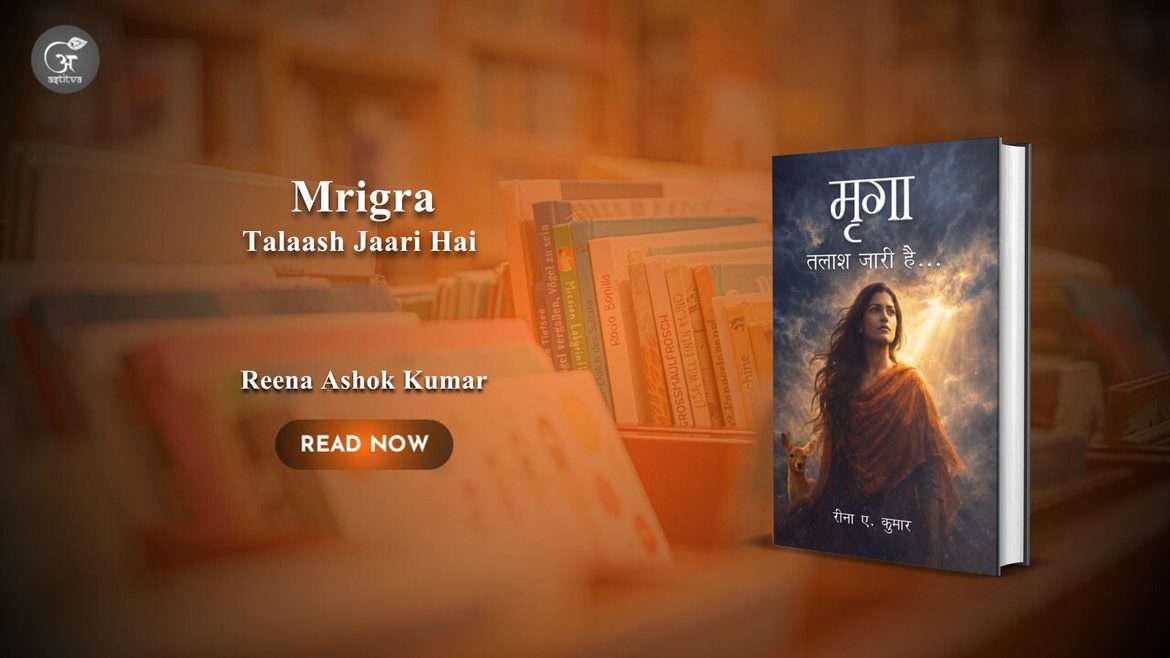
With Mrigra: Talaash Jaari Hai, Reena Ashok Kumar returns to the literary terrain of stories shaped by ordinary life, memory, struggle, relationships and the continuing search for meaning. The book follows her first collection, Kuch Bikhri Pankhudiyan (Some Scattered Petals), whose readers’ appreciation encouraged her to undertake a second volume. That background is important to understanding the spirit of Mrigra: it is presented not as a collection detached from lived reality, but as a work gathered from the winding lanes of time and from the stories and experiences that surround us. The title’s sense of an ongoing “talaash”—a search—also provides a useful lens through which to approach the collection. These are stories born from observation and emotional engagement, moving through moments that can be easy as well as those marked by struggle, and inviting readers to recognize something of their own lives in the human situations they encounter.
At the heart of the book is a view of storytelling as an intimate way of understanding life. Kumar’s own account of her creative identity makes clear that she does not see stories merely as constructed narratives or their characters as distant figures. For her, stories are inseparable from existence, and every person is, in some sense, a character in a larger story while also having a role in the lives of those around them. This perspective gives Mrigra a thematic foundation rooted in human connection. The collection can therefore be read as an exploration of the emotional spaces created by relationships, choices, circumstances and the experiences through which people change. Rather than presenting life as a simple progression from difficulty to resolution, the author’s description suggests an interest in the complexity of living itself—the way moments of ease and moments of struggle coexist, and the way both become part of memory and identity.
One of the book’s notable strengths is the author’s emphasis on emotional participation. Kumar describes the writing process as one in which she becomes deeply involved with her characters: living alongside them, experiencing their laughter and tears, and moving through the emotions they encounter. Such an approach suggests a writing practice grounded in empathy. It also indicates why the collection’s material is drawn from the world immediately around us. The stories are not introduced as distant or extraordinary curiosities; instead, they emerge from familiar human experience. This gives the book potential relevance for readers who value fiction and storytelling that look closely at everyday life and the emotional truths embedded within it. The resulting appeal lies less in spectacle than in recognition—the possibility that a reader may see a familiar feeling, relationship or struggle reflected in a story.
The writing approach, as described by the author, is therefore both observational and inward-looking. She gathers stories from different moments and circumstances, but she also allows those stories to affect her personally. This dual movement—from the world into the story and from the story back into the self—forms one of the most compelling ideas surrounding Mrigra. It suggests that storytelling can become a process of refining one’s own character, because engaging with other lives encourages reflection on our own. In this sense, the book’s relevance extends beyond entertainment. It offers readers an opportunity to pause over the ways people respond to one another, the roles they assume in relationships, and the emotional consequences of the choices they make. The collection’s literary value, as presented by its author, lies in this meeting point between narrative and self-examination.
Another important quality is the sense of continuity behind the project. Mrigra is a second book of stories, and its existence is directly connected to the encouragement Kumar received after her first collection. That relationship between writer and reader is part of the book’s story before the reader even reaches its pages. It reflects a literary practice sustained by companionship: the author writes, readers respond, and that response becomes an incentive to continue. The author’s gratitude toward her readers is therefore more than a conventional acknowledgment; it reveals how she understands the creative relationship. For readers discovering Mrigra without having read the earlier collection, the book can still be approached on its own terms, particularly through its broad concerns with life, relationships and emotional experience. For returning readers, it represents a continuation of an already established conversation.
For contemporary readers, the collection’s strongest relevance may lie in its attention to the stories that exist around us but can easily be overlooked. In a cultural moment saturated with speed and distraction, there is value in literature that turns attention back toward human experience. The author’s stated belief that we are all characters in our own stories gives this idea a particularly accessible form. It encourages readers to consider not only what happens to people, but also how they participate in the lives of others. This makes Mrigra suitable for readers who are drawn to reflective storytelling, relationship-centred narratives and literature that treats emotion as a serious part of understanding character. It may also appeal to readers interested in the creative process itself, because the author’s relationship with her characters and material is so central to her account of writing.
The book’s central promise, ultimately, is one of continued searching. Talaash Jaari Hai does not suggest that life offers a final, uncomplicated answer; instead, its very phrasing evokes an ongoing journey of discovery. Within the framework supplied by Kumar, that search can be understood as a search through time, memory, relationships and emotion. The stories gather experiences that have been easy at times and difficult at others, and in doing so they acknowledge the uneven texture of real life. Their potential value is in encouraging readers to remain attentive—to people, to relationships, to their own inner responses, and to the stories that surround them every day. The collection’s emphasis on empathy also gives it a humane centre: to enter a story is, in the author’s understanding, to encounter another life and perhaps to understand oneself a little more clearly.
Mrigra: Talaash Jaari Hai emerges, then, as a thoughtful continuation of Reena Ashok Kumar’s engagement with the short-story form and with the emotional material of everyday existence. Its stated themes—life, relationships, struggle, connection, self-understanding and the continuing search for meaning—give it a broad human reach, while the author’s deeply participatory approach to character suggests a writing practice founded on empathy and emotional sincerity. The book is likely to resonate most with readers who look to stories not only for narrative movement but also for reflection and recognition. Its most enduring idea may be the one at the centre of the author’s own philosophy: that stories are not separate from us. We inhabit them, shape them, and are shaped by them. In that sense, the search announced by the subtitle remains open—and that openness is precisely what gives the collection its reflective appeal.