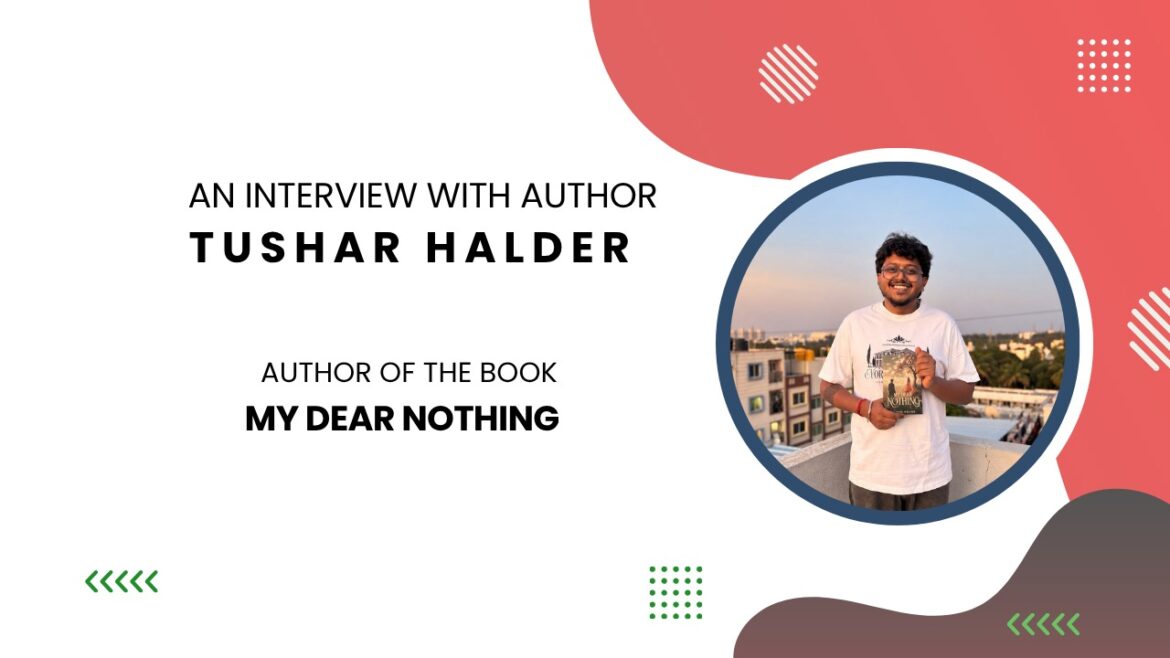
Title: My Dear Nothing
Author: Tushar Halder
Publishing: Evincepub Publishing
About The Book
My Dear Nothing moves through silence, unspoken emotions, heartbreak, memory, letting go, healing, self-recovery, and finally a goodbye that no longer hurts. The book begins from emotional absence and gradually shifts toward reclaiming one’s own voice and identity.
About The Author
Tushar Halder is a writer who finds meaning in the emotions that are often difficult to put into words.
His writing is deeply rooted in love, loss, silence, memory, healing, and the quiet transformation that happens when we are forced to let go of something we once thought we could never live without.
For Tushar, writing is not simply about telling a story. It is about giving a voice to the feelings that remain unspoken—the conversations that never happened, the goodbyes that never felt complete, and the memories that stay long after people leave.
My Dear Nothing is a reflection of that journey. Written as a collection of intimate poetic reflections, the book explores what happens after love ends: the silence that follows, the weight of memories, the struggle to let go, and, eventually, the discovery of oneself again.
Through simple words and deeply personal emotions, Tushar writes about the kind of heartbreak that does not always have a dramatic ending. Sometimes, people simply grow apart. Sometimes, there is no final conversation. Sometimes, closure is something we have to create for ourselves.
His writing does not romanticize pain. Instead, it tries to understand it.
At the heart of his work is a belief that even the deepest wounds can become places of growth, and that losing someone does not always mean losing yourself.
My Dear Nothing is his attempt to turn those feelings into pages—not to hold on to the past, but to finally make peace with it.
This book is for anyone who has loved quietly, lost deeply, waited too long, or found themselves again after believing they were lost.
And perhaps, most importantly, it is for those who are still learning how to say goodbye—without forgetting how to live
Neel Preet: The title My Dear Nothing is emotionally striking. Why did you choose the word “Nothing” for someone who once meant everything?
Tushar Halder: Because that’s exactly how heartbreak feels sometimes. Someone who was once your whole world slowly becomes… nothing. Not because they never mattered, but because life forces you to accept their absence.
“Nothing” isn’t a person in this book. It’s every unfinished conversation, every memory, every feeling that stayed after someone left. I wrote letters to that emptiness because sometimes it’s easier to talk to silence than to someone who’s no longer there.
Neel Preet: The book begins with silence and gradually moves toward healing. Did you intentionally structure the chapters as an emotional journey from loss to self-discovery?
Tushar Halder: Yes. I wanted the book to feel like healing actually feels.
We don’t wake up one day and suddenly become okay. First comes silence. Then questions. Then memories. Then acceptance. And somewhere in between, you slowly meet yourself again.
Every chapter is a different stage of that journey. By the last page, I didn’t want readers to feel like they forgot someone. I wanted them to feel like they found themselves.
Neel Preet: In The Things I Never Said, you explore how people often silence their own emotions out of fear of losing someone. Why do you think honesty becomes so difficult when a relationship matters deeply?
Tushar Halder: Because when someone means everything to you, honesty starts feeling risky.
We hide words thinking they’ll protect the relationship. We keep saying “I’m fine” because we’re scared that the truth might push the other person away.
The sad part is that silence often hurts a relationship more than honesty ever could. That’s something I understood while writing this chapter.
Neel Preet: One of the book’s strongest ideas is that closure does not always come from the person who hurt us. How did your understanding of closure evolve while writing this book?
Tushar Halder: I used to believe closure was a conversation. Now I believe it’s a decision.
Sometimes people leave without explaining anything. Sometimes they never apologize. If we keep waiting for them, we stay stuck.
While writing My Dear Nothing, I realised closure isn’t something someone gives you. It’s something you choose for yourself when you’re finally ready to stop carrying the weight.
Neel Preet: You make an important distinction between remembering someone and wanting them back. Why was it necessary for you to explore that difference so deeply?
Tushar Halder: Because they’re not the same feeling.
I think we’ll always remember certain people. Memories don’t disappear just because we healed. But remembering someone doesn’t always mean they still belong in our life.
I wanted readers to know it’s okay to miss a memory without reopening a door that was meant to stay closed.
Neel Preet: In the book, healing is rarely shown as a dramatic breakthrough; it happens through small moments—a song that no longer hurts, a night of peaceful sleep, or a day without checking for someone. Why did you choose to portray healing in such an ordinary and realistic way?
Tushar Halder: Because that’s how healing happened for me and may be others too.
It wasn’t one big moment. It was one day I didn’t check my phone. One night I slept peacefully. One song didn’t hurt anymore.
Healing is very quiet. Most of the time, you don’t even realise it’s happening until you look back and notice you’re carrying less pain than before.
Neel Preet: At several points, the narrator realizes that he is not only grieving a person but also the future he once imagined with them. Do you think losing an imagined future can sometimes hurt more than losing the relationship itself?
Tushar Halder: Absolutely.
Sometimes we don’t cry because someone left. We cry because the future we built in our head disappears with them.
You mourn birthdays that never happened, trips that never happened, conversations that never happened. Losing possibilities can hurt just as much as losing reality.
Neel Preet: The book repeatedly returns to the idea of finding oneself after losing someone. At what point does heartbreak stop being a story about the person who left and become a story about the person who remains?
Tushar Halder:
I think it changes the day you stop asking, “Why did they leave?” and start asking, “How do I live now?”
That’s the turning point.
Heartbreak begins with someone else’s absence, but healing begins when you start giving your own life the attention you were giving someone else.
Neel Preet: You write about forgiveness without necessarily allowing someone back into your life. How important is it to separate forgiveness from reconciliation?
Tushar Halder: It’s very important.
Forgiveness is for peace. Reconciliation is about trust. Those are two different things.
You can forgive someone and still choose distance. Forgiving doesn’t mean forgetting what happened or pretending it didn’t hurt. Sometimes it simply means you’re no longer letting that pain control your life.
Neel Preet: By the end of My Dear Nothing, the emotional tone changes from longing to peace. If readers could carry only one realization from this book into their own lives, what would you want it to be?
Tushar Halder: I want them to remember that losing someone doesn’t mean losing themselves.
People leave. Memories stay. Pain changes. And life still has a way of growing around the places that once felt broken.
If this book gives someone the courage to finally let go without feeling guilty, then My Dear Nothing has done exactly what I wrote it for.
And one more thing I want to add at the last that it:
People ask me one question more than any other: Who is “Nothing”?
And my answer is always the same.
Nothing is not a person. Nothing is a feeling.
It’s the empty chair after someone leaves. It’s the unread message that never gets a reply. It’s the version of yourself that disappeared after heartbreak, grief, or change.
I wrote My Dear Nothing because I realised we all spend our lives talking to someone who is no longer there. Sometimes it’s a person. Sometimes it’s a dream. Sometimes it’s our past.
So instead of writing letters to a person, I wrote letters to that absence. And the beautiful part is this: my “Nothing” doesn’t have to be your “Nothing.” Every reader brings their own meaning to the book.