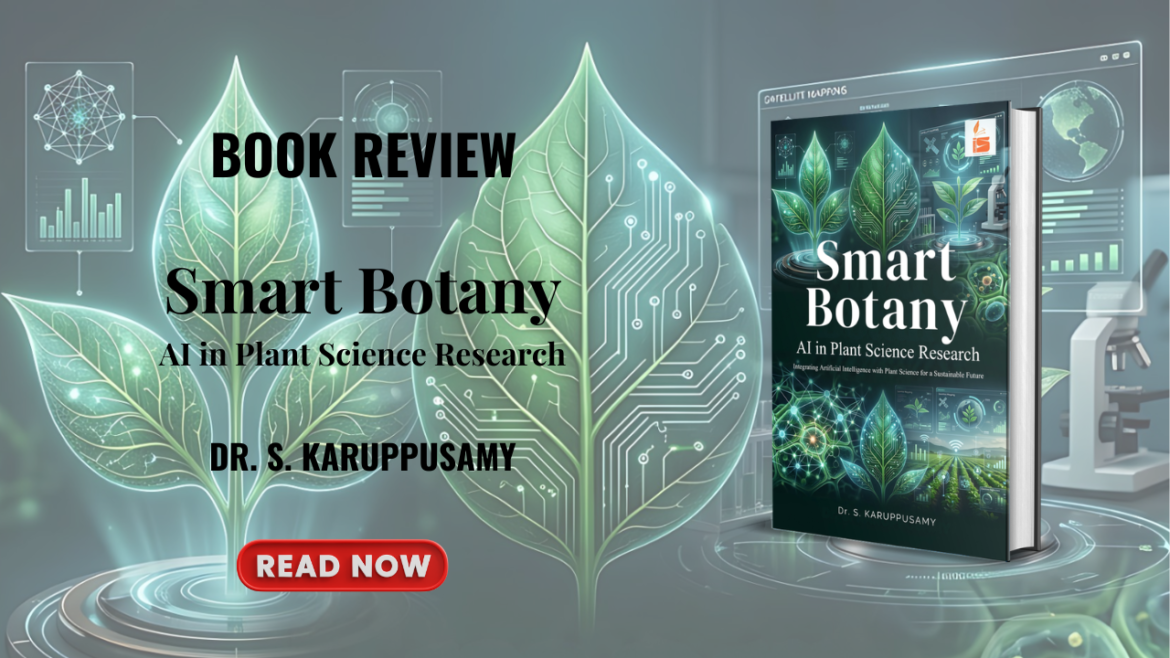
Title: Smart Botany:AI in Plant Science Research
Author: Dr. S. KARUPPUSAMY
ISBN: 978-93-7900-403-1
Publisher: Inksight Publishers
Science and technology are changing the world very quickly, and agriculture and plant science are also becoming smarter with the help of modern innovations. One such important innovation is Artificial Intelligence (AI). The book Smart Botany: AI in Plant Science Research by Dr. S. Karuppusamy is an informative and forward-looking work that explains how AI is transforming plant science and agriculture in today’s world. This book is highly useful for students, researchers, teachers, and professionals who are interested in both botany and modern technology. It successfully combines biological science with artificial intelligence in a simple and understandable way.
One of the biggest strengths of this book is its relevance to present-day global challenges. Today, the world is facing serious problems like climate change, food insecurity, loss of biodiversity, and declining agricultural productivity. Traditional methods alone are not enough to solve these issues. Through this book, Dr. Karuppusamy explains how AI can help scientists and farmers improve crop production, detect diseases early, conserve biodiversity, and make agriculture more sustainable. The book introduces readers to important AI technologies such as machine learning, deep learning, robotics, data analytics, and remote sensing. These topics may sound technical at first, but the author explains them in a very simple and learner-friendly manner. Even readers without advanced computer knowledge can understand the concepts comfortably.
The author discusses how AI is being used in many important areas of plant science. For example, AI can help identify plant diseases and pests quickly through image recognition systems. This can help farmers take action early and reduce crop loss. Similarly, AI-based precision agriculture helps in better water management, fertilizer use, and crop monitoring, leading to improved productivity and reduced waste. Another important topic covered in the book is plant phenotyping and genomic prediction. These areas are becoming very important in modern plant breeding and crop improvement. The book explains how AI tools can analyse large amounts of plant data faster and more accurately than traditional methods. This can help scientists develop stronger and climate-resistant crop varieties.
One of the most impressive aspects of the book is its interdisciplinary approach. It shows that the future of science lies in combining different fields together. Botany is no longer limited only to plant identification and classification. With the help of AI, plant science is becoming more predictive, data-driven, and technology-oriented. Dr. S. Karuppusamy deserves appreciation for making such an advanced topic easy to understand. His writing style is clear, systematic, and informative. Instead of using unnecessarily difficult language, he explains scientific concepts in a practical and simple manner. This makes the book accessible for a wide range of readers.
The book also includes practical examples and case studies, which make the content more engaging and realistic. Readers can understand how AI technologies are actually being used in agriculture and plant research around the world. This practical approach increases the educational value of the book. Another strong point of the book is the author’s rich academic and research experience. Dr. S. Karuppusamy is a highly respected botanist and researcher with more than 200 research papers and many published books to his credit. His deep knowledge in botany, taxonomy, medicinal plants, and biodiversity conservation is clearly reflected throughout the book.
His achievements, including awards from the Indian Botanical Society and his association with international organizations like IUCN, add credibility and depth to this work. Because of his vast experience, the book feels both academically strong and practically meaningful. The book is especially valuable for young students and researchers who want to explore new career opportunities in plant science and agri-technology. It encourages readers to think beyond traditional learning and adopt innovative scientific approaches for solving future agricultural problems.
At the same time, the book also reminds readers about the importance of sustainability and environmental conservation. The author clearly shows that AI should not only be used for increasing productivity but also for protecting biodiversity and ensuring ecological balance. Overall, Smart Botany: AI in Plant Science Research is a highly informative, timely, and inspiring book. It successfully bridges the gap between artificial intelligence and plant science in a simple and practical way. The book is educational without becoming difficult, and scientific without losing readability.
Dr. S. Karuppusamy has made an important contribution to modern botanical literature through this work. The book not only increases knowledge but also inspires readers to imagine the future of smart agriculture and technology-driven plant research. This is a valuable book for anyone interested in botany, agriculture, environmental science, and modern technological innovations. It is both a learning resource and a guide towards the future of sustainable plant science research.
By on Amazon: https://www.amazon.in/dp/9379004036/
Review by Neel Preet
For www.theliteraturetimes.com