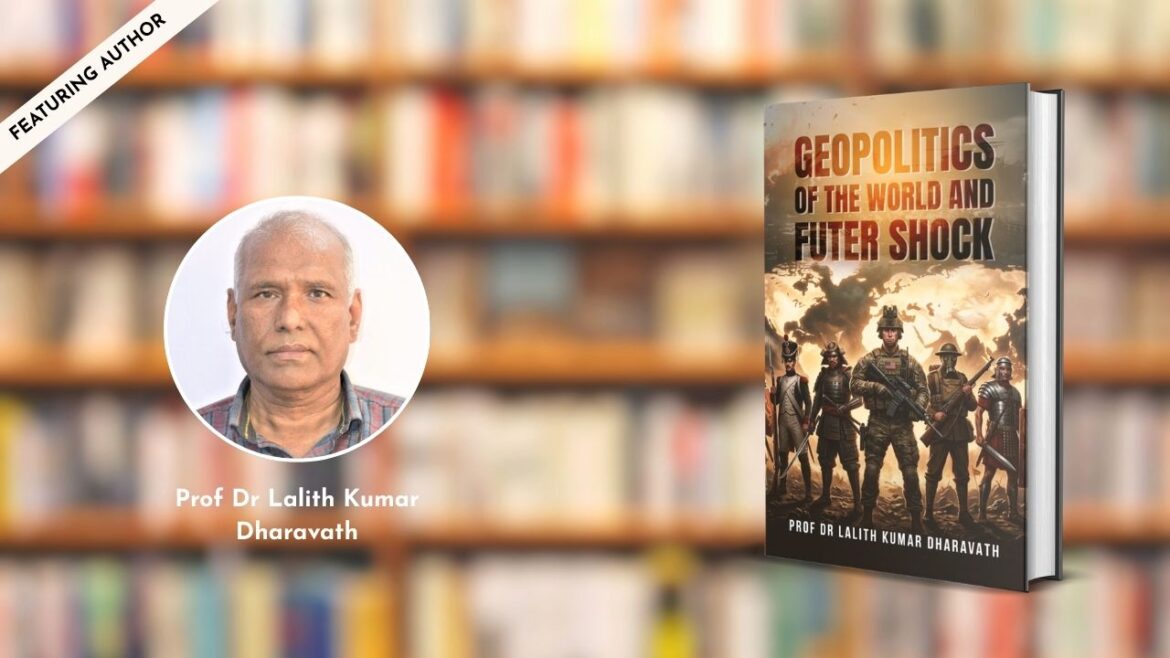
In an era defined by rapid technological advancement, shifting geopolitical alliances, economic uncertainty, and social transformation, understanding the forces shaping the future has become more important than ever. Few contemporary scholars have dedicated themselves as extensively to examining these challenges as Professor (Dr.) Lalith Kumar Dharavath. Through his prolific academic career, innovative theoretical contributions, and extraordinary body of published work, Dr. Dharavath has established himself as a significant voice in contemporary intellectual discourse, exploring how societies can navigate an increasingly complex and unpredictable world.
His latest work, Geopolitics of the World and Future Shock, reflects this commitment to understanding the global forces that influence nations, institutions, and individuals. Drawing upon geopolitical analysis, social theory, and future studies, the book examines the evolving dynamics of international relations in a century marked by accelerating change. It addresses one of the most pressing questions of our time: How can humanity adapt to a world where technological, political, and economic transformations occur at an unprecedented pace?
At the heart of Dr. Dharavath’s intellectual inquiry lies a deep concern for resilience. While many analysts focus solely on crises and conflicts, his work seeks to understand how societies can respond constructively to disruption. This perspective is particularly evident in his examination of the modern global order. The traditional belief that economic interdependence and nuclear deterrence would prevent large-scale conflicts has long shaped international relations theory. However, contemporary realities suggest a more complicated picture. Trade relationships are increasingly influenced by strategic competition, technological rivalries are reshaping global power structures, and geopolitical tensions continue to evolve in unpredictable ways.
Through Geopolitics of the World and Future Shock, Dr. Dharavath explores these developments through the lens of accelerating change. Inspired by the concept of “Future Shock,” originally introduced by futurist Alvin Toffler, the book examines how societies respond when transformation occurs faster than institutions and individuals can comfortably absorb. In doing so, it provides readers with a framework for understanding the uncertainty, anxiety, and disruption that characterize the modern age.
What makes Dr. Dharavath uniquely qualified to address such complex issues is the breadth of his academic and professional experience. Over the course of a distinguished career, he has emerged as an educator, researcher, administrator, theorist, and prolific author. His contributions extend beyond traditional academic boundaries, engaging with practical questions of governance, social organization, and sustainable development.
One of his most notable achievements is the development of original theoretical frameworks that seek to explain how communities and institutions adapt to change. Among these are the Resilience Theory Tanda Gor Banjar and the Reciprocity Theory and Practice. These concepts demonstrate his ability to integrate traditional social structures with contemporary administrative and governance challenges. Rather than viewing indigenous knowledge systems and community-based practices as relics of the past, he recognizes them as valuable sources of insight for addressing modern problems.
This ability to bridge tradition and innovation is a defining characteristic of Dr. Dharavath’s work. He consistently explores how enduring cultural values can inform responses to contemporary challenges. Whether examining community resilience, social cooperation, governance systems, or global transformations, his research emphasizes the importance of adaptability, mutual support, and sustainable development.
Perhaps even more remarkable is the sheer scale of his scholarly output. With more than 120 books and over 40 research articles to his credit, Dr. Dharavath stands among the most prolific contemporary authors in academic and intellectual circles. His publications span a wide range of subjects, reflecting a deep curiosity about society, governance, human behavior, and global change. Each work contributes to an ongoing conversation about how individuals and institutions can better understand and navigate the complexities of the modern world.
Beyond his personal scholarship, Dr. Dharavath has also played an important role in supporting the broader academic community. Through editing scholarly books and journals, serving on advisory boards, and mentoring students and researchers, he has helped foster intellectual growth and scholarly excellence across multiple disciplines. His influence extends beyond his own publications, shaping discussions within educational and research communities.
As an administrator and educator, he has consistently demonstrated a commitment to nurturing future generations of thinkers and leaders. His academic leadership reflects a belief that education should not merely transmit knowledge but cultivate critical thinking, creativity, and a capacity for addressing real-world challenges. This philosophy is evident throughout his writing, which seeks to connect theoretical understanding with practical application.
The themes explored in Geopolitics of the World and Future Shock are particularly relevant in today’s interconnected world. From technological disruption and economic realignments to geopolitical competition and social transformation, the challenges facing humanity are increasingly complex and interconnected. Dr. Dharavath’s work encourages readers to move beyond simplistic explanations and develop a deeper understanding of the forces shaping contemporary society.
Yet despite the complexity of the issues he addresses, his central message remains remarkably hopeful. Rather than portraying the future as something to fear, he views it as something to understand, prepare for, and shape through informed action. His theories of resilience and reciprocity underscore the belief that societies can adapt successfully when they cultivate cooperation, flexibility, and shared responsibility.
Professor (Dr.) Lalith Kumar Dharavath’s career stands as a testament to the power of intellectual inquiry in addressing the defining challenges of our time. Through his scholarship, teaching, and leadership, he continues to provide valuable insights into the evolving relationship between society, governance, and global change. Geopolitics of the World and Future Shock is not merely an academic work; it is an invitation to think critically about the future and to recognize that resilience, understanding, and cooperation remain essential tools for navigating an uncertain world.
In an age often characterized by complexity and disruption, Dr. Dharavath’s work reminds us that thoughtful analysis, informed leadership, and a commitment to collective progress can help transform uncertainty into opportunity and change into growth.