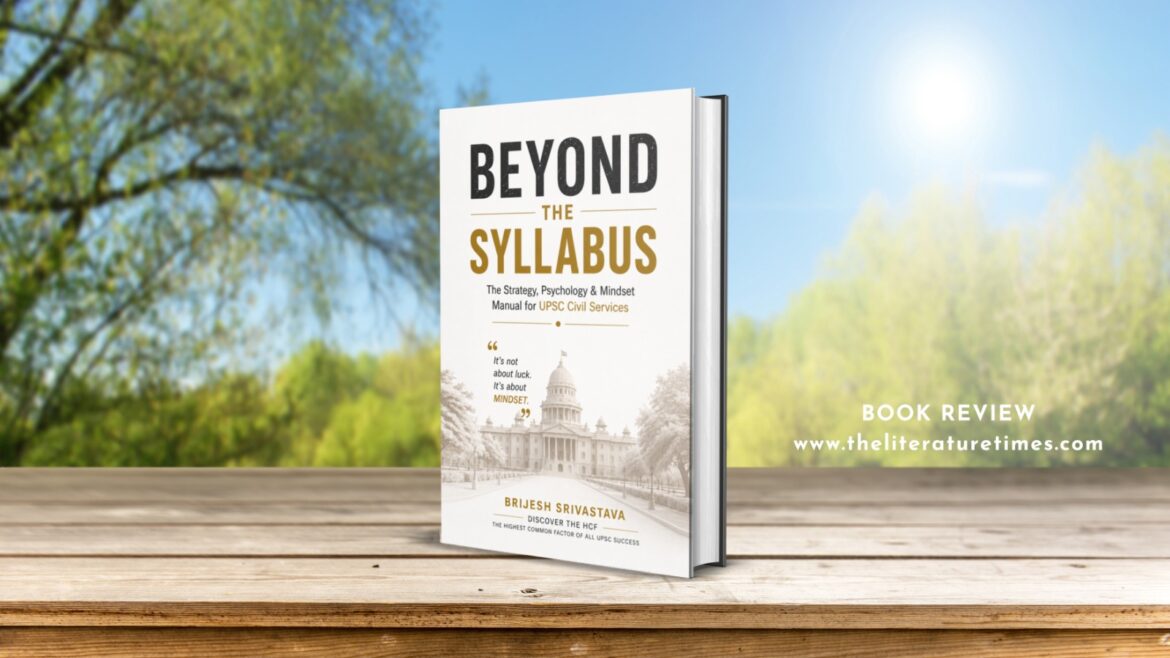
Beyond The Syllabus: The Strategy, Psychology & Mindset Manual for UPSC Civil Services by Brijesh Srivastava offers a refreshing departure from the conventional genre of Civil Services preparation books. Rather than attempting to add another layer of notes, strategies or subject-wise guidance to an already crowded market, the book positions itself as a manual for developing the one asset that underlies every successful preparation—the human mind. Based on its premise, the book argues that success in the UPSC Civil Services Examination is determined not merely by knowledge or hard work, but by the quality of thinking, concentration, reasoning and psychological preparedness that aspirants bring to the process.
The central idea revolves around what the author describes as the “Highest Common Factor” (HCF) of UPSC success. According to Srivastava, every aspirant studies from similar books, attends similar coaching classes and solves similar mock tests. Yet only a very small percentage ultimately succeed. The difference, he suggests, lies in the ability to train the mind itself. This proposition forms the foundation of the book and distinguishes it from traditional preparation guides that primarily focus on the examination syllabus.
One of the book’s greatest strengths is its interdisciplinary approach. It combines examination strategy with insights from psychology, neuroscience, cognitive science and habit formation. Instead of treating preparation as a mechanical exercise of reading and memorisation, it presents learning as a cognitive process that can be systematically improved. Readers are introduced to concepts such as focused attention, deep learning, reasoning ability, mental resilience and consistency, all of which are presented as essential ingredients of long-term success. By integrating scientific understanding of how the brain learns with practical preparation techniques, the book broadens the conversation around competitive examinations beyond textbooks and coaching institutes.
The practical dimension of the book is equally noteworthy. It reportedly covers all three stages of the Civil Services Examination—Prelims, Mains and the Personality Test—while emphasising that strategy alone cannot compensate for an untrained mind. The author’s emphasis on disciplined habits, emotional regulation, effective revision, sustained motivation and intelligent decision-making reflects an understanding that success in UPSC preparation depends as much on psychological endurance as on academic competence. For aspirants who often struggle with burnout, self-doubt and information overload, this perspective is likely to resonate strongly.
Another distinguishing feature is the author’s attempt to bridge ancient wisdom with modern science. Brijesh Srivastava draws upon an early experience of learning a concentration technique from a village mystic, a practice he later recognised as closely aligned with focused attention training described in contemporary neuroscience. This synthesis of traditional experiential knowledge and scientific explanation gives the book a distinctive philosophical dimension. Rather than presenting spirituality and science as opposing ideas, the narrative appears to demonstrate how both can converge in understanding the functioning of the human mind.
The author’s professional background further strengthens the credibility of the work. As an IIT Roorkee alumnus with Bachelor’s and Master’s degrees in Civil Engineering and a distinguished 36-year career culminating as General Manager at RITES Ltd., Srivastava brings analytical rigour and disciplined thinking to his writing. His long association with large-scale infrastructure projects reflects a career built on precision, planning and execution—qualities that naturally translate into his systematic approach to examination preparation. At the same time, his decades-long independent study of psychology and neuroscience adds a unique dimension that is uncommon among authors writing in the competitive examination space.
The writing, as suggested by the book’s description, appears to focus less on motivational rhetoric and more on thoughtful reflection supported by practical insights. Instead of promising shortcuts or miraculous success formulas, the book encourages readers to cultivate habits and mental frameworks that require patience and consistent effort. This makes it particularly appealing for serious aspirants who are looking for sustainable methods rather than quick fixes.
Perhaps the most valuable contribution of Beyond The Syllabus is its attempt to redefine what preparation actually means. It challenges the assumption that collecting more study material automatically leads to better performance. Instead, it encourages readers to optimise the quality of their learning by improving attention, reasoning, retention and emotional stability. In an environment where aspirants are often overwhelmed by information and competing advice, this shift in focus from external resources to internal capability is both timely and thought-provoking.
The book is likely to appeal not only to first-time UPSC aspirants but also to repeat candidates who may have realised that simply studying harder does not always produce better results. Many of its discussions on concentration, habit formation, cognitive performance and resilience may also prove valuable for students preparing for other competitive examinations, professionals pursuing demanding careers and anyone interested in personal growth and effective learning.
Readers expecting exhaustive subject-wise notes or detailed coverage of the UPSC syllabus should understand that this is not the book’s objective. Its value lies in complementing conventional preparation rather than replacing it. It seeks to equip aspirants with the mental framework that enables them to use existing study resources more effectively.
Overall, Beyond The Syllabus: The Strategy, Psychology & Mindset Manual for UPSC Civil Services presents an ambitious and intellectually engaging perspective on one of India’s most challenging examinations. By placing the trained mind at the centre of preparation, Brijesh Srivastava invites aspirants to rethink the foundations of success. If the book delivers on the vision outlined in its description, it has the potential to become a meaningful companion for those who recognise that mastering the syllabus begins with mastering the mind.