Every year, nearly a million young Indians begin one of the most demanding journeys of their lives—the pursuit of a place in the Civil Services. They collect standard books, join coaching institutes, prepare meticulous notes, and attempt countless mock tests. Yet, despite years of disciplined effort, only a tiny fraction achieve success. The obvious question remains: if hard work alone were enough, why do so many sincere aspirants fall short?
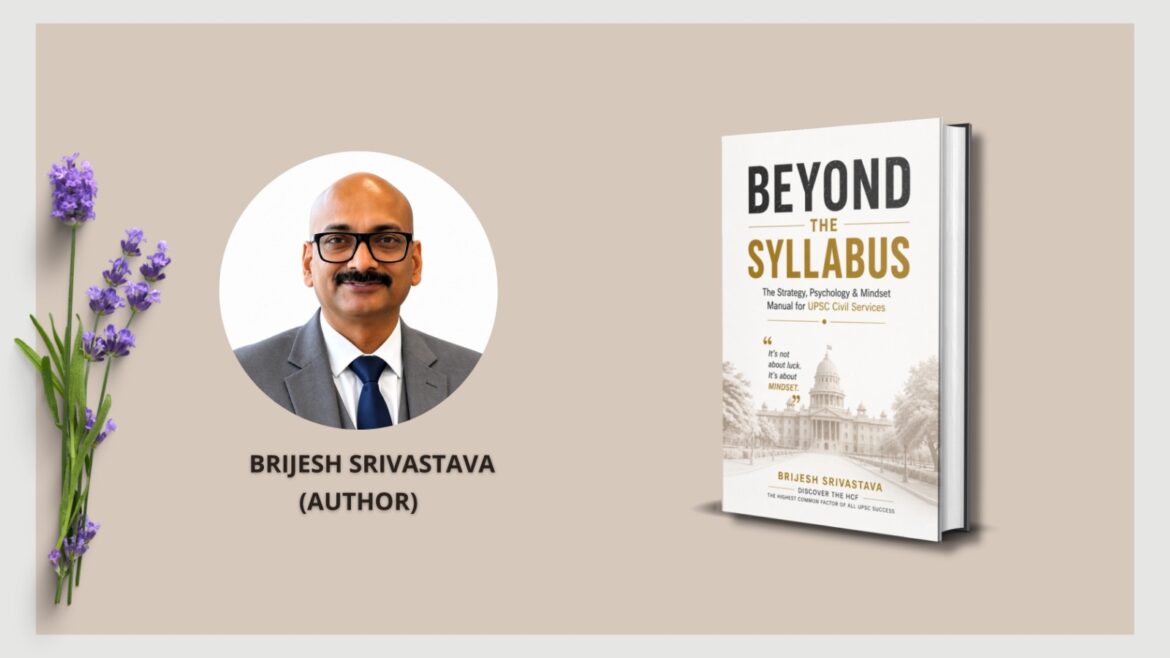
Brijesh Srivastava believes the answer lies beyond conventional preparation. His latest book, Beyond The Syllabus: The Strategy, Psychology & Mindset Manual for UPSC Civil Services, challenges the long-held belief that success in the examination depends primarily on covering the syllabus. Instead, it introduces readers to what he calls the “Highest Common Factor” (HCF) behind every successful candidate—a trained, disciplined and activated reasoning mind.
Unlike traditional preparation manuals that focus almost exclusively on subjects and study plans, this book explores the invisible dimension of success. It argues that the human mind is the true engine of performance. Every hour spent studying, every revision session and every practice test becomes significantly more effective only when the mind itself is trained to learn, reason and perform under pressure.
The book combines practical examination strategy with insights from psychology, neuroscience and cognitive science. It takes aspirants through the complete journey of the Civil Services Examination—from Prelims to Mains and finally the Personality Test—while simultaneously teaching them how to develop deep concentration, long-term consistency, emotional resilience and clear decision-making. Rather than adding another layer of information, Beyond The Syllabus seeks to transform the way candidates think, learn and prepare.
One of the book’s distinguishing features is its emphasis on cognitive performance. Modern neuroscience has repeatedly demonstrated that focused attention, deliberate practice and habit formation dramatically improve learning outcomes. Srivastava translates these scientific principles into practical techniques that aspirants can apply in their daily preparation. He explains why many students study for long hours without achieving meaningful retention, and how disciplined mental training can dramatically enhance both efficiency and understanding.
The work also addresses one of the most overlooked aspects of UPSC preparation—the psychology of the long haul. Civil Services preparation is not a sprint but a marathon requiring sustained motivation over months, often years. During this period, aspirants encounter uncertainty, self-doubt, repeated setbacks and intense competition. Srivastava argues that these challenges cannot be overcome merely by reading more books. They demand a resilient mindset built on clarity of purpose, disciplined habits and emotional balance.
Equally compelling is the philosophical foundation that quietly runs through the narrative. Long before neuroscience began explaining attention and cognitive control, the author was introduced to a powerful concentration technique by a village mystic. What began as an ancient practice rooted in traditional wisdom was later recognised by him as remarkably similar to focused attention training now validated by contemporary neuroscience. This unique convergence of ancient insight and modern science lends the book an uncommon depth, offering readers perspectives that are both timeless and evidence-based.
Brijesh Srivastava’s own life journey lends exceptional credibility to his work. An alumnus of IIT Roorkee with Bachelor’s and Master’s degrees in Civil Engineering, he devoted 36 years to building some of India’s most significant railway and metro infrastructure projects. Retiring as General Manager from RITES Ltd., a premier Government of India enterprise under the Ministry of Railways, he contributed to bridges, viaducts, metro systems and large-scale engineering works across the country. His professional career demanded analytical precision, structured thinking and disciplined execution—qualities that naturally inform his approach to Civil Services preparation.
Yet his expertise extends well beyond engineering. Alongside his distinguished career, Srivastava spent decades independently studying psychology, neuroscience and human cognitive performance. Through years of observation and quiet mentoring, he recognised recurring patterns among successful aspirants that conventional coaching often overlooked. These insights eventually evolved into the framework presented in Beyond The Syllabus.
What makes the book particularly relevant today is its refusal to offer shortcuts. Instead of promising secret notes or magical strategies, it presents a systematic blueprint for developing the one resource every aspirant already possesses but rarely trains effectively—the mind itself. It teaches readers not merely what to study but how to think, how to sustain focus, how to build productive habits, how to recover from failure and how to perform consistently under examination pressure.
For first-time aspirants, the book offers a strong conceptual foundation before preparation begins. For repeat candidates, it provides an opportunity to identify hidden weaknesses that may have limited previous attempts. Even beyond the Civil Services Examination, many of its lessons on learning, concentration, decision-making and resilience hold value for students, professionals and lifelong learners alike.
At its heart, Beyond The Syllabus is more than an examination guide. It is a thoughtful exploration of human potential and disciplined excellence. It reminds readers that the syllabus may define the examination, but it does not define success. Success emerges from the quality of the mind engaging with that syllabus.
In an increasingly competitive environment where information is abundant but clarity is rare, Brijesh Srivastava offers a refreshing perspective. His message is both simple and profound: books, coaching and strategy matter, but they become truly powerful only when guided by a trained and disciplined mind. That, he believes, is the Highest Common Factor shared by every successful UPSC candidate—and the enduring lesson at the heart of Beyond The Syllabus.