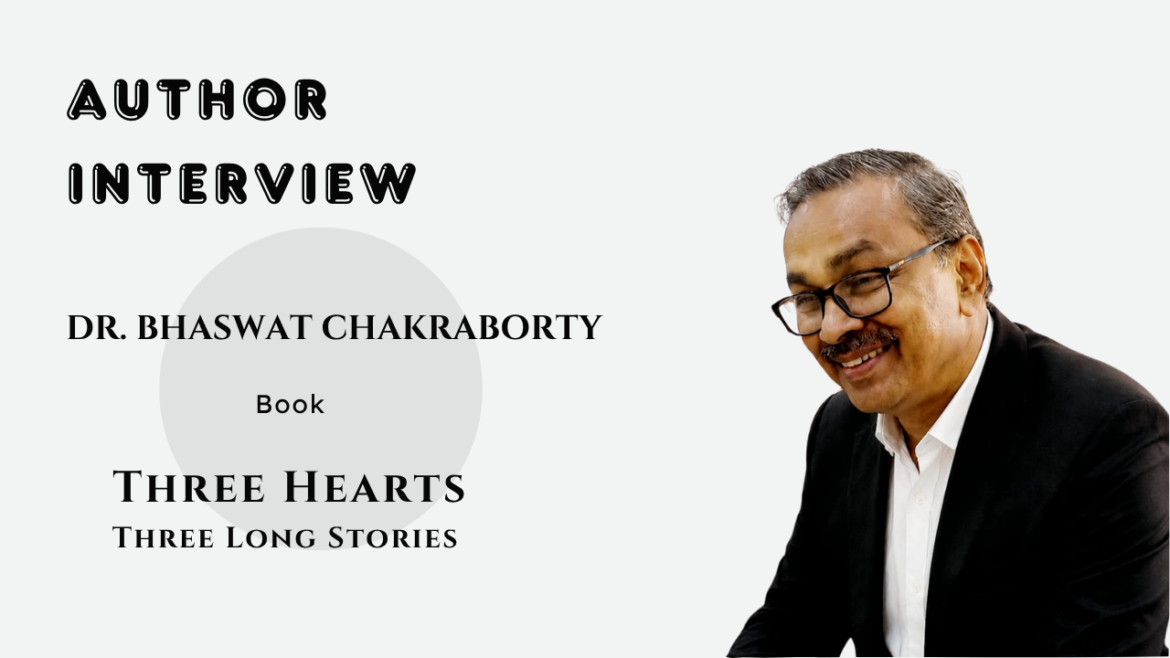
Title: Three Hearts তিনটে হৃদয় (বড় গল্প তিনটে)
Author: Dr. Bhaswat Chakraborty
ISBN: 978-93-7900-029-3
Publisher: Inksight Publishers
About the Author: Prof. (Dr.) Bhaswat S. Chakraborty graduated with a B.Pharm. (Hons.) from IIT, BHU and a PhD in Pharmacology from University of Saskatchewan, Canada. He is a former Professor Emeritus of Ganpat University and Nirma University, India. Before this, Dr. Chakraborty was Senior VP & Chair of R&D of Cadila Pharma, India and President of Foresee Consultants, Toronto, Canada. Prior to that he was Director of Biopharmaceutics at Biovail International, Canada and a Senior Regulator at Health Canada, Government of Canada.
Dr. Chakraborty has served as the Chairman, Pharma and Healthcare Panel, CII; and Senior Regulatory Advisor, New Drugs, Dabur Research Foundation, India. He has also had various honorary important academic, industry & government positions in Canada and USA. He has led 2 of the largest clinical trials coming out of India, trials of 2 international blockbuster drugs and 3 new drugs in India. Recipient of many honors and grants, Prof. Chakraborty has 126 scientific papers (68 full length articles and 48 abstracts) in refereed international journals and has led and reviewed >1200 projects of bioequivalence and clinical trials. Dr. Chakraborty also supervised 24 Masters and 5 PhD students; examined 58 MPharm/ MSc/ MPhil and 1 PhD theses has also many publications and interviews in non-refereed journals.
More pertinent to this interview, Dr. Chakraborty also loves to write books. He has written about 20 books and a few more are in progress. He writes in prose as well as poetry. His favorite topics in writing are: Science, Spirituality, Philosophy and Poetry.
Neel Preet: What inspired you to write this book, and how did the idea first develop in your mind?
Dr. Bhaswat Chakraborty: We often tend to think that only humans possess a loving heart. Yet, a closer look reveals that emotions like love, hurt, longing, and companionship are not confined to humanity alone. I always wanted to write some stories about pure existential love relating to non-humans – like plants, trees, nature, animals and even ideas like tales or geographic sceneries.
These stories gradually unfold those very sentiments. Thus, they can be read not merely as accounts of events or memories, but as chronicles of life and living relationships.
Neel Preet: What is the central message you want readers to understand through your book?
Dr. Bhaswat Chakraborty: Take love, for instance—it possesses no distinct physical form, yet its existence is profoundly real. A relationship, a memory, a creative act, or a journey—these, too, are facets of being, for they exert a tangible influence on human life and consciousness. These three stories are, in essence, tales of existence, of being, and—above all—of the heart.
Written in Bengali, they tell about people and animals, relationships and anticipation, joy and—equally—silent suffering.
Neel Preet: How did your personal experiences, observations, or professional background influence the themes of the book?
Dr. Bhaswat Chakraborty: In short, all three stories are my real-life stories, albeit a little fictionalized.
Neel Preet: Which character, idea, or chapter is especially close to your heart, and why?
Dr. Bhaswat Chakraborty: The first story is the autobiography of a story itself. Whenever I read a great story by Tagore, Tolstoy, O. Henry, or another great writer, I often wonder: if that very story could tell its own life story, what would it say? How did the author first get the idea, and how did that small idea slowly grow into a complete story? The second story is about a little flowering vine and the beautiful feeling I—and, I should say, we—had when it produced younger vines, as though the little plant had become a mother. The third story is about two dogs who became an important part of my life. One of them is still with me, caring for me, loving me, and receiving the same care and love from me in return.
Together, these three stories are simple stories of life, growth, love, and the quiet bonds that connect us to the world around us.
Neel Preet: What was the most challenging part of writing this book, and how did you overcome that challenge?
Dr. Bhaswat Chakraborty: Perhaps the most challenging part of writing these stories was putting myself in the shoes of a sincere reader—someone who regularly reads short and long stories, understands them, and simply enjoys them. I usually write about philosophy, science, poetry, and related subjects, so writing these longer stories—with dialogues, characters, and descriptions of places and surroundings—felt somewhat difficult at first. But as I moved beyond the first story, the process gradually became easier and more natural.
Neel Preet: Your book explores important human emotions and experiences. What made you choose these particular themes?
Dr. Bhaswat Chakraborty: Human emotions and experiences arise from human beings and are, in many ways, expressions of our existence. They reflect how we grow, how we change, how we form relationships, and how we gradually gain wisdom. As a happy and grateful human being, I feel connected to all these experiences, including the joys as well as the sufferings of human life.
I believe that understanding human suffering is just as important as sharing in human happiness. My parents were much the same way. They had a deep love for their fellow human beings and always showed kindness and concern toward others. I feel that much of what I am comes from what I learned by watching them. In many ways, I am simply trying to follow in their footsteps.
Neel Preet: How do you hope readers will connect emotionally or intellectually with your work?
Dr. Bhaswat Chakraborty: I hope readers will connect with these stories wholeheartedly, but also read them with a thoughtful and critical mind. To me, a good reader is not simply someone who follows a story from beginning to end. When a story or a piece of writing truly interests us, something changes within us. We begin to reflect on what we have read and relate it to our own experiences. In that sense, even an ordinary reader can become a thoughtful participant in the creative process. The reader becomes almost like a mirror, reflecting the ideas, emotions, and meanings that the writer has created. I would be very happy if these stories encourage such reflection. After all, a story is truly alive when it continues to grow in the mind and heart of its reader.
Neel Preet: Was there anything unexpected that you discovered about yourself or your subject while writing the book?
Dr. Bhaswat Chakraborty: I discover and rediscover myself every time I engage in productive or creative writing. Writing allows me to look within, understand myself better, and see both my strengths and my limitations more clearly. Yet the greatest joy comes when something I write brings happiness, insight, or growth to another person. Knowing that my words may touch someone’s heart or help them see something in a new way gives meaning to my efforts.
In that sense, writing is not only a creative activity for me; it is also a journey of self-discovery. Each time I write, I learn something new about my own authenticity, as well as about the weaknesses I still need to understand and overcome. This process keeps bringing me back to myself, again and again. Perhaps that is why writing has become both an expression of who I am and a way of becoming more fully myself.
Neel Preet: What do you think makes your book different from other books dealing with similar themes?
Dr. Bhaswat Chakraborty: I cannot answer that question very well. To me, a story written by another author can be just as good as, or even better than, anything I have written, if it is interesting and touches the reader’s heart. I do not think writing is a competition between authors. I simply try to write as sincerely and honestly as I can. After retiring from my professional career, writing has opened up an entirely new world for me. It has brought me a kind of freedom, peace, and happiness that is difficult to describe. It has become a wonderful space where I can think, create, remember, and share what is close to my heart. In fact, writing has given me such a heaven of joy that you probably would not believe it.
Neel Preet: If readers remember only one message from your book, what would you like that message to be?
Dr. Bhaswat Chakraborty: A meaningful life is one enriched by good relationships, love, and wisdom. Treasure the people around you and nurture the relationships that bring warmth and meaning to your life. Love your family, your friends and colleagues, and those who have guided you as mentors or gurus. Learn to appreciate the beauty of your surroundings and the simple joys that each day brings.
Above all, love life itself, with all its beauty, surprises, joys, and challenges. Do it whenever and however you can. And if possible, make this love a habit—not something you remember only on special occasions, but a way of living each day.