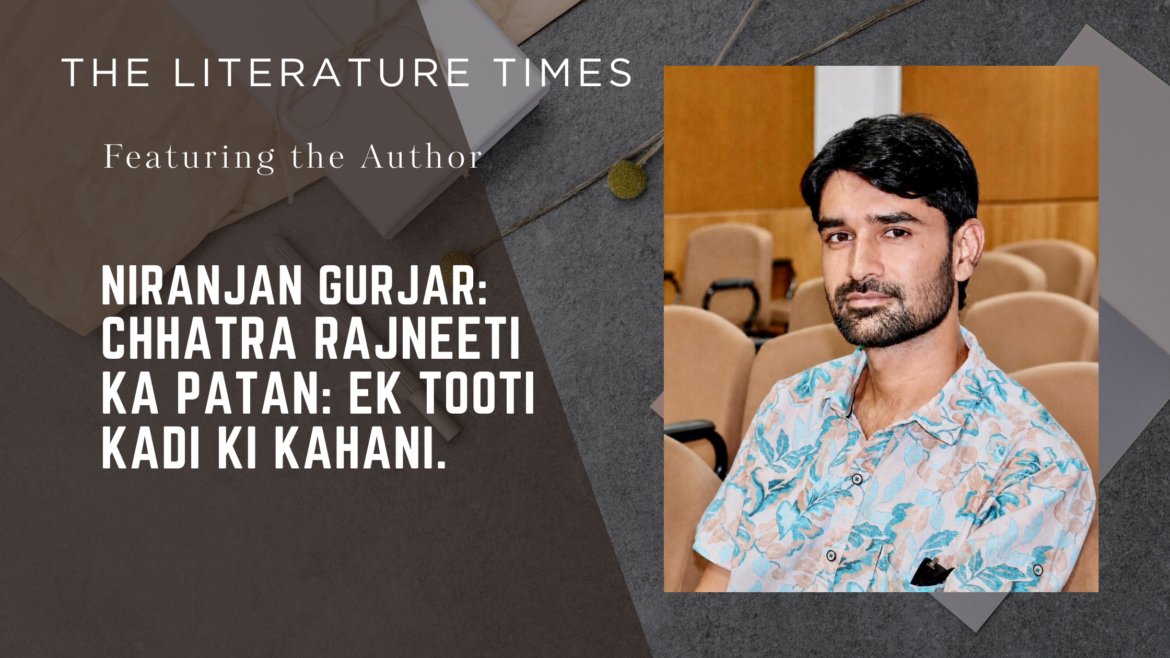
At a time when Indian politics is often discussed through the lens of elections, political parties, and established leaders, an equally important question deserves attention: where will the next generation of political leadership come from? Young author Niranjan Gurjar explores this question through his writing and research, focusing on the changing condition of student politics and the growing crisis of youth leadership.
Hailing from Rajgarh district in Madhya Pradesh, Niranjan Gurjar is an emerging writer whose interest in politics has been shaped by both his personal experiences and his surroundings. His political awareness developed early in life, influenced in part by his father, who served as a village Sarpanch. Growing up with an understanding of grassroots public life allowed Niranjan to observe the relationship between politics, society, leadership, and the everyday concerns of people.
Currently pursuing Journalism and Mass Communication at Devi Ahilya University, Indore, Niranjan combines his academic interests with a deep curiosity about contemporary political and social issues. His journey as a student has also played an important role in shaping his perspective on youth participation in democracy.
For Niranjan, student politics is not merely about campus elections or political affiliations. He sees it as an important platform where young people can learn the fundamentals of leadership, representation, public speaking, debate, organization, negotiation, and accountability. Student unions and campus elections, in his view, can provide aspiring leaders with an early opportunity to understand democratic participation and public responsibility.
However, the prolonged absence of student union elections in many educational institutions has created an issue that Niranjan feels deserves serious discussion. He himself hoped to begin his leadership journey through student union elections, but the restrictions and suspension of such electoral platforms prevented him from having that opportunity. Rather than allowing this experience to remain a personal disappointment, he transformed it into a subject of research, reflection, and writing.
This journey led to the creation of his book, Chhatra Rajneeti Ka Patan: Ek Tooti Kadi Ki Kahani. The book examines the current challenges surrounding student politics and the crisis of young political leadership, particularly in Madhya Pradesh. Through his work, Niranjan raises important questions about why student politics has weakened, how the absence of student union elections affects young people, and what consequences this could have for the future of mainstream politics.
The book is the result of a thoughtful attempt to understand the relationship between student politics and the larger political ecosystem. Although its primary focus remains on campus politics, its concerns extend far beyond educational institutions. Political leadership is often developed over time through participation, public engagement, organizational experience, debate, and exposure to social realities. Student politics has historically served as one of the spaces where many young individuals take their first steps into public life.
To bring multiple perspectives to the discussion, Niranjan has engaged with leaders who have emerged from student politics and youth movements. His work includes discussions and perspectives from political figures and young leaders such as Jitu Patwari, Sachin Pilot, Ravindra Singh Bhati, Abhimanyu Poonia, Pushyamitra Bhargava, Hanuman Beniwal, Nishant Khare, and Vipin Wankhede. Through their experiences and viewpoints, he explores the importance, relevance, and continuing need for student politics in the development of future leaders.
This research oriented approach gives Niranjan’s work an important dimension. Rather than limiting the discussion to personal opinion, he attempts to connect his concerns with the experiences of individuals who have themselves travelled from student politics towards larger roles in public life. Their stories highlight how student organizations and campus elections can become spaces for leadership development and democratic learning.
At the heart of Niranjan’s work lies a concern about the growing gap between young people and formal democratic participation. India has a large and politically aware youth population, yet the opportunities available to young people for gaining practical leadership experience remain an important subject of debate. If students are unable to participate in representative institutions during their formative years, Niranjan asks whether this could eventually create a vacuum in the political leadership of the future.
His book also seeks to encourage readers to think about the consequences of this situation. The decline or absence of student elections is not presented merely as an institutional issue. Instead, it is connected to broader questions concerning democratic participation, political awareness, leadership development, and the future direction of public life.
Niranjan’s background in journalism further complements his work as an author. Journalism encourages individuals to ask questions, investigate issues, listen to different perspectives, and examine the realities behind public debates. These qualities are reflected in his approach to the subject of student politics. His writing is driven by a desire to understand why a crisis has emerged, how it affects young people, and what possible solutions can be considered.
What makes his journey particularly interesting is that he writes not only as an observer but also as a member of the generation directly affected by the issue. His interest in student politics comes from lived aspirations as well as academic inquiry. This gives his writing a sense of personal connection and urgency.
Yet, the purpose of his work is not limited to criticism. Niranjan also seeks to open a wider conversation about the importance of youth participation and the possible restoration of student union elections. He hopes that readers will reflect on the role that educational institutions can play in preparing future leaders and will form their own opinions about the relevance of student politics in contemporary India.
As an emerging author, Niranjan Gurjar represents a young voice that is engaging with questions of democracy, leadership, and political participation through research and writing. His journey demonstrates how personal experiences can inspire deeper inquiry and how the concerns of one generation can become the subject of meaningful public discussion.
Through Chhatra Rajneeti Ka Patan: Ek Tooti Kadi Ki Kahani, Niranjan attempts to draw attention to a link that he believes is gradually weakening between young people and the political processes that can shape their future. His work is both an exploration of student politics and a call for reflection on how future leadership is created.
As he continues his academic and writing journey, Niranjan Gurjar stands as an emerging voice interested in examining the questions that matter to his generation. His work reminds readers that the future of democracy depends not only on the leaders who hold positions of power today, but also on the opportunities available to young people who may lead tomorrow.
For Niranjan, writing is a way to raise questions, encourage dialogue, and bring attention to issues that deserve greater consideration. His first major work marks the beginning of a journey that connects journalism, research, political awareness, and literary expression. Through his words, he invites readers to consider a simple but significant question: if young people are not given spaces to participate, debate, learn, and lead today, how will the leaders of tomorrow find their voice?