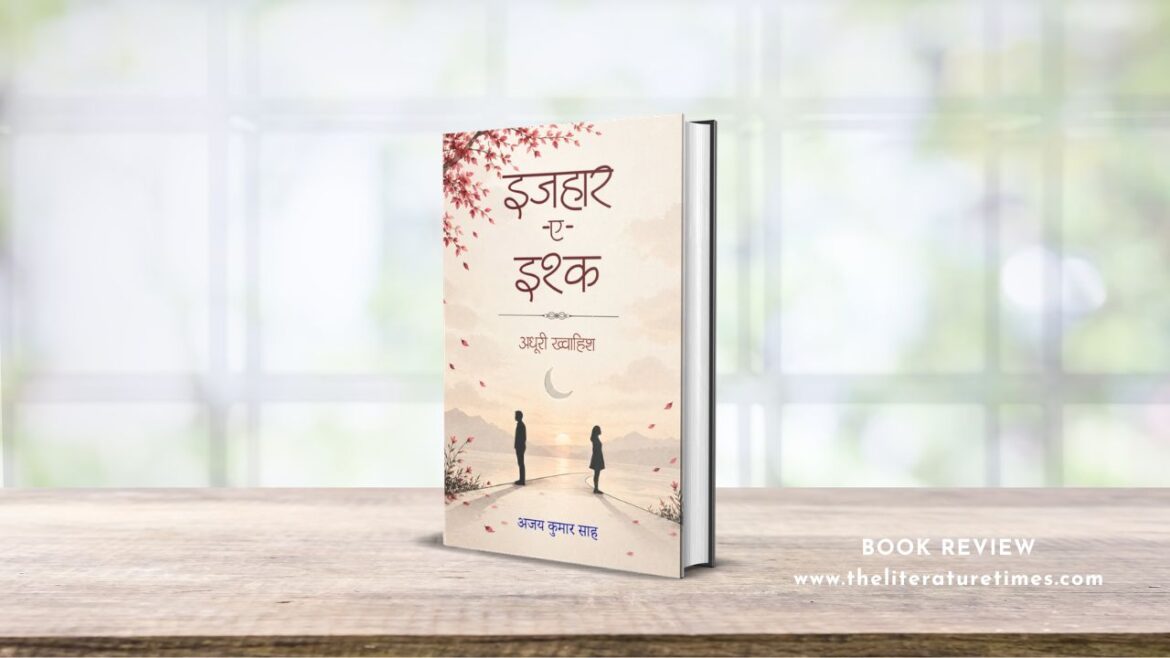
Love has always occupied a distinctive place in poetry because it is at once deeply personal and universally recognisable. In इजहार-ए-इश्क: अधूरी ख्वाहिश, अजय कुमार साह approaches this enduring subject through a collection of 101 poems centred on the emotional world of love, imagination, longing and selfless devotion. The book is built around the poet’s imagined beloved and seeks to give poetic form to the spiritual and emotional sensations that arise from loving her. Rather than treating love simply as romantic attraction, the collection presents it as an inward experience—one shaped by tenderness, idealisation, yearning and surrender. The result is a work that places emotional sincerity at the heart of its poetic identity and invites readers to consider love not merely as a relationship between two people, but as an intense inner state capable of connecting imagination, memory, devotion and aspiration.
One of the most significant dimensions of the collection is its understanding of pure and selfless love. The supplied description of the book explicitly connects its emotional landscape with the devotional traditions associated with Radha and Krishna, as well as Meera’s unwavering love and surrender toward Krishna. This reference provides an important interpretive framework for the poems. It suggests that the book’s idea of love extends beyond possession or expectation and moves toward an ideal of unconditional emotional dedication. In this sense, अधूरी ख्वाहिश is not simply a phrase suggesting an incomplete desire; it also captures the tension between what the heart imagines and what life is able to fulfil. That tension is central to the emotional power of love poetry, and the book appears to explore it through a sustained focus on longing, imagined companionship and the quiet intensity of devotion.
The concept of an imagined beloved is particularly interesting because it allows the poet to explore love as an interior creative experience. The beloved is described as emerging in the poet’s imagination, making the act of writing itself part of the emotional journey. Such an approach gives the collection an introspective character: the poems are not dependent on a conventional narrative of a relationship, but on the feelings, images and possibilities generated within the poet’s mind. This makes the work relevant to readers who recognise that some of the strongest experiences of affection are formed through imagination, anticipation and emotional projection. The collection’s emphasis on a woman who exists within the poet’s emotional and imaginative world also creates a space in which admiration, vulnerability and idealism can be expressed without reducing love to a simple romantic formula.
The book’s literary approach is grounded in feeling rather than intellectual abstraction. Its 101-poem structure gives the author a broad canvas on which to revisit the emotional vocabulary of love from multiple perspectives. A collection of this nature can be especially effective when each poem allows a slightly different shade of emotion to emerge—whether it is yearning, admiration, surrender, hope, incompleteness or spiritual reflection. The strength of the project lies in its willingness to take these emotions seriously. In an age in which expressions of affection are often reduced to brief and immediate forms, a sustained poetic engagement with love creates an opportunity for slower reading and contemplation. Readers can approach the poems individually, but the collection as a whole also offers the possibility of following an emotional continuum in which love is repeatedly examined through imagination and devotion.
Another notable aspect is the meeting of romantic and devotional sensibilities. The invocation of Radha-Krishna and Meera places the book within a recognisable Indian cultural and literary tradition in which earthly affection and spiritual devotion can overlap. This does not necessarily turn the collection into religious poetry; rather, it establishes a vocabulary for understanding love as something capable of transcending ordinary expectations. The comparison is meaningful because both Radha’s love and Meera’s devotion have long been interpreted through ideas of surrender, intensity and emotional steadfastness. By drawing on this cultural memory, the collection situates its exploration of personal love within a wider Indian understanding of devotion. This gives the central theme a dimension that may resonate particularly strongly with readers familiar with Hindi literary and devotional traditions.
The author’s own background also adds an intriguing contrast to the subject of the book. Aजय कुमार साह is a कृषि वैज्ञानिक and agricultural education administrator with more than 28 years of experience in agriculture and education. He has published more than 350 technical research papers, books and articles relating to agriculture, entrepreneurship and associated subjects. Against this professional background, his engagement with Hindi literature, books and poetry represents another important dimension of his creative identity. His admiration for writers and poets such as Atal Bihari Vajpayee, Shivmangal Singh ‘Suman’ and Harivansh Rai Bachchan indicates an appreciation for established Hindi literary traditions, while this book represents a long-held aspiration to write in Hindi. इजहार-ए-इश्क: अधूरी ख्वाहिश can therefore be viewed as a creative extension of an author whose professional life has been rooted in knowledge and education, but whose literary interests have remained an enduring part of his personal world.
For readers, the principal value of the collection lies in its emotional accessibility. Love poetry does not require a reader to share the author’s precise circumstances; its effectiveness often comes from its ability to awaken feelings that readers already carry within themselves. The idea of an incomplete wish is especially universal. Many readers have experienced emotions that remained unspoken, relationships shaped by distance or circumstance, affection that existed more strongly in imagination than in reality, or simply the awareness that some desires remain unfinished. By centring the collection on these emotional possibilities, the book can speak to readers who enjoy reflective poetry and writing about the inner life. Its devotional references may further appeal to readers interested in the intersection of Hindi poetry, Indian cultural traditions and spiritual conceptions of love.
The intended audience is therefore broad, but particularly suited to readers who value Hindi poetry, romantic and reflective literature, and emotionally driven writing. Readers interested in the literary expression of longing and selfless affection may find the collection especially engaging. It can also appeal to those who enjoy poetry as a form of personal reflection rather than as a purely formal literary exercise. The collection’s 101-poem format makes it possible to read gradually, returning to individual pieces according to one’s mood or emotional response. Such a format suits poetry well because the reader does not necessarily need to proceed in a single sitting; instead, the poems can become separate moments of contemplation.
Ultimately, इजहार-ए-इश्क: अधूरी ख्वाहिश is a sincere exploration of love as imagination, longing and devotion. Its central premise is simple but enduring: a human being can carry an intense experience of love within the mind and heart, even when that experience remains incomplete. By connecting this emotional world with the ideals of Radha-Krishna love and Meera’s devotion, अजय कुमार साह gives the subject a distinctly Indian cultural resonance. The collection’s greatest strength is its commitment to emotional sincerity and its attempt to preserve the purity of selfless love as a meaningful poetic ideal. For readers seeking poetry that reflects upon affection, yearning, imagination and surrender, this collection offers an opportunity to pause and engage with the quieter dimensions of the heart. It is ultimately a work about what love can become when it is not measured only by fulfilment, but also by the depth of feeling it inspires.
Rating: 4.7/5