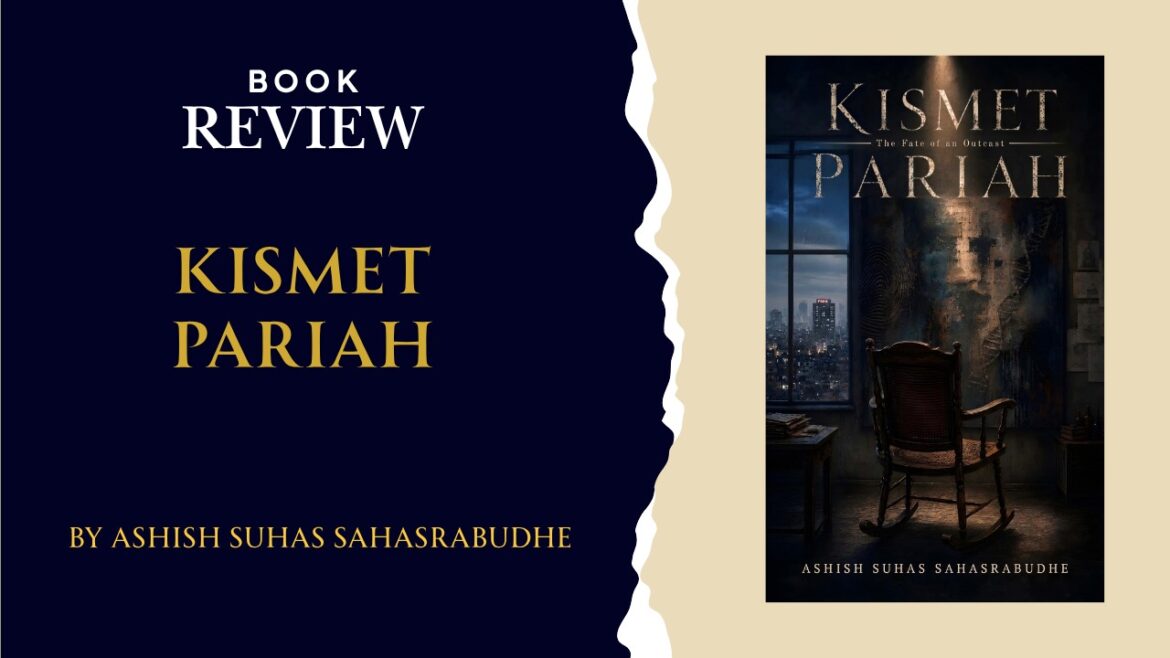
Book Title: Kismet Pariah
Author: Ashish Suhas Sahasrabudhe
Publisher: Evincepub Publishing
I picked up Ashish Suhas Sahasrabudhe’s Kismet Pariah late one weekend evening, planning to read a chapter or two before bed. I finished it well past midnight, with a cup of tea beside me, long since cold. I can’t think of better praise for a crime novel.
The story opens in Pune during the lockdown. A well-known painter, whose canvases sell for crores though no one has ever seen his face, is found dead in his bungalow. He’s seated in a carved chair, wearing a freshly pressed shirt, as if he’d nodded off. Inspector Vishwas Khare arrives just before midnight and senses that the room has been arranged. Within two hours, the body disappears from the ambulance somewhere on the Solapur highway, and the driver and his assistant both tell the same story about a woman in a white sari standing in the road.
Each chapter is stamped with the hour, from Hour Zero to Hour Thirty-One, and I liked this more than I expected to. You always know how long Khare has been on his feet, and by the second night I was feeling tired on his behalf. The story moves between Khare, who drives out into Solapur district, and Sub-Inspector Mohite, who stays back in Pune and ends up in Mumbai. Each of them keeps finding pieces the other one needs, without either of them realising it.
Sahasrabudhe works in banking IT, and I suspect that’s where the careful plotting comes from. Small details from the early chapters come back later and turn out to matter, and I couldn’t find much that was there just for decoration. This is his second novel, nearly ten years after his first, and he clearly didn’t rush it.
He also makes good use of the lockdown and gets the details right: the Khalapur toll plaza with every lane but one coned off, and Akkalkot with its coconut stalls shuttered and a lone monkey sitting on a roof as if he owns the place. It matters to the plot, too. With a whole city indoors, a van turning into a lane at two in the morning stands out, and the police notice.
Mukadam, the sub-inspector the whole station calls “Mama,” is genuinely funny. He worries constantly and would much rather be asleep. He’s also the one who quietly handles the paperwork while Khare chases his hunches, and their arguments in the car are some of the best writing in the book. I also liked Ambadas, a pilgrim guide who won’t answer a question until he has finished his prayer. My favourite chapter belongs to Dr Kelkar, a conservator who shows a tired police officer how to tell one painter’s hand from another’s under a lamp held almost flat against the canvas. I’d never thought about brushstrokes that way before.
I won’t spoil anything. About two-thirds of the way in, the book stopped being the story I thought I was reading, and I found myself going back over earlier chapters in my head. I respected that Khare doesn’t come out of it looking like a genius. He has been confidently wrong for a long time, and the book forces him to confront it. The last chapters slow right down. Near the end there’s a scene in a Solapur courtyard with a woman, a stove and a cup of tea, where hardly a word is spoken. I kept thinking about it long after I’d finished.
My complaints are small. The author has a few favourite tricks, such as ending a chapter on a single ominous line, and by the last third I could see them coming. It didn’t bother me much.
The idea I keep coming back to comes from Khare himself, when he says that science wants to know what a person is and religion wants to know who. The whole novel is built around the space between those two questions, and around the people who fall into it.
If you like a police story that cares about its people, get yourself a copy. I don’t think you’ll regret it.
Buy on Amazon: https://www.amazon.in/Kismet-Pariah-Ashish-Suhas-Sahasrabudhe/dp/9373356356/