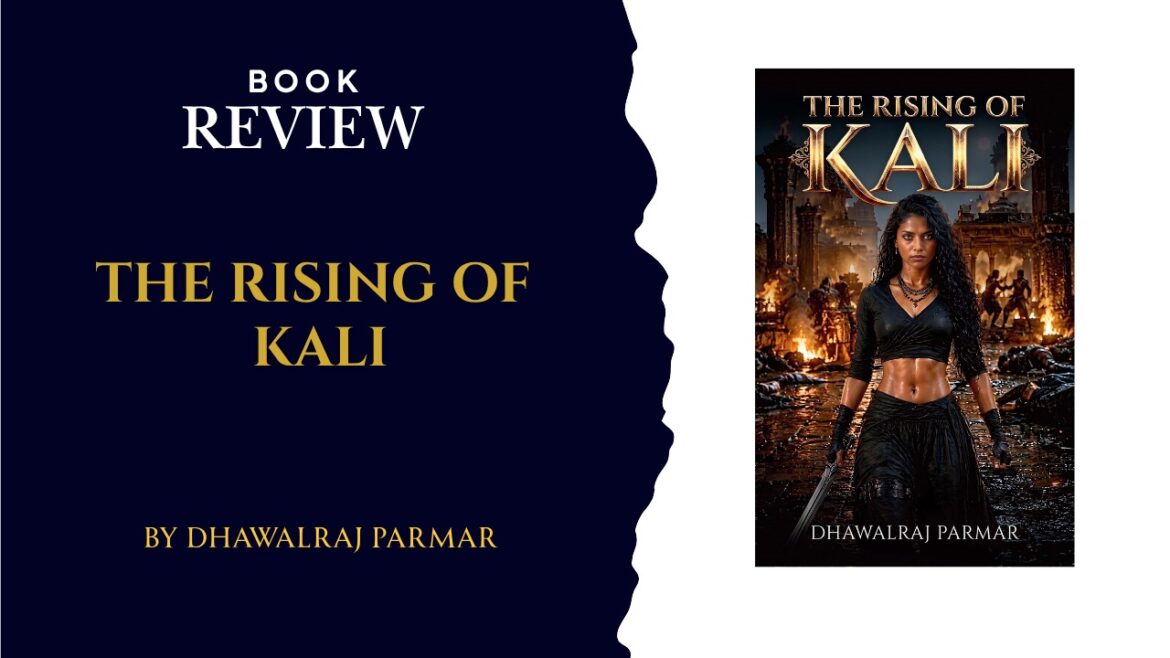
Title: The Rising of Kali
Author: Dhawalraj Parmar
Publisher: Evincepub Publishing
Dhawalraj Parmar’s The Rising of Kali is a genre-blending novel in which mythological fantasy, martial-arts fiction, conspiracy thriller and coming-of-age narrative intersect. Its considerable narrative scale could easily have reduced it to a sequence of confrontations and revelations; instead, its strongest moments are held together by a recurring philosophical concern—the distinction between defeating an opponent and mastering oneself.
The novel announces this concern through Saumya. Her earliest training emphasises meditation, concentration and the ability to remain composed amid chaos. Adhira, meanwhile, embodies spectacular physical capability complicated by ambition. The sisters therefore establish two competing definitions of strength before the larger plot has properly begun. Adhira wants confirmation that she is worthy; Saumya initially possesses less ambition but greater receptiveness to discipline. The irony of the narrative is that Saumya must later pass through extreme violence before she can fully understand the value of that early teaching.
The disappearance of Adhira is an effective inciting wound because it operates on several narrative levels. It creates mystery, fractures the family and gives Saumya a motive stronger than abstract heroism. Even when the plot expands geographically and introduces wider conspiracies, her search for Adhira preserves an emotional through-line.
Among the novel’s most successful inventions is The Factory. As both setting and metaphor, it represents institutionalised dehumanisation. Its purpose is not education but manufacture: individuals are stripped of ordinary attachments and transformed into efficient instruments. Against this environment, the Gurukul acquires greater thematic importance. The two institutions become distorted mirrors of one another—both value training, discipline and exceptional ability, but only one connects strength with moral responsibility.
The title itself develops into a useful symbolic motif. “Kali” initially signifies the terrifying warrior identity Saumya acquires through survival and bloodshed. Yet the novel gradually interrogates the seductiveness of that identity. Rage can make her formidable, but it cannot make her complete. The climactic battle turns this internal contradiction into external action when aggression itself becomes the source of the antagonist’s strength. The device may belong to fantasy, but its thematic logic is elegant: uncontrolled anger literally empowers the enemy.
Parmar also integrates Indian mythological material into a modern action framework. Prophecy, the divine sword, Parshurama, the Rakshini Sena and weapons associated with epic traditions allow the narrative to treat mythology as living inheritance rather than distant background. Particularly effective is the concept that ancient power must be accompanied by worthiness. The sacred weapon therefore carries a moral as well as supernatural function.
Stylistically, the novel prioritises clarity and movement. The language is straightforward, dialogue-driven and visually oriented, making many sequences easy to imagine cinematically. Combat scenes generally maintain spatial clarity and momentum. The trade-off is that emotional states are sometimes stated explicitly rather than allowed to emerge through gesture, imagery or subtext. A more restrained use of explanation could have increased psychological complexity. Similarly, the large number of plot developments in the latter sections occasionally compresses potentially rich emotional moments.
Nevertheless, the narrative architecture achieves a satisfying thematic return. Saumya’s final victory depends upon remembering rather than rejecting her original self. She does not ultimately triumph because Kali becomes stronger; she triumphs because she learns when Kali must become silent. Her decision to spare a defeated enemy completes that development.
The resulting novel is therefore less about becoming powerful than about becoming responsible for one’s power. The Rising of Kali uses the vocabulary of mythology and the momentum of a thriller to explore anger, sisterhood, trauma, forgiveness, inherited duty and self-command. Its most enduring proposition is simple but resonant: the highest form of strength may not be the ability to strike, but the ability to stop.
Buy on Amazon: https://www.amazon.in/Rising-Kali-Dhawalraj-Parmar/dp/9373356755