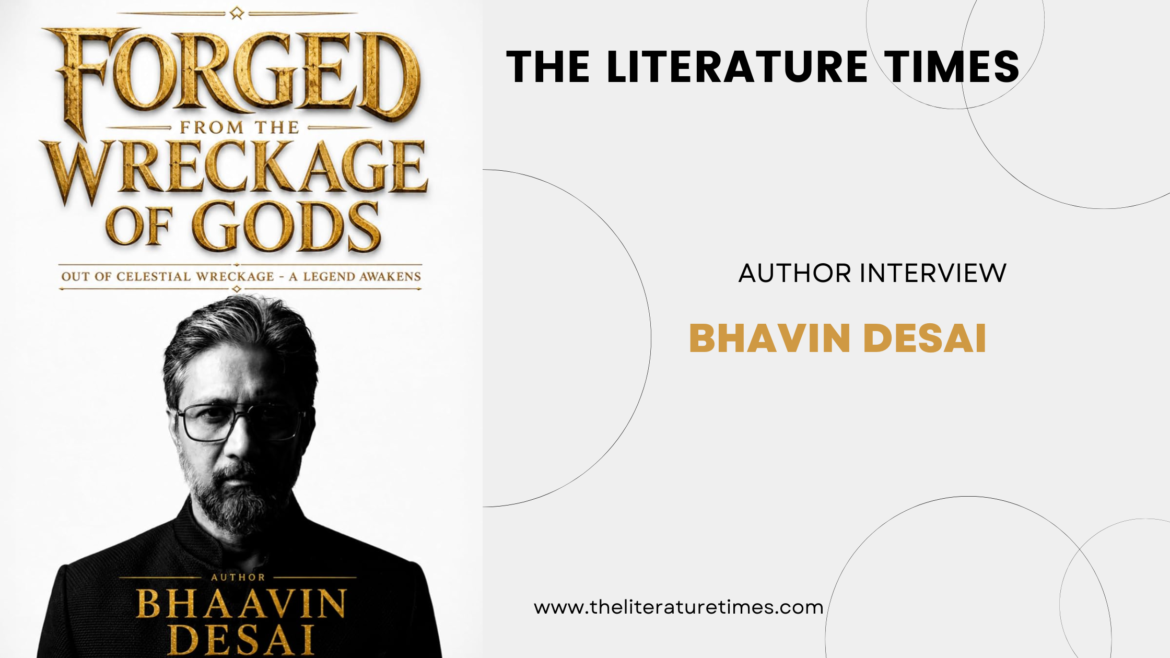
By Bhavin Desai
The Literature Times: Your book, Forged from the Wreckage of Gods, focuses strongly on transformation and rebuilding oneself. What inspired you to write this book?
Bhavin Desai:
The book was born from a question that stayed with me for a long time: what happens to a person when everything they once believed about themselves is challenged?
I have always been fascinated by the human ability to rebuild. Not the kind of rebuilding that happens when life is comfortable, but the kind that begins when certainty disappears, when expectations collapse, when people leave, when plans fail, and when the person you thought you were no longer feels sufficient for the person you need to become.
Forged from the Wreckage of Gods came from that space.
I did not want to write another book that simply tells people to stay positive or keep going. Life is far more complicated than that. Sometimes you have to confront yourself before you can change yourself. Sometimes the greatest obstacle is not the world outside us, but the identity we have carried for too long.
The book is my reflection on that process. It is about what happens when a person stops asking, “Why is this happening to me?” and begins asking, “What can I become because of this?”
For me, transformation is not about becoming someone else. It is about stripping away everything that was never truly you and discovering what remains.
The Literature Times: The title Forged from the Wreckage of Gods is powerful and symbolic. What does it represent, and what message do you want readers to take from it?
Bhavin Desai:
The title is symbolic of the destruction of the things we once placed above ourselves.
We all create our own “gods”. They can be people, relationships, approval, success, status, expectations, fear, comfort, or even the version of ourselves we have become attached to. We give these things enormous power over our identity. Then, when one of them collapses, we feel as though our entire world has collapsed with it.
But sometimes what we call destruction is actually liberation.
The “wreckage” in the title represents everything that had to fall apart for a stronger identity to emerge. And “forged” is important because forging requires pressure, heat, force and transformation. Strength is not simply discovered. It is developed through what we are willing to endure and what we choose to do with it.
The message I want readers to take away is simple: your ruins do not have to become your identity.
You can build from them.
You can take disappointment, failure, rejection, loss, mistakes and pain and turn them into understanding, discipline and strength. What broke you does not get to decide what you become.
The Literature Times: You emphasize resilience, discipline, and self-mastery throughout the book. Why do you believe these qualities are essential for personal transformation?
Bhavin Desai:
Because transformation without discipline is usually temporary.
Resilience teaches us how to remain standing when life becomes difficult. Discipline teaches us what to do when we do not feel like standing at all. And self-mastery teaches us that our greatest battle is often with ourselves.
We live in a culture that frequently celebrates results without discussing the internal structure required to achieve them. People see the achievement, but they do not see the mornings when the person continued despite having no motivation, the decisions nobody applauded, or the sacrifices nobody knew about.
That is where discipline becomes powerful. Motivation can inspire you to begin, but discipline determines whether you continue when the excitement disappears. Resilience allows you to survive the storm. Discipline allows you to keep building during it. Self-mastery allows you to decide who you will be once the storm is over.
Real transformation happens when these qualities stop being occasional behaviours and become part of your character.
The Literature Times: Your philosophy suggests that people must stop blaming circumstances and take ownership of who they are becoming. How can someone begin making that shift in their life?
Bhavin Desai:
The first step is brutally honest self-accountability.
That does not mean pretending that circumstances do not matter. They do. People can hurt us. Life can be unfair. Opportunities can be unequal. Some things happen to us that we never deserved.
But there is a difference between acknowledging what happened and surrendering our entire identity to what happened.
Ownership begins when we separate what we cannot control from what we can. You may not control what someone did to you. You may not control who walked away. You may not control the circumstances you were born into. But you can control what you do next.
I believe one of the most powerful questions a person can ask themselves is: “What is still within my control?”
That question changes the direction of the mind. Instead of spending all your energy arguing with the past, you begin investing it in the future. You stop waiting for life to become easier before you become stronger. And eventually, you understand that taking responsibility for your life does not mean accepting blame for everything that happened to you. It means refusing to surrender responsibility for everything that happens next.
The Literature Times: You believe that pressure and adversity can create strength. Can difficult experiences actually become the foundation for a stronger version of ourselves?
Bhavin Desai:
Yes, but adversity itself does not automatically make us stronger. That distinction matters.
Two people can go through the same difficult experience and emerge completely differently. One may become bitter, while the other becomes wiser. One may allow pain to close every door, while the other uses it to build a new one. The difference is not always what happened. It is what we choose to do with what happened.
Pressure can reveal parts of ourselves that comfort never demanded we develop. Difficult experiences can force us to discover patience, courage, discipline, boundaries, independence and clarity. But pain should not be romanticized. Suffering is not automatically meaningful. Meaning is something we create from it.
I believe adversity becomes valuable when we refuse to let it remain merely an injury. We study it. We learn from it. We understand ourselves through it. And then we use that understanding to construct a better life.
The strongest version of ourselves is rarely created during the easiest chapter of our lives.
The Literature Times: In a world filled with distractions and instant gratification, why do you think discipline has become increasingly important?
Bhavin Desai:
Because we are living in a time where almost everything is designed to compete for our attention. We can get entertainment instantly, information instantly, reactions instantly and gratification instantly. But the things that genuinely transform a human being rarely happen instantly.
Character takes time.
Wisdom takes time.
Mastery takes time.
Trust takes time.
A meaningful life takes time.
The danger of instant gratification is that it can train us to confuse immediate pleasure with genuine progress. We begin choosing what feels good now over what will make us better later. Discipline is the ability to resist that trade. It is choosing the book over another distraction. The difficult conversation over avoidance. The long-term goal over the immediate reward. The uncomfortable truth over the convenient lie.
Discipline is not about making life joyless. It is about deciding what deserves your attention. In a distracted world, attention itself has become a form of power.
And the person who can control where their attention goes has an enormous advantage over the person who allows everything around them to control it.
The Literature Times: Your book goes beyond temporary motivation and focuses on lasting inner strength. What is the difference between motivation and genuine transformation?
Bhavin Desai:
Motivation changes how you feel. Transformation changes how you live. Motivation can give you a powerful moment. You watch something, hear something, read something, and suddenly you feel ready to conquer the world. But feelings are temporary.
Transformation begins when the feeling disappears and the decision remains. It is easy to promise yourself that you will change when you are inspired. The real test comes three days later, when nobody is watching, the excitement has faded and the old habits are calling you back.
That is where transformation begins.
Genuine transformation changes your standards. It changes what you tolerate, what you pursue, what you refuse, how you respond and ultimately how you see yourself. You no longer need to constantly convince yourself to behave differently because the person you have become naturally makes different choices.
Motivation says, “I want to change.”
Transformation says, “I have changed.”
That distinction is at the heart of the book.
The Literature Times: You write about character being more important than reputation. Why is character such an important part of personal growth?
Bhavin Desai:
Because reputation is what people believe about you, while character is who you are when there is nobody there to believe anything. Reputation can be constructed. Character has to be lived.
You can manage an image. You can impress people. You can collect recognition. But eventually, life places you in situations where there is no audience, no applause and no reward for doing the right thing. That is where character reveals itself. I believe personal growth becomes meaningful only when the person we present to the world begins to resemble the person we are in private.
Character is built through small decisions. Keeping your word. Accepting responsibility. Controlling your reactions. Standing by your principles when compromising them would be easier. Treating people with dignity even when there is nothing to gain from it.
A reputation can disappear overnight. Character stays with you.
And ultimately, the most important person you have to live with is yourself. That is why I believe becoming someone you respect is more important than becoming someone everyone else admires.
The Literature Times: Forged from the Wreckage of Gods is your first book. What was the most challenging part of turning your experiences and philosophy into a book?
Bhavin Desai:
The hardest part was not writing. It was being honest.
When you write about transformation, you cannot comfortably stand outside the subject and analyse it as though you have mastered everything you are discussing. You inevitably have to confront yourself. There were thoughts I had to examine more deeply than I had before. There were experiences I had to look at without the protection of hindsight. And there were ideas that had to be expressed without making them sound like instructions being given from a pedestal.
I wanted the book to speak as one human being to another. I also wanted to avoid writing a book that simply tells readers what they want to hear. Real growth is not always comfortable. Sometimes the truth we need is not the truth we want. Turning a philosophy into a book also requires discipline. An idea can exist beautifully in your mind, but translating it into words requires structure, clarity and patience.
The greatest challenge was therefore finding the balance between vulnerability and conviction: being honest about the human experience while still giving the reader something strong enough to carry forward.
The Literature Times: Finally, if you could leave readers with one message after they finish Forged from the Wreckage of Gods, what would you want them to remember?
Bhavin Desai:
I would want them to remember that their life is not finished simply because a chapter ended badly.
There will be moments when something you believed would last does not. There will be people who leave, plans that fail, identities that collapse and versions of yourself that you eventually outgrow.
Do not mistake the end of something for the end of yourself.
Stand in the wreckage for a while if you must. Feel it. Understand it. Learn from it. But do not build your permanent home there.
You are allowed to become someone your past could not have imagined.
You are allowed to change your standards, change your direction, change your habits and change the person you are becoming.
And perhaps most importantly, do not wait for someone else to come and rebuild you.
Pick up what remains. Stand up. Begin again. And this time, build yourself with greater awareness than before.
If Forged from the Wreckage of Gods leaves the reader with anything, I hope it leaves them with this conviction:
You are not the wreckage. You are what you choose to forge from it.