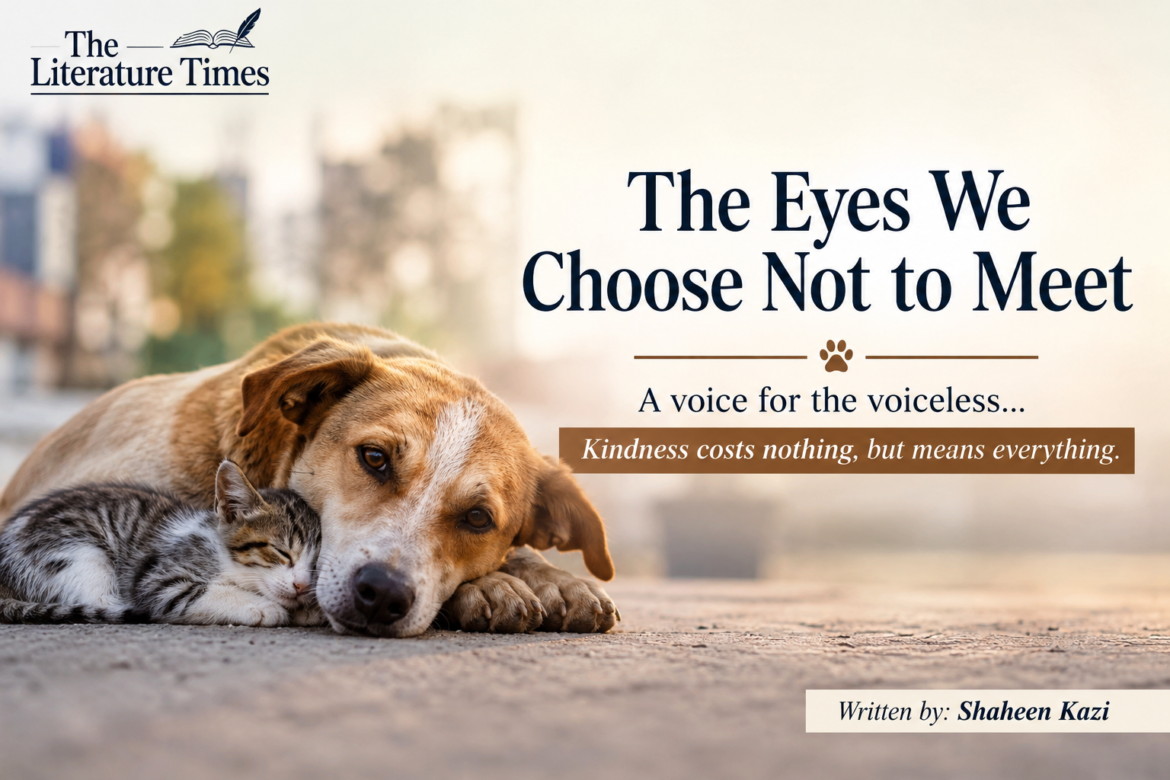
Every morning, before the city truly wakes, another world is already alive.
A stray dog curls up beside a tea stall, hoping yesterday’s kindness returns today. A mother cat searches endlessly for food while trying to keep her tiny kittens alive. Birds wait patiently on electric wires for someone to leave a bowl of water. They do not dream of comfort or luxury. They ask only for another day to survive.
Yet every day, we fail them.
Cruelty toward animals rarely begins with violence. It begins with indifference.
It begins when we drive past an injured dog because we are getting late. It begins when children are taught to throw stones at cats instead of kindness. It begins when a hungry animal is chased away as though its life has no value. It begins the moment we convince ourselves that because they cannot speak our language, they do not feel pain.
But they do.
They feel fear.
They feel hunger.
They feel loneliness.
And they remember both the hands that feed them and the hands that hurt them.
In today’s world, acts of animal cruelty have become disturbingly common. Every few weeks, another heartbreaking video appears on our screens. A helpless dog is beaten. A horse is abandoned after years of service. Birds’ nests are destroyed for amusement. A terrified cat is thrown from a balcony, leaving millions of people shocked, angry and heartbroken.
For a few moments, the internet mourns.
Comments pour in. People express outrage. The video trends.
Then another headline replaces it.
But for the animal, the suffering never ends.
Perhaps the saddest part is not that cruelty exists. It is that we have slowly begun to accept it as something that happens every day. We shake our heads, whisper, “How terrible,” and continue scrolling, while another voiceless life disappears into silence.
If you have ever looked into the eyes of a stray animal, you will notice something extraordinary. Despite abandonment, starvation and abuse, they still choose to trust.
A stray dog still wags its tail at the stranger who offers a biscuit.
A frightened cat slowly walks toward the hand that reaches out with kindness.
They do not carry revenge in their hearts.
Only hope.
Maybe that is the lesson they have been trying to teach humanity all along.
As our cities continue to grow taller, their world continues to grow smaller. Forests become highways. Empty fields become concrete. Trees disappear. Shelters vanish. Roads replace the spaces they once called home.
And then we ask why stray animals are everywhere.
The truth is painfully simple.
They are not living in our world.
We have built our world over theirs.
This is why I often think about the generation growing up today.
Generation Z has inherited a world connected by technology unlike any generation before it. A single photograph can travel across continents within minutes. A single video can awaken millions of hearts overnight. Social media has become more than entertainment; it has become a place where voices gather, movements begin and compassion can spread faster than ever before.
Perhaps this generation has an opportunity that no generation before it possessed.
Not simply to witness cruelty, but to change how the world responds to it.
When kindness is shared as passionately as outrage, something remarkable happens. A rescued puppy finds a home because thousands cared enough to share its story. An injured cat receives treatment because strangers refused to look away. An act of compassion inspires another, until kindness itself becomes contagious.
Real change has always begun with ordinary people who decided that looking away was no longer an option.
Compassion does not require wealth.
It begins with noticing.
With leaving a bowl of water outside during summer.
With slowing down on roads where stray animals wander.
With feeding a hungry soul when you can.
With teaching children that every living creature deserves respect.
These may seem like small acts, but to a stray animal, they can mean the difference between another day of suffering and another chance at life.
One day, history will remember our technology, our skyscrapers and our achievements.
But humanity will be remembered for something far simpler.
How did we treat those who were completely at our mercy?
The next time a stray dog follows you with hopeful eyes…
The next time a frightened cat waits quietly outside your gate…
The next time a thirsty bird lands on your balcony…
Pause for a moment.
To you, it may be an ordinary encounter.
To them, it may be the first act of kindness they have experienced in days.
A civilization is never judged by how it treats the powerful.
It is judged by how gently it protects the lives that cannot protect themselves.
Because in the end, the true measure of humanity is not found in the monuments we build or the wealth we accumulate.
It is found in the eyes we choose not to look away from.
Article by: Shaheen Kazi
Shaheen Kazi is a versatile Indian author renowned for her aptitude for writing multiple fictional books across various genres. Her compelling storytelling and creative flair have captivated readers worldwide. Ms. Kazi’s writing journey began in 2018; she has consistently produced exceptional content. Her current projects are a testament to her unwavering passion for writing. To encounter the vivid imagination and heartfelt narratives of Shaheen Kazi, explore her works. Her fusion of diverse cultures, life experiences, and narratives enriches the literary world and has left an indelible impression on her readers. We recommend Shaheen Kazi’s books to anyone who seeks to have a rich and unforgettable reading experience. Her literary expertise and storytelling prowess are unparalleled, and she promises to transport readers to a new world.