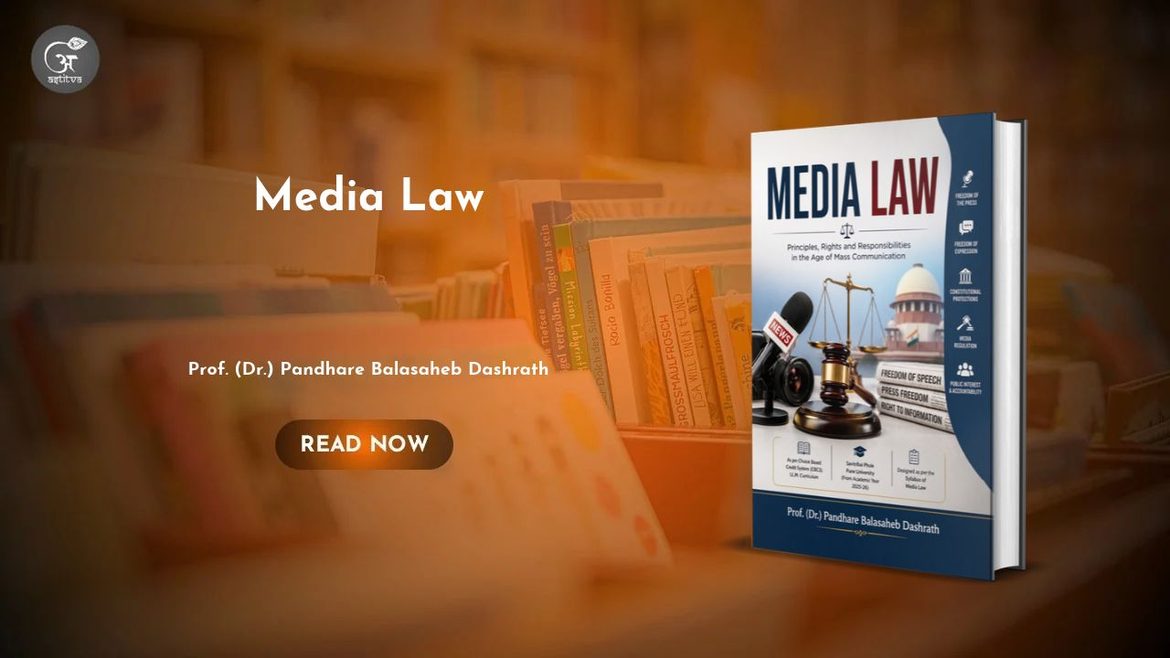
Media Law, an academic book by Prof. (Dr.) Pandhare Balasaheb Dashrath, examines the relationship between media freedom, legal accountability, and democratic society. Written with students in mind, the book offers a structured introduction to the principles, institutions, and debates that shape media law in India.
From newspaper reporting and television broadcasting to online journalism and social media, the book explores how different forms of communication raise questions about freedom, responsibility, and public interest. Its central concern is the balance between protecting independent expression and respecting privacy, reputation, fairness, and the administration of justice.
Prof. (Dr.) Pandhare Balasaheb Dashrath, who holds an LL.M. and Ph.D., serves as a professor at Ahmednagar Jilha Maratha Vidya Prasarak Samaj’s New Law College, Ahilyanagar. In the preface, he describes the book as an effort to help students develop conceptual clarity, prepare for examinations, and appreciate the practical significance of the subject. This educational purpose guides its progression from introductory concepts to more complex legal and regulatory questions.
Organised into seven chapters, Media Law begins with the foundations of media and communication, including their functions and importance in a democracy. It then examines the historical development of the press and the principal theories concerning its role in society. These opening discussions provide context for understanding the competing expectations placed upon media institutions.
The constitutional framework of media freedom in India forms a substantial part of the book. Topics include freedom of speech and expression, reasonable restrictions, legislative privileges, privacy, and media freedom during an emergency. Through discussions of constitutional provisions and judicial decisions, the author introduces readers to the legal reasoning surrounding expression and its limits.
The book also addresses the interaction between media and other branches of law. Its coverage includes criminal law, civil liability, defamation, contempt of court, official secrecy, access to information, and employment protections for journalists. Together, these subjects connect classroom study with situations involving reporting, publication, institutional scrutiny, and individual rights.
A separate chapter examines regulation across print, broadcasting, cinema, and advertising. It discusses statutory frameworks alongside approaches to self-regulation, encouraging readers to consider how oversight, professional standards, and editorial independence interact. This breadth gives students a framework for studying the different institutions involved in media governance.
Contemporary issues receive particular attention. Trial by media, sting operations, broadcasting rights, intellectual property, internet freedom, media convergence, violence against media persons, and electoral communication are among the subjects explored. These discussions extend the book’s scope beyond traditional press regulation to the questions raised by digital communication and changing patterns of information sharing.
The concluding chapter brings together the author’s findings, critical observations, and suggestions. It returns to the relationship between freedom and responsibility, with attention to journalist protection, ethical reporting, transparency, and the need for legal institutions to respond thoughtfully to technological change.
With its sequential chapter structure, table of cases, references, and straightforward presentation, Media Law is intended primarily as an academic companion for students. Its themes may also interest teachers, journalism learners, and readers seeking an introduction to the legal questions surrounding public communication.