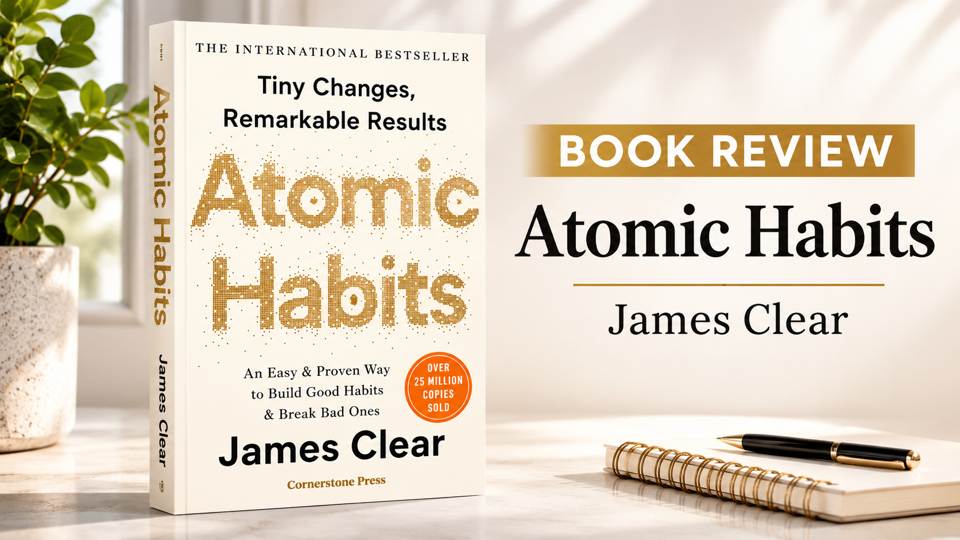
Can a change so small you barely notice it genuinely improve your life? That is the question at the heart of Atomic Habits: An Easy & Proven Way to Build Good Habits & Break Bad Ones, James Clear’s popular guide to sustainable behaviour change. Instead of asking readers to transform themselves overnight, Clear argues for making positive actions easier to repeat and unwanted actions harder to perform.
Interested in Atomic Habits?
Affiliate link: we may earn a commission on qualifying purchases at no extra cost to you.
In this detailed Atomic Habits book review, we examine the book’s main framework, its most useful techniques, its limitations and the type of reader most likely to benefit. The discussion draws on the book’s published framework and the author’s official explanatory materials rather than pretending to report a fresh, independently conducted long-term experiment.
Atomic Habits: Book Details
| Book | Atomic Habits: An Easy & Proven Way to Build Good Habits & Break Bad Ones |
|---|---|
| Author | James Clear |
| Genre | Self-help, productivity, personal development |
| Featured edition | Paperback, ISBN 9781847941831 |
| Core idea | Small, consistent improvements supported by better systems |
What Is Atomic Habits About?
Clear starts from an accessible observation: people often expect progress to arrive as a dramatic turning point, yet most achievements depend on repeated everyday behaviour. Studying a little more consistently, exercising briefly but regularly, or making a healthier choice easier to reach can matter more than a burst of motivation that disappears in a week.
The title uses “atomic” in the sense of something very small but potentially powerful. The book is not an argument for thinking small forever. It is about making the first action manageable enough that repeating it becomes realistic. Clear then builds a system around recognising cues, shaping desire, simplifying actions and rewarding repetition.
Identity-Based Habits: Become the Person Who Does the Work
One of the book’s strongest ideas is its distinction between an outcome and an identity. A person might want to finish a novel, for example, but a more useful day-to-day focus could be becoming someone who writes regularly. The identity does not appear merely because it is declared; it is reinforced by small acts repeated over time.
There is a practical strength in that approach. “Write for ten minutes today” gives a reader something controllable, while “become a successful novelist” remains a distant and uncertain outcome. This shift makes progress less dependent on mood, applause or an ideal future.
But identity language has a limit. It can become discouraging if readers treat every missed habit as a verdict on their character. A better interpretation is flexible: identity is built through an overall pattern, not a perfect streak.
The Four Laws of Behaviour Change Explained
1. Make it obvious
Positive habits are easier to begin when their cues are visible. Keep a book near your bed if you want to read. Put walking shoes where you will see them in the morning. Clear also popularises habit stacking: attaching a new action to a routine that already happens. The value here is practical design rather than willpower.
2. Make it attractive
A behaviour feels easier to repeat when we associate it with something appealing. Pairing an otherwise dull task with an enjoyable context can make the initial effort less intimidating. That does not mean every hard activity must be fun, but it helps explain why environment and anticipation influence what we do.
3. Make it easy
The Two-Minute Rule is perhaps the book’s most immediately usable technique. Reduce a new habit to a small starting version: open the textbook, put on the running shoes, or write one sentence. The goal at first is not impressive output. It is reliable initiation. A short routine can later grow once the act of starting becomes familiar.
4. Make it satisfying
Rewards and visible progress can reinforce repetition. A habit tracker or a simple record of completed actions can make an otherwise invisible process tangible. Still, tracking should remain a tool rather than the purpose: ticking a box is useful only when it represents behaviour that genuinely helps.
For breaking unwanted habits, Clear suggests reversing these principles: make the cue less visible, the behaviour less attractive, the action more difficult and the reward less satisfying. This can be more useful than repeatedly telling yourself to “try harder.”
Why Systems Can Matter More Than Goals
Goals describe a destination; systems describe what happens on an ordinary Tuesday. A student can set the goal of excellent marks, but the system involves where, when and how studying actually takes place. A writer may aim to publish a book, yet the system involves drafting, editing and responding to feedback. Clear’s emphasis on systems helps transform vague ambition into behaviour that can be observed and adjusted.
However, the advice should not be interpreted to mean that goals are useless. Goals help identify direction and priorities. Systems become powerful when they are pointed toward a meaningful objective, not when routine is pursued for its own sake.
What Atomic Habits Does Especially Well
- It is specific: strategies such as habit stacking and the Two-Minute Rule can be tried without expensive equipment.
- It respects friction: the book recognises that surroundings and convenience shape choices.
- It is memorable: the four laws give readers a framework they can return to.
- It favours consistency: the approach is encouraging to beginners who find ambitious plans overwhelming.
- It translates across situations: reading, writing, fitness, finance and workplace routines all offer possible applications.
Where the Book Has Limitations
Some chapters restate a central principle through different anecdotes, which may feel repetitive to readers already familiar with behaviour-change literature. The framework is also easier to apply to personal routines than to challenges shaped by illness, poverty, unstable working hours or other circumstances outside an individual’s control. Good habits can help, but they cannot solve every structural problem.
Another risk is turning self-improvement into constant measurement. Not every valuable part of life needs a tracker, a streak or a productivity target. Rest, relationships and spontaneity matter too. These caveats do not undermine Clear’s practical advice; they help readers use it sensibly.
How to Apply Atomic Habits in Real Life
- For students: put the textbook on the desk before sleeping, then begin with a two-minute review.
- For writers: attach ten minutes of drafting to a daily cup of tea and keep a simple record of sessions.
- For professionals: start the day with one priority task before checking nonessential notifications.
- For readers: keep a book visible and make the first goal just two pages.
- For anyone reducing screen time: move distracting applications away from the home screen and make opening them less automatic.
These are examples of applying Clear’s framework, not guaranteed outcomes. The practical experiment is to choose one small behaviour, make it repeatable and adjust based on what happens.
Atomic Habits vs Dopamine Detox: Which Should You Read?
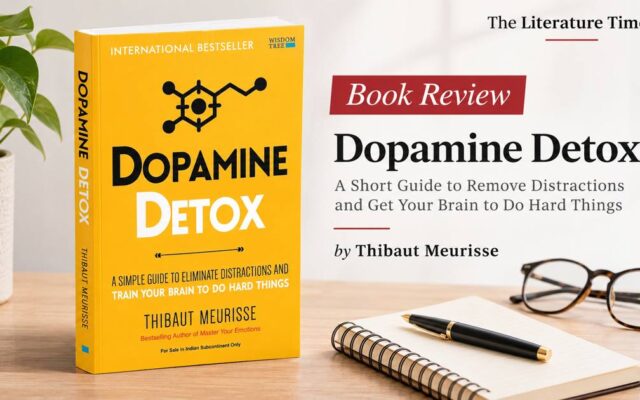
Atomic Habits provides a broad, structured approach to behaviour design. Dopamine Detox by Thibaut Meurisse is more narrowly concerned with overstimulation, distraction and recovering focus. Readers seeking a long-term toolkit for building and breaking routines may find Clear more comprehensive; those who want a short introduction to reducing distracting inputs may prefer Meurisse. The two approaches can complement each other.
Frequently Asked Questions
Is Atomic Habits worth reading for beginners?
Yes, its methods are clearly organised and the starting actions are deliberately small. Beginners can implement one technique without adopting the entire framework.
What are the four laws of Atomic Habits?
Make the desired behaviour obvious, attractive, easy and satisfying. Reverse those qualities when trying to reduce an unwanted habit.
Does Atomic Habits promise instant success?
No. Its central argument favours the cumulative value of consistent action over quick transformation.
Is Atomic Habits a scientific textbook?
No. It is popular personal-development writing that draws on psychology and behaviour research, packaged into practical advice.
Final Verdict: Is Atomic Habits Worth Buying?
Atomic Habits is a strong choice for readers who want clear, usable ways to improve everyday routines. Its greatest contribution is not the idea that consistency matters, which is hardly new. It is the way James Clear makes that idea operational: notice the cue, design the environment, reduce friction and make repetition rewarding.
It is most effective when read as a toolkit rather than a promise of effortless transformation. Pick one idea, apply it for a reasonable period and keep what actually improves your life. That, more than reading every page, is the real test of a practical self-help book.
Explore the book: Check Atomic Habits by James Clear on Amazon.
Further reading: James Clear’s official book summary and Penguin Random House India’s edition details.
Affiliate disclosure: This article contains an affiliate shopping link. The Literature Times may earn a commission on qualifying purchases, at no additional cost to readers. The review is an editorial assessment based on the book’s documented ideas and publisher/author materials, not a claim of independently verified results.
Interested in Atomic Habits?
Affiliate link: we may earn a commission on qualifying purchases at no extra cost to you.




Your perspective matters
Share your thoughts respectfully. Comments are moderated.