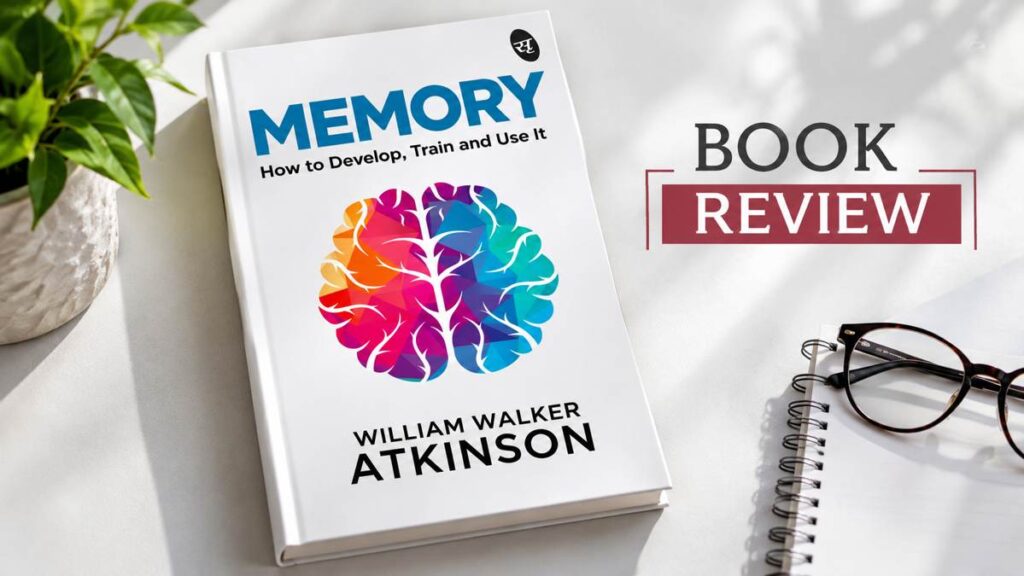
It is a familiar experience: you have just been introduced to someone, but their name disappears from your mind before the conversation ends. You finish a chapter, close the book and realise that you remember its general mood more clearly than its key ideas. Memory: How to Develop, Train and Use It by William Walker Atkinson addresses precisely these ordinary problems, with a surprisingly direct proposition: remembering begins with the quality of attention we give to something.
Interested in Memory by William Walker Atkinson?
Affiliate link: we may earn a commission on qualifying purchases at no extra cost to you.
This classic guide to mental training approaches memory not as a mysterious gift reserved for a few gifted people, but as an ability that can be supported through observation, association and practice. Our Memory by William Walker Atkinson book review explores the work’s structure, practical value and the ways its early-twentieth-century perspective differs from modern cognitive science.
Memory: How to Develop, Train and Use It — Book Information
| Title | Memory: How to Develop, Train and Use It |
|---|---|
| Author | William Walker Atkinson |
| Genre | Classic self-help, mental training, memory improvement |
| Historical context | Early twentieth-century personal development literature |
| Edition featured | Indian paperback edition listed as ISBN 9789390441020; confirm specifications with the seller |
| Central topics | Attention, association, observation, memory systems and remembering names, facts and numbers |
What Is the Book About?
Atkinson begins by explaining why memory matters in education, business and ordinary social life. The chapters then investigate how information is noticed and mentally connected before turning to targeted exercises for different types of recall. The published table of contents includes sections on training the eye and ear, remembering names and faces, recalling places and numbers, and retaining facts, words, music, occurrences and the ideas of books or performances.
That structure is helpful because memory is rarely one undifferentiated task. Recognising a face, remembering a telephone number and reconstructing the argument of a nonfiction chapter require different forms of processing. The book’s approach encourages readers to identify the particular kind of recall they want to improve instead of pursuing a vague ambition to “have a better memory.”
Lesson One: Attention Is the Starting Point of Memory
The strongest and most enduring part of Atkinson’s argument concerns attention. If a person barely notices a new name, it is unrealistic to expect that name to reappear effortlessly later. If a reader moves through a paragraph while thinking about a dozen unrelated things, little information may be retained.
Atkinson therefore emphasises active observation. Pay attention to what you are hearing, looking at or learning. Notice significant characteristics rather than letting experience pass in the background. The message is simple, but it remains relevant to students, professionals and anyone who spends the day moving between notifications.
As a practical example, imagine meeting a colleague named Anita. Instead of immediately shifting to your own reply, pause to register the name, connect it with the setting and use it naturally during the conversation. The point is not that a ritual guarantees flawless recall; it is that information has a better chance when it receives deliberate attention in the first place.
Lesson Two: Association Gives Information a Path Back
The chapters on association explore the role of connections in remembering. A name can be linked to a familiar person, a date to a meaningful event, and a set of ideas to a story or category. Isolated information is often harder to retrieve than information anchored in an existing mental network.
For learners, this can mean creating a meaningful example rather than simply repeating a definition. For professionals, it may mean remembering a meeting’s three main decisions by connecting them to a shared project. For readers, it can mean writing a brief summary that explains how a chapter’s central idea relates to the previous one.
Readers should also understand the limits. Not every association will be memorable, and strange imagery is not automatically better than clear understanding. What matters is whether the connection is meaningful and retrievable to that individual.
Training the Eye and Ear: Learning to Observe
Atkinson devotes separate attention to observing visual and auditory details. These chapters reflect the author’s broader idea that careful perception precedes dependable memory. Looking at an object with the intention of later describing it is different from glancing at it casually. Listening for important details is different from merely allowing words to reach the ears.
A useful modern adaptation is to listen to a short explanation, put it aside, and then recall its key points without immediately checking the source. The exercise can expose gaps in attention. It also offers an important distinction: remembering is not merely experiencing something twice; it includes the effort to retrieve it.
Remembering Names and Faces
Names and faces are among the book’s most relatable subjects. Social embarrassment often follows when we recognise someone but cannot recall their name. Atkinson’s approach encourages fuller initial observation and stronger associations between a person and the information we want to retain.
The practical value here is high for people who meet many clients, students or colleagues. However, a face should not be reduced to a caricature or an intrusive judgment about personal appearance. Respectful attention, repeated natural use of a name and context are better contemporary adaptations of this section.
Remembering Numbers, Facts and Books
The book also discusses more deliberate forms of retention, including numbers and factual material. Numbers are easy to forget when treated as arbitrary strings. Grouping them meaningfully or linking them to known patterns can make them easier to hold in mind.
The chapters on books, plays and stories are particularly relevant to habitual readers. Instead of remembering only whether a book was enjoyable, one can ask: What was its central argument? Which examples supported it? Which ideas were weak or unconvincing? This shifts reading from passive consumption toward genuine comprehension and recall.
A simple study method inspired by these principles is to finish a section, close the book and write down the argument in three sentences. Compare the result with the chapter and correct anything missed. This is an application of the broader memory-training idea, not a claim that Atkinson invented this precise modern exercise.
Where Atkinson’s Book Remains Useful
- For students: it encourages deliberate attention and connecting facts with ideas rather than mechanical rereading alone.
- For working professionals: its treatment of names, conversations and factual recall has immediate social and workplace relevance.
- For readers: it encourages reflection and reconstruction of what a book actually says.
- For anyone interested in classic self-help: it offers a window into how personal improvement and mental training were discussed more than a century ago.
Where the Book Shows Its Age
This is not a current neuroscience textbook. Some of its terminology, explanations of the subconscious and confidence about mental training reflect the period in which it was written. Readers should distinguish its practical suggestions about attention and association from scientific claims requiring modern experimental support.
The prose and repeated emphasis on memory cultivation may also feel formal to people accustomed to contemporary productivity writing. A newer guide may provide more information about sleep, spaced retrieval, cognitive limitations and learning research. Atkinson is best approached as a historically influential practical guide whose suggestions can be tested thoughtfully, not as a comprehensive statement of today’s science.
How to Use the Book: A Simple Seven-Day Practice Plan
- Day 1: Identify the specific situation where you forget things most often.
- Day 2: Practise paying full attention to a short explanation and restating it afterward.
- Day 3: Use a meaningful association to remember a small list of unrelated items.
- Day 4: Recall the names of people you met and the context of each introduction.
- Day 5: Study a group of facts, then retrieve them without immediately looking at your notes.
- Day 6: Read a short chapter and summarise its structure from memory.
- Day 7: Review which methods improved your recall and which felt awkward or unhelpful.
This suggested practice plan is an editorial exercise based on the book’s themes, not a clinical programme or a guaranteed method of memory improvement.
Frequently Asked Questions About Memory by William Walker Atkinson
Is this a good book for improving memory?
It introduces practical ideas about attention, observation and association. Its usefulness depends on the reader’s needs and willingness to practise, and its science should be viewed in historical context.
Does the book teach how to remember names and faces?
Yes. The published table of contents includes dedicated chapters on remembering names and faces.
Is Memory easy for beginners?
The principles are accessible, though the older style of writing may require more patience than contemporary self-help books.
Is the book scientifically up to date?
No. It is an older work. Pair its practical ideas with modern, evidence-based research if your goal is to understand memory scientifically.
Who should consider reading it?
Students, readers, professionals and people who enjoy classic self-improvement literature may find it worthwhile.
Final Verdict: Is Memory Worth Reading?
Memory: How to Develop, Train and Use It succeeds best as a reminder that remembering is an active process. Its most persuasive chapters concern attention, association and deliberate observation. The promise that memory can be approached systematically is empowering, while the historical language and dated explanations encourage a measured reading.
For someone seeking an inexpensive, approachable introduction to classical memory-training ideas, Atkinson offers useful starting points. For a complete understanding of memory and learning, this book should be supplemented with more recent research.
Find the edition: Explore Memory: How to Develop, Train and Use It on Amazon.
Further reading: Chapter listing and bibliographic information on Google Books.
Affiliate disclosure: This article includes an affiliate link. The Literature Times may earn a commission on qualifying purchases without additional cost to the reader. This is an editorial appraisal of the book’s documented themes and structure, not a claim of personally tested memory gains.
Interested in Memory by William Walker Atkinson?
Affiliate link: we may earn a commission on qualifying purchases at no extra cost to you.







Your perspective matters
Share your thoughts respectfully. Comments are moderated.