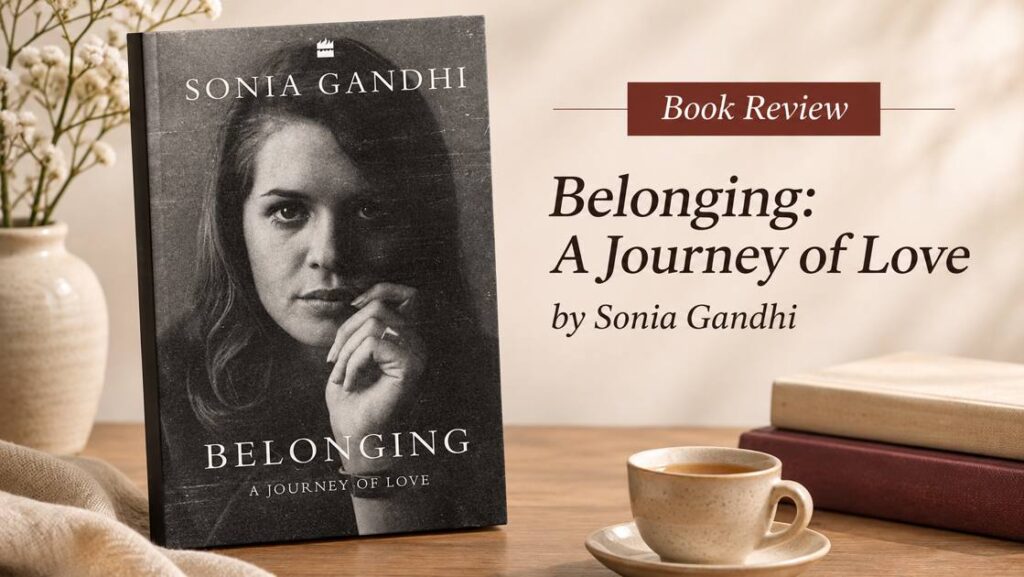
Few public figures in India have lived under as much scrutiny while revealing so little about their private selves as Sonia Gandhi. In Belonging: A Journey of Love, her memoir published in November 2026, the former Congress president turns toward the personal experiences behind a life shaped by migration, marriage, loss and politics. It is the story of a young woman from Italy who built a home in India, entered one of the country’s most influential families and eventually became a major political leader. This Belonging book review considers the memoir’s intimate appeal, its historical setting and the limits of political autobiography.
Interested in Belonging: A Journey of Love by Sonia Gandhi?
Affiliate link: we may earn a commission on qualifying purchases at no extra cost to you.
Belonging by Sonia Gandhi: Book Details
| Book | Belonging: A Journey of Love |
|---|---|
| Author | Sonia Gandhi |
| Genre | Memoir, biography, Indian political history |
| Publication | November 2026 |
| Publisher | HarperCollins India; regional and international editions may differ |
| Major themes | Love, family, migration, grief, public duty, politics and identity |
What Is Belonging: A Journey of Love About?
At the centre of this memoir is not simply a political career but the question of how a person comes to feel at home in a place different from the one where she was born. The published description traces Sonia Maino’s childhood in post-war Italy, her studies in Cambridge and her meeting with Rajiv Gandhi in 1965. Their relationship takes her into the Nehru-Gandhi family and into an India whose cultural and political life she must learn to navigate.
For readers interested in Indian history, the memoir unfolds against familiar turning points: the death of Sanjay Gandhi in a plane crash, the 1984 assassination of Indira Gandhi, Rajiv Gandhi’s subsequent premiership and his assassination in 1991. The publisher presents these events through Sonia’s personal memories and the changes they made to her life. Later sections cover her reluctance to join active politics, her eventual leadership of the Congress party and her decision not to become prime minister after the 2004 election.
This mixture of domestic experience and national events gives the book its distinctive premise. Rather than operating primarily as a chronological history of governments, it asks what these events felt like from within a family frequently at the centre of national attention.
The Love Story That Changes Everything
The memoir opens a space for a relationship that has often been recounted as part of the history of a political dynasty. Sonia and Rajiv’s meeting in Cambridge, their marriage and their early years together form an emotional starting point. The publisher’s framing stresses the romance and the gradual process of adapting to a new country: learning Hindi, discovering Indian food, wearing saris and building relationships within a close but unusually public family.
One reason these passages attract attention is that they reveal a dimension of a well-known figure that political speeches and press conferences rarely show. Everyday details can be more revealing about belonging than a grand claim of loyalty. Learning the rhythms of another household, adjusting to expectations and creating a family identity in a new culture are experiences that many readers, including those far removed from politics, may recognise.
From Italy to India: The Meaning of Home
The title, Belonging, carries a larger idea than marriage alone. It points toward what happens when the country of one’s birth and the country one calls home become intertwined. Sonia Gandhi’s Italian origins were repeatedly discussed in Indian political debate, and the book gives her an opportunity to describe identity on her own terms.
As a reading theme, this raises useful questions. Is belonging established by birthplace, citizenship, language, shared experience or personal commitment? What does it mean to enter another culture without entirely giving up the memories of one’s first home? The strength of a personal memoir is its ability to explore those questions through lived detail instead of reducing them to political slogans.
Grief and the Private Cost of Public Life
The deaths of Indira and Rajiv Gandhi transformed the family’s private world while also changing India’s political landscape. According to the official description, the memoir places these losses among the central experiences that reshaped Sonia Gandhi’s life. This is where the title’s reference to love also takes on the character of remembrance.
For a reader, the distinction between public event and private grief is important. An assassination becomes a date in a history book; to a surviving spouse or family member, it also becomes a permanent personal rupture. Autobiographical writing can help explain how public responsibilities are encountered by those dealing with immediate loss.
That emotional vantage point is a strength of the genre, though it should not be mistaken for a comprehensive historical account. Private memory captures one perspective and requires comparison with independent records when public controversies or collective experiences are involved.
Entering Politics After Years of Reluctance
Another major strand is Sonia Gandhi’s movement from a position largely outside formal party leadership into the presidency of the Indian National Congress. Her decision to decline the premiership in 2004 remains an important point of interest. The memoir provides her own account of the motivations and circumstances surrounding that choice, while the broader political significance remains a matter for historians, political analysts and readers to examine from multiple sources.
People approaching Belonging primarily for party strategy or a comprehensive account of the Congress years may find the personal emphasis either refreshing or frustrating. The book is framed as an individual life story, not an independent investigation into all the controversies associated with the family or the party.
The Memoir’s Strongest Literary Quality: Intimacy
Early critical responses have highlighted the candour of the personal material, especially the Italian childhood, the courtship and the adjustments of early married life. Reviewers have also noted how the memoir brings small, everyday impressions into a public story dominated by large political events. These details make the account interesting even to readers who do not share the author’s political outlook.
There is a broader literary attraction to such writing. A former political leader is a public symbol, but a memoir can restore the ordinary experiences that existed before the symbol was created: parental authority, school memories, friendships, domestic routines and the unexpected choices that alter a life.
What the Book May Leave Readers Wanting
Political memoirs are never neutral historical sources. Authors choose what to emphasise, what to defend and what to leave underexplored. Independent reviews of Belonging have raised concerns that the political chapters are less searching than the intimate ones, particularly when examining contested decisions and controversies involving the Congress and members of the Gandhi family.
That criticism deserves consideration. Readers hoping for a complete political reckoning may need additional biographies, archival work and accounts from people with different perspectives. At the same time, a memoir’s emphasis on personal memory is not inherently a flaw: it is part of the form. The right question is whether the reader understands its scope rather than treating the author’s version as the final word.
For contrasting critical perspectives, see Mint’s review and The Federal’s analysis.
Who Should Read Belonging?
- Readers of memoirs: the narrative offers a rare first-person perspective on a highly scrutinised life.
- Students of contemporary Indian history: the family story intersects with major events in the decades after Independence, though it should be read alongside independent history.
- Readers interested in migration and identity: the book explores forming a sense of home across countries, languages and cultures.
- Followers of Indian politics: the memoir provides a participant’s interpretation of important political choices, even where that interpretation may be contested.
- Readers interested in family and grief: love, loss and continuity form much of the personal story.
Belonging: A Journey of Love — Key Strengths and Limitations
Strengths
- An unusual first-person perspective on events familiar from Indian political history.
- The intersection of migration, romance, family and public duty.
- Personal details that bring a less visible side of a political figure into focus.
- A narrative structure connecting decades of Indian change to one individual life.
Limitations
- Autobiographical memory is selective and cannot independently resolve political disputes.
- Some critical responses suggest the political discussion is less candid than the personal sections.
- Readers wanting exhaustive policy analysis or an impartial Congress history should consult other works as well.
Frequently Asked Questions
Is Belonging written by Sonia Gandhi herself?
The book is published as Sonia Gandhi’s personal memoir and is presented as her own life narrative.
What is Belonging: A Journey of Love mainly about?
It recounts Sonia Gandhi’s childhood in Italy, relationship with Rajiv Gandhi, life in India, family tragedies and eventual political role.
Does Belonging cover the Congress party and Indian politics?
Yes, politics forms a significant setting, but the work is framed as a personal memoir rather than a comprehensive independent political history.
When was Belonging released?
The memoir was released in November 2026.
Is Belonging worth reading even if I disagree with Sonia Gandhi’s politics?
Yes, it can be read as a personal historical document. Readers may find it useful to compare its claims with independent criticism and historical accounts.
Final Verdict: Is Belonging Worth Reading?
Belonging: A Journey of Love is a compelling subject for anyone interested in the private experiences behind one of modern India’s most recognisable political lives. Its primary appeal lies in the intimacy of childhood, love, migration and loss. Its limitation is equally familiar to readers of political autobiography: a personal account cannot replace scrutiny from other perspectives. Approached with both curiosity and critical distance, it offers a valuable window into the relationship between private identity and public history.
Publisher and bibliographic information: Book description and Google Books publication record.
Editorial note: This is a critical overview grounded in the publisher’s description, bibliographic records and accessible reviews. It does not claim to provide an independent firsthand reading of every page or an exhaustive historical account.
Interested in Belonging: A Journey of Love by Sonia Gandhi?
Affiliate link: we may earn a commission on qualifying purchases at no extra cost to you.





Your perspective matters
Share your thoughts respectfully. Comments are moderated.