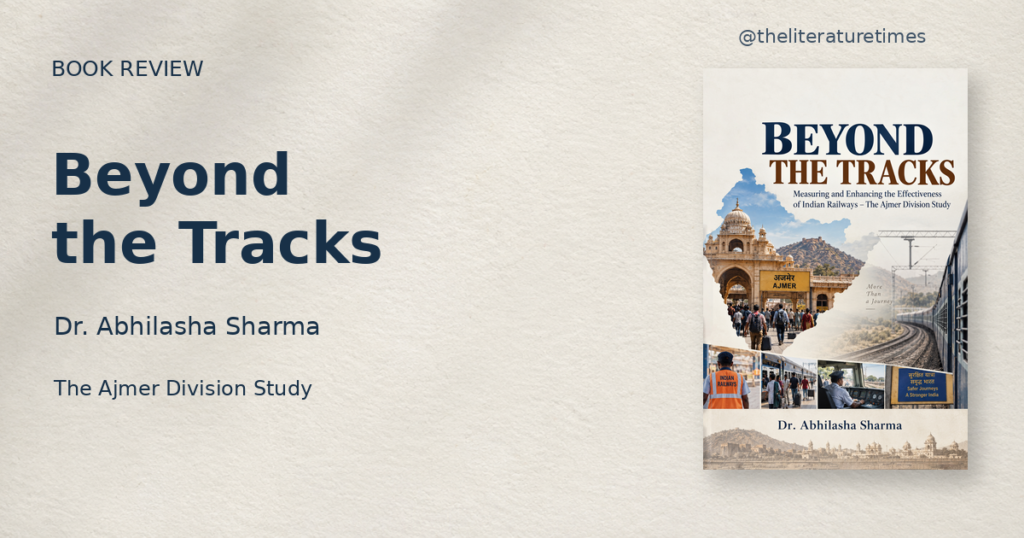
Indian Railways is much more than a transportation network. It is one of India’s largest and most significant public institutions, connecting cities, towns, villages, markets, and communities across the country. Beyond carrying millions of passengers, it plays an important role in economic development, regional connectivity, public service delivery, and national integration. Exploring these broader dimensions, the book by Dr. Abhilasha Sharma offers a comprehensive examination of Indian Railways, focusing on its historical evolution, administrative structure, organisational functioning, and contribution to the development of modern India. With particular reference to the Ajmer Division of North Western Railway, the book presents an insightful study of how a major public institution functions and responds to the expectations of passengers, employees, and administrators.
One of the book’s most important strengths is its historical perspective. It traces the development of Indian Railways from its origins during the colonial period to its transformation into an extensive national institution after Independence. This historical journey helps readers understand how the railway system gradually became an essential part of India’s social and economic structure. The author explores its contribution to nation-building, regional development, economic activities, and national integration. By examining these developments, the book highlights how Indian Railways has evolved beyond its original transportation purpose to become an important instrument of public administration and national progress.
The discussion moves beyond historical developments to examine the administrative and organisational dimensions of railway operations. The author recognises that the effectiveness of such a large institution depends on several interconnected factors, including infrastructure, administrative efficiency, employee participation, passenger satisfaction, and quality of public services. The book explores these elements through different perspectives, offering readers an opportunity to understand the complexities involved in managing a vast public organisation. Rather than looking at Indian Railways only through its infrastructure and operational achievements, it considers the people and administrative systems responsible for keeping the institution functional.
A particularly interesting aspect of the book is its focus on the Ajmer Division of North Western Railway. This regional case study provides a closer understanding of railway administration at the divisional level. Through this perspective, the author examines the everyday experiences of passengers and railway employees while considering the role of administrators in maintaining service quality and organisational effectiveness. The book addresses several important aspects of railway functioning, including passenger amenities, punctuality, safety and security, cleanliness, food services, employee welfare, working conditions, and administrative practices. These subjects are directly connected to the everyday experiences of people who depend on railway services, making the discussion relevant to both general readers and those interested in public administration.
Another notable feature is the research-based foundation of the study. The book incorporates empirical evidence collected from 300 passengers and 300 railway employees, providing a broader understanding of the institution through the experiences of those who use and operate the railway system. These findings are supplemented by interactions with railway officials, field observations, official reports, government publications, and relevant academic literature. This combination of research methods gives the discussion a practical dimension and helps connect administrative theories with real institutional experiences. By including the perspectives of different stakeholders, the author presents a more comprehensive picture of railway administration and the challenges associated with delivering public services effectively.
The examination of passenger services is especially relevant because passenger satisfaction remains an important measure of any public transportation institution. Punctuality, cleanliness, safety, food quality, and the availability of essential amenities influence how people experience railway journeys. The book brings attention to these everyday service-related concerns and places them within the wider framework of institutional effectiveness. It encourages readers to consider how administrative decisions and organisational practices directly affect the quality of services received by the public. This approach makes the study meaningful for understanding the relationship between public institutions and the citizens they serve.
Equally important is the book’s attention to railway employees and their working conditions. Large public organisations depend on the dedication, efficiency, and well-being of their workforce. Employees perform essential responsibilities that contribute to the smooth functioning of railway operations, often within demanding working environments. By examining employee welfare, organisational support, and administrative practices, the author highlights the importance of human resources in institutional development. The discussion suggests that improving public service delivery requires attention not only to infrastructure and technology but also to the people who make the system work.
Dr. Abhilasha Sharma brings considerable academic and research experience to this subject. She is an Assistant Professor in the Department of Political Science and Liberal Studies at JECRC University, Jaipur, and has more than eleven years of experience in teaching, research, and higher education. She holds a Ph.D. in Public Administration from Mohan Lal Sukhadia University, Udaipur, and was awarded a Gold Medal in M.A. Public Administration. She has also received a Doctoral Fellowship from the Indian Council of Social Science Research, New Delhi. Her research interests include organisational behaviour, public policy, administrative reforms, governance, international relations, and institutional effectiveness. Her academic background and engagement with field-based research provide a strong foundation for examining Indian Railways from the perspective of public administration.
The book is particularly valuable for students and researchers of Public Administration, Political Science, Governance, and organisational studies. It can also be useful for academics, railway administrators, policymakers, and readers interested in understanding how major public institutions operate. Its combination of historical discussion, administrative analysis, and empirical research makes it relevant to those seeking a deeper understanding of India’s railway system. The focus on the Ajmer Division also demonstrates how regional-level studies can contribute to a broader understanding of national institutions.
Overall, Dr. Abhilasha Sharma’s work presents Indian Railways as a living institution shaped by history, administration, employees, passengers, and changing public expectations. It moves beyond the conventional understanding of railways as a means of transportation and explores their wider significance in India’s development and governance. By bringing together institutional perspectives and field-based evidence, the book offers a meaningful examination of the strengths, challenges, and responsibilities associated with railway administration. It ultimately reminds readers that the success of a public institution depends not only on its scale and infrastructure but also on its ability to serve people efficiently, responsibly, and consistently.






Your perspective matters
Share your thoughts respectfully. Comments are moderated.