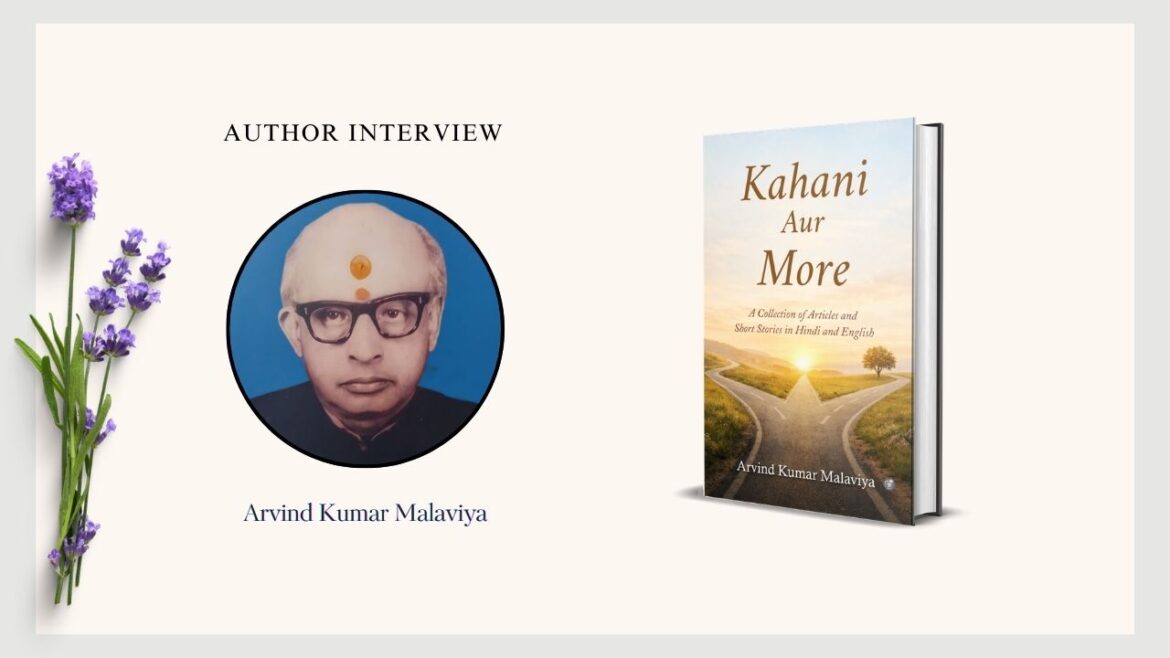
The Literature Times: Your book brings together articles and short stories written over different phases of your life. What inspired you to preserve and publish these writings for today’s readers?
Arvind Kumar Malaviya: Even if an article was written decades ago, the core human emotions—love, grief, ambition, and conflict—remain identical. Bringing these pieces into the light today proves that while the world changes, the essence of our stories does not.
The Literature Times: Kahani Aur More is a unique bilingual collection. How did writing in both Hindi and English shape your creative and intellectual expression?
Arvind Kumar Malaviya: Writing a bilingual collection like Kahani Aur More shapes expression in a very organic way, where the choice of language isn’t a rigid academic decision, but rather a reflection of how the human mind processes different dimensions of life. When a writer creates across both Hindi and English, the two languages don’t compete; instead, they complement each other to create a whole intellectual and emotional ecosystem- The Cultural and Emotional Depth of Hindi, The Analytical Precision of English.
The Literature Times: Many of the pieces in this collection were written between 1970 and 1985. How do you think that era influenced your thoughts and writing style?
Arvind Kumar Malaviya: The period between 1970 and 1985 was a remarkably vibrant, turbulent, and transformative era, both globally and within India. For any writer putting pen to paper during those days, the socio-political climate and cultural shifts acted as a massive crucible, deeply shaping both the subject matter and the very style of their expression.
The Literature Times: As a scholar of Hindi Journalism, how did your academic background contribute to your approach towards writing articles and stories?
Arvind Kumar Malaviya: An academic background rooted deeply in evolution of Hindi literature profoundly shapes how one approaches creative and analytical writing. Journalism and creative literature in Hindi have always shared a deeply intertwined history, historically, the greatest journalists were also the finest novelists, essayists, and poets. For a scholar steeped in this tradition, that academic foundation influences both articles and short stories.
The Literature Times: Your writings cover a wide range of themes and issues. What subjects have always been closest to your heart as a writer?
Arvind Kumar Malaviya: When a writer looks back over a lifetime of work, across different eras and changing times, they usually find that certain core themes act as an anchor. Even when writing across a wide range of issues, a few specific subjects almost always remain closest to the heart like, Hindi journalism, short stories.
The Literature Times: You had the privilege of interacting with the renowned poet Harivansh Rai Bachchan. How did his guidance and friendship influence your literary journey?
Arvind Kumar Malaviya: To be in the orbit of a literary titan like Dr. Harivansh Rai Bachchan—especially during the vibrant decades of mid-20th-century Hindi literature—was nothing short of transformative for any writer or scholar of that era. The greatest lesson Bachchan Sahab imparted to the literary world was that writing does not need to be complex to be profound. Before his era, much of Hindi poetry and formal prose was heavily Sanskritized and distant from the common man. With masterpieces like Madhushala, he proved that the highest philosophical truths could be expressed in words that a common reader could sing, recite, and instantly feel. For a journalist and storyteller, this was the ultimate validation: write with absolute clarity, and let the emotional honesty of your words do the heavy lifting.
The Literature Times: Having worked extensively in language development, translation, and government institutions, what role do you believe language plays in shaping society?
Arvind Kumar Malaviya: From an institutional standpoint, the language used by governance determines who gets to participate in society. When policies, legal texts, and public services are available in the languages people actually speak and think in, it shifts the balance of power. True democracy requires that the common man understands his rights, can communicate with administration without fear, and feels a sense of ownership over public institutions. Transparent, accessible language in governance fosters civic trust and ensures that no citizen is left marginalized by a linguistic barrier.
The Literature Times: While revisiting your old writings, were there any articles or stories that surprised you or felt particularly relevant even today?
Arvind Kumar Malaviya: There are certain articles/ stories that feel particularly relevant even today viz, f“k{kk rFkk ekuoh;rk, laxhr rFkk Je, Hkkjr dk iqjkru jksx&QwV, Language: A Double–Edged Weapon, The British Gift to India, Martyrdom Day (Sept.11) Remembrance- M.A. Jinnah, Let Us Unite to name few.
The Literature Times: What challenges and opportunities do you see for Hindi literature and journalism in the contemporary world?
Arvind Kumar Malaviya: The landscape for Hindi literature and journalism is undergoing one of its most dynamic transformations since the post-independence press expansion. Driven by rapid digital democratization, changing reading habits, and shifting political-economic realities, the field sits right at the intersection of remarkable growth and real structural tension. The transition from physical paper to pixels has broken traditional distribution bottlenecks. Modern writers have championed a conversational, relatable style of storytelling that reflects how urban youth actually speak—a blend of Hindi, local dialects, and everyday English terms. This has brought millions of Gen Z and millennial readers into the fold who previously found classical Hindi (shuddh Hindi) intimidating or disconnected from daily life.
The Literature Times: If readers take away one message or feeling from Kahani Aur More, what would you hope it to be?
Arvind Kumar Malaviya: If readers were to take away just one central message or feeling from Kahani Aur More, the hope would be a profound sense of continuity—the beautiful realization that while time flows relentlessly, true thought, sincerity, and human emotion remain timeless.