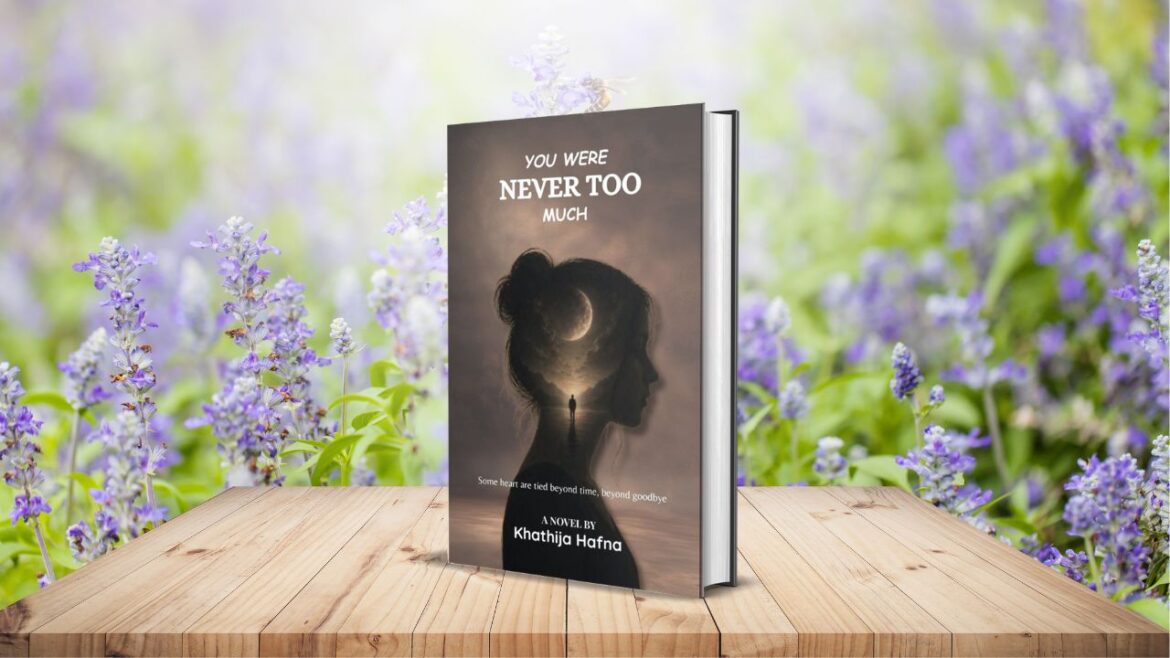
Khathija Hafna’s journey to becoming an author is a testament to the quiet power of dreams that are nurtured over time. Long before she wrote her first novel, she was an avid reader who found comfort, inspiration, and companionship within the pages of countless stories. Those experiences gradually shaped her imagination, strengthened her love for storytelling, and inspired a lifelong aspiration—to one day create a story of her own. With her debut novel, You Were Never Too Much, she transforms that dream into reality, introducing readers to a heartfelt tale that celebrates love, emotional vulnerability, and the courage to embrace one’s true self.
Professionally, Khathija is a graphic designer, a field that has sharpened her creative instincts and appreciation for visual storytelling. Design taught her to communicate emotions through simplicity, balance, and thoughtful details. These same qualities naturally flow into her writing, where every scene, conversation, and emotional moment is crafted with sensitivity and care. Her artistic background enables her to create not only memorable characters but also vivid emotional landscapes that readers can easily connect with.
For Khathija, reading has always been more than entertainment. Books became companions through different stages of life, offering new perspectives, emotional comfort, and endless inspiration. Every novel she encountered reinforced her belief that stories possess the remarkable ability to heal, inspire, and remind readers that their emotions are valid. This realization eventually encouraged her to move beyond being a reader and begin writing the stories that had long lived within her imagination.
Her debut novel, You Were Never Too Much, reflects this deeply personal connection to storytelling. Rather than focusing solely on dramatic events, the novel celebrates the quiet evolution of love—the kind that grows naturally through everyday conversations, shared silences, mutual understanding, and emotional trust. It is a story that recognizes that the strongest relationships are often built not through grand declarations but through countless small moments that gradually become unforgettable.
At the center of the novel are Anaya and Aarav, two individuals whose bond develops with remarkable authenticity. Their relationship unfolds gently, illustrating how love often arrives unnoticed, growing steadily through companionship and emotional closeness. Khathija beautifully captures the subtle transformations that occur when two people become each other’s emotional refuge. The story reminds readers that genuine love is rarely instantaneous; instead, it is built through patience, presence, and the quiet certainty of always finding one’s way back to the person who feels like home.
One of the defining strengths of Khathija’s writing is her ability to portray emotional intimacy with honesty and restraint. She understands that silence can communicate as much as dialogue, and that the smallest gestures often carry the deepest meaning. Her storytelling focuses on emotions that readers may recognize from their own lives—the uncertainty of opening one’s heart, the comfort of being understood, and the hope that comes from finding someone who accepts every part of who we are.
The title, You Were Never Too Much, itself conveys a powerful message of acceptance and self-worth. In a world where many people question whether they are too emotional, too sensitive, or too difficult to love, the novel gently reassures readers that authentic love embraces rather than diminishes individuality. It celebrates the idea that the right people never see genuine emotions as burdens but as beautiful expressions of humanity.
Khathija’s storytelling is characterized by warmth, sincerity, and emotional accessibility. She avoids unnecessary complexity, choosing instead to write in a way that allows readers to become fully immersed in the characters’ experiences. Her language is simple yet expressive, making the emotional journey feel intimate and relatable. Whether describing moments of joy, vulnerability, longing, or quiet reflection, she writes with a sincerity that invites readers to connect deeply with every page.
As a first-time author, Khathija demonstrates remarkable emotional insight. She recognizes that relationships are not defined solely by romance but also by trust, understanding, patience, and emotional safety. Through Anaya and Aarav’s journey, she explores the importance of feeling seen, valued, and accepted without conditions. These universal themes ensure that readers from different backgrounds can find pieces of their own experiences within the story.
Beyond its romantic elements, You Were Never Too Much also reflects Khathija’s belief in the transformative power of storytelling. She hopes her readers will not simply follow the characters’ journey but also discover reassurance within it—that love can be gentle, healing, and accepting, and that vulnerability should never be mistaken for weakness. Her novel encourages readers to embrace both their emotions and themselves with greater compassion.
Khathija’s transition from passionate reader to published author serves as an inspiration to aspiring writers everywhere. Her story demonstrates that dreams often take shape through persistence, patience, and the willingness to believe in one’s creative voice. By transforming years of imagination into a published novel, she has shown that every story worth telling begins with the courage to write the first page.
With You Were Never Too Much, Khathija Hafna introduces herself as a promising new voice in contemporary romance. Her debut combines emotional authenticity, relatable characters, and heartfelt storytelling to create a novel that lingers long after the final chapter. As she embarks on her literary journey, readers can look forward to more stories that celebrate love in its quietest, truest, and most enduring forms—stories that remind us all that we are never too much for the hearts meant to hold us.