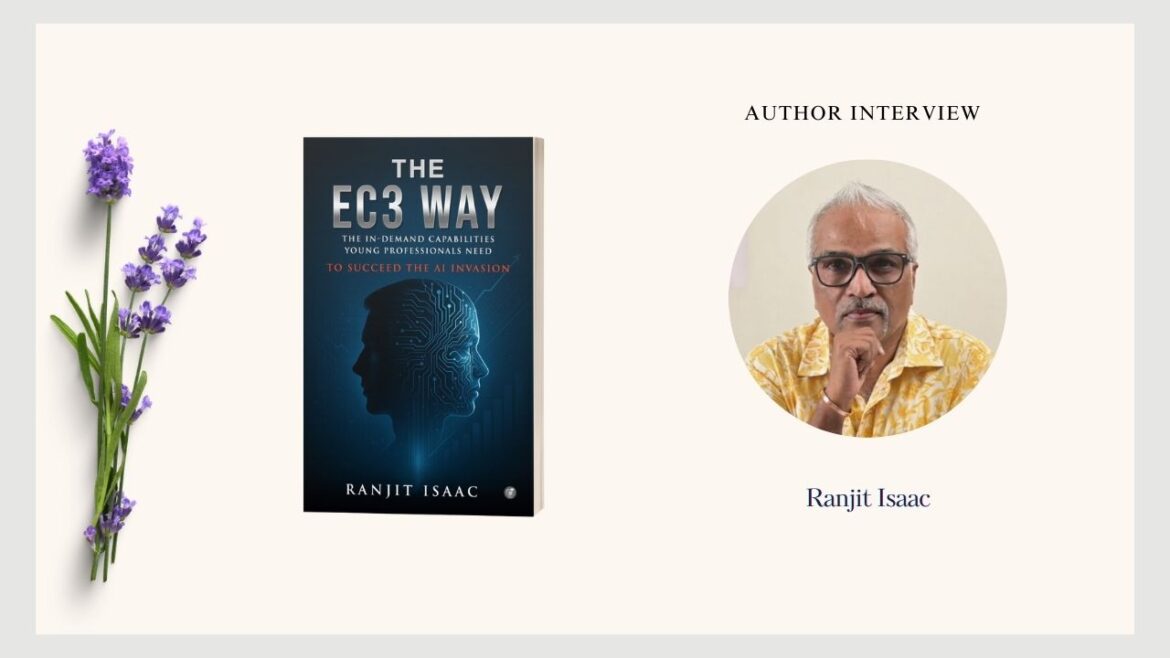
In a world where AI devours routine jobs, retired Group Captain Ranjit Isaac’s book “The EC3 Way” arms young professionals with irreplaceable human superpowers skills: Empathy, Critical Thinking, Creativity, and effective Communication. Launched at his alma mater, NIT Calicut, amid cheers from future leaders, this no-nonsense guide—born from Air Force grit and corporate insights—transforms confusion into career dominance. The Literature Times sits down with the author to unpack why being human beats algorithms every time.
The Literature Times: Congratulations, Group Captain, on the launch of The EC3 Way. What an honour—released at your alma mater, NIT Calicut, with the IIT Palakkad Director presenting the first copy to the NIT Director. Well, the title alone sparks curiosity. What inspired it, and how did your Indian Air Force years shape its core?
Ranjit Isaac: Thank you. NIT Calicut holds a special place in my heart, and launching there amid such an inspiring crowd of professionals and students was a privilege. Moreover, the spark that made this book happen was ignited by the students at NIT.
It grew from the frustration of watching capable young professionals toil endlessly yet feel stuck, confused, and directionless across industries. In the Air Force, we transformed raw recruits into elite air warriors through proven systems. Corporations, on the other hand, often lack them, leaving talent adrift. Hard work without clarity can backfire. It is like a miscalculated flight path, where confusion is unforgiving.
EC3 distils what I’ve learned from decades in training, that is, effort needs direction. Action needs clarity. Choices need ownership. We lived it daily in the Air Force, though it wasn’t labelled as such.
The Literature Times: The subtitle—”The in-demand capabilities young professionals need to succeed in the ‘AI invasion'”—feels timely. Is it a hook for our AI-obsessed world, or does EC3 truly counter the job market shake-up?
Ranjit Isaac: It’s no mere hook. At first glance, it might seem like an AI book, but EC3 is a timeless mindset, not a formula. Technical skills get you hired; human skills like Empathy, Critical Thinking, Creativity, and effective Communication propel you to the stars. Remember, nowadays most hard skills get obsolete like last year’s smartphone, not these. LinkedIn ranks these human skills as today’s must-haves. Business leaders crave them to future-proof their teams.
The Literature Times: Part I shares raw stories of young people. Are they real? How did you gather them, and what’s the key takeaway?
Ranjit Isaac: Most of them are straight from NIT students and other budding pros. These tales of confusion, self-doubt, peer pressure, and comparison ring true for most, we too, would have faced them. Even with Google at their fingertips, Millennials and Gen Alpha grapple with an uncertain future. The message I have is: If you’re lost, you’re not broken—you’re early. Growth starts when you realise you’re not alone in the boat.
The Literature Times: You spotlight internal tools like mindset and habits. Which is most essential for young pros?
Ranjit Isaac: Ownership trumps all—not motivation or confidence. Stop waiting for permission, validation, perfect clarity, and everything shifts. Habits and mindset follow ownership naturally. Without it, even the best advice remains theory. Put simply, ownership is accepting the situation you are in. Like, if you are in “SHIT” (pardon the bluntness), the only way you can get out of it is by accepting it.
Ownership is uncomfortable, but it’s the fastest way out of confusion.
The Literature Times: Translating military leadership for civilian youth—what were the toughest hurdles?
Ranjit Isaac: Removing the uniform, literally and mentally, is not easy. It will be part of your DNA. But then one needs to adapt. Military leadership often comes with hierarchy and authority. Civilian life doesn’t. You can’t order clarity or creativity to come into existence. So, I had to strip these skills to their essence, to help these young professionals in areas like thinking clearly under uncertainty, taking responsibility without supervision, or acting without perfect information.
Once you remove the jargon, the lessons become surprisingly universal.
The Literature Times: How can young professionals spot and shatter self-limiting beliefs in the cutthroat settings of today’s work environment?
Ranjit Isaac: By questioning where those beliefs came from. Most self-limiting beliefs are inherited from parents, peers, society, or comparison. What I call the Standard India Career Playbook, which we are made to believe in from our childhood. They may sound personal, but they’re usually borrowed. The moment someone asks, “Is this actually my belief, or something I absorbed without questioning?” the grip loosens.
Awareness doesn’t solve everything immediately, but it creates space — and space has the power to create
The Literature Times: You tackle growth barriers in your book. What’s the biggest issue for today’s youth?
Ranjit Isaac: “Mind the Gap” is what I call it in the book. Bridging this human-centric skill gap has become such a pressing challenge for young professionals, of today that they don’t realise its absence. Vulnerability is the primary reason that they don’t want to attempt it. This is because when they attempt to cross those skill gaps, it makes them Vulnerable, as there is every possibility of failure, and failure, is something, that is not acceptable in today’s society. That is also called the “Vulnerability Gap”. How we address this gap is the root of many of the issues in our lives.
The Literature Times: As AI reshapes workplaces, how will EC3 evolve?
Ranjit Isaac: It’ll only grow vital. AI owns execution; humans win with their ability to make smart choices, think clearly, and adapt. EC3 isn’t anti-tech—it’s anti-mindless effort. Tools like ChatGPT, Claud, Gemini etc they all if used mindlessly, are dulling our edge. But the EC3 skills trace back to our Homo erectus roots, and the same skills have helped us survive, grow and land on the moon and will manage the AI Invasion to further itself.
Are we not better than the Chimpanzees our closest relative?
The Literature Times: What would be your advice for educators and mentors, and is there a need to build these human skills early?
Ranjit Isaac: We need to stop dictating to our future generations on “What to think”, we need to teach how. Nurture curiosity, it helps develop critical thinking and creativity. Teach how to communicate effectively with better questions and tolerate different views. Let them wrestle with the problem and find solutions.
The good news is that the EC3 skill set can be learned at any age, and “The EC3 Way” shows you the way.
The Literature Times: Post-launch, what’s next in empowering young pros?
Ranjit Isaac: As I said in the book, I came this way by accident. An accident for which I have no regret. Such that it became my “Otaku”. “Otaku” is the Japanese word that describes something that’s more than a hobby, but a little less than an obsession.
I love interacting with the young, bright and curious minds, and that’s what I will continue to do. It has been a great learning experience for me, and realising my grey hair is not inhibiting me in being able to relate with them is a great feeling, and when I see them relating back, it is an even greater feeling. And sometimes, when you add a little value to their lives, it is immensely satisfying. This book is just a part of that journey, which I want to continue. That is to help more young professionals deliver “Performance Beyond Expectations”.