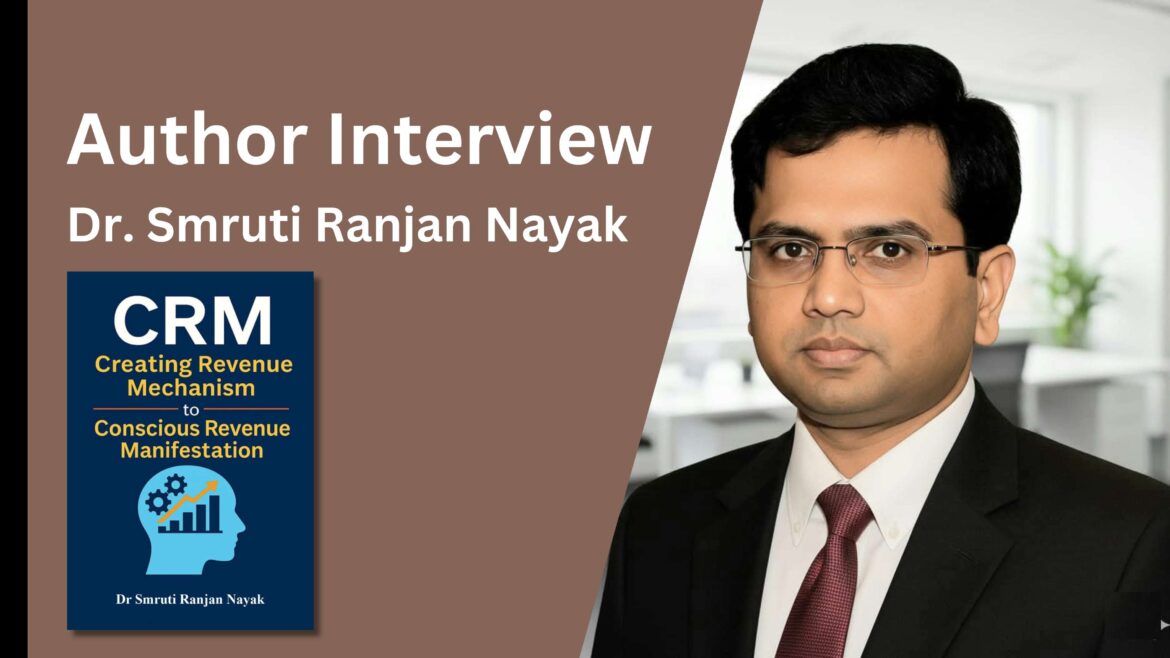
The Literature Times: Your book reimagines CRM not as software, but as a living system. What was the moment that made you see Customer Relationship Management as something fundamentally broken in its current form?
Dr. Smruti Ranjan Nayak: The decisive realisation came when I observed a paradox across multiple organisations: companies were investing millions into CRM platforms, yet revenue volatility, customer leakage, and trust erosion continued almost unchanged. That forced me to ask a deeper question—if this system is truly managing customer relationships, why is it not consistently creating revenue stability? The answer was uncomfortable but clear: CRM had been reduced to a digital record-keeping discipline instead of being treated as a strategic revenue mechanism. Enterprises were storing contacts, tracking opportunities, and generating reports, but they were not architecting customer conviction, continuity, and expansion. In other words, the industry had mastered Customer Relationship Management administratively but had failed to unlock CRM as Creating Revenue Mechanism economically. That conceptual limitation is what I call fundamentally broken.
The Literature Times: You introduce the concept of “Conscious Revenue Manifestation.” For a CEO who has spent decades measuring revenue in numbers and forecasts, what does it practically mean to “manifest” revenue rather than manage it?
Dr. Smruti Ranjan Nayak: Traditional revenue management focuses on outcomes after the fact—quarterly targets, forecasts, bookings, and closure ratios. Conscious Revenue Manifestation shifts the executive lens toward the invisible mechanisms that make those outcomes possible. It means the CEO begins to recognise that revenue is not produced at the point of invoice; revenue is produced long before that through trust accumulation, relevance of engagement, service reliability, memory of customer context, and emotional assurance. When CRM is viewed only as Customer Relationship Management, leaders monitor interactions. When CRM is understood as Creating Revenue Mechanism, leaders engineer the conditions under which interactions repeatedly convert into retention, upsell, advocacy, and predictable financial continuity. So manifestation is not mystical language but it is disciplined causation management.
The Literature Times: The leap from CRM to Conscious Quantum Revenue Mechanism is a bold one. How do you defend the use of the word “quantum” in a business context without it becoming a metaphor without substance?
Dr. Smruti Ranjan Nayak: Because revenue does not move only through significant visible decisions; it moves through microscopic relational shifts. A delayed callback, an unresolved complaint, a forgotten customer preference, a poorly timed proposal, a tone of indifference—these seem operationally small, but commercially they can alter the entire probability of retention or expansion. That is quantum in behaviour: minute interactions producing disproportionate financial effects. My use of “quantum” is therefore not poetic; it is analytical. It recognises that CRM as Creating Revenue Mechanism operates through thousands of subtle trust particles exchanged daily between customer and organisation. Leaders often watch only the macro revenue graph, while the quantum signals causing that graph are happening in every email, every support case, every follow-up, and every silence.
The Literature Times: You argue that data can “breathe empathy.” Critics might say empathy and data are fundamentally incompatible — one is human, one is algorithmic. How do you respond to that?
Dr. Smruti Ranjan Nayak: Empathy becomes commercially powerful only when it is consistent, and consistency requires memory. Data is what gives an organisation memory at scale. If a system can recognise recurring hesitation before renewal, detect dissatisfaction in response patterns, remember service frustrations, and identify moments where reassurance is needed, then the organisation is no longer reacting blindly—it is responding with informed sensitivity. That is where CRM transcends Customer Relationship Management and becomes Creating Revenue Mechanism. Because empathy in this context is not sentimental kindness; it is strategic anticipation. Data allows the enterprise to make customers feel seen, understood, and remembered. And customers who feel remembered stay longer, spend deeper, and advocate wider. That is empathy monetised through intelligence.
The Literature Times: In the book you describe most CRM implementations as producing diminishing returns. What are the specific organisational behaviours that cause that decline, and why do conventional CRM upgrades fail to address them?
Dr. Smruti Ranjan Nayak: Diminishing returns begin when CRM is treated as a reporting obligation instead of a revenue behaviour laboratory. Employees fill records because management demands visibility, not because the organisation seeks predictive understanding. Departments own fragmented pieces of the customer journey, so customer intelligence never matures into customer continuity. Leadership reviews dashboards but rarely converts dashboard observations into redesigned customer actions. As a result, CRM becomes a museum of past transactions rather than a machine for future revenue creation. Conventional upgrades fail because they usually add more automation to the museum. More fields, more workflows, more alerts do not solve the central issue: the company still does not think of CRM as Creating Revenue Mechanism. Until that philosophical upgrade occurs, technical upgrades only make inefficiency look more sophisticated.
The Literature Times: You describe pipelines becoming “purpose lines.” What structural changes inside an organisation are actually required before a pipeline can function that way — beyond a shift in mindset?
Dr. Smruti Ranjan Nayak: A sales pipeline tracks commercial movement; a purpose line tracks firm conviction. To make that shift, organisations must redesign what they measure, what they reward, and what they share internally. Metrics can no longer stop at lead stage, deal size, or closure percentage; they must include trust indicators, retention energy, unresolved friction, referral likelihood, and post-sale engagement health. Incentives must move beyond immediate bookings to customer lifetime expansion. Most importantly, customer intelligence must become enterprise-wide rather than department-bound. When CRM is viewed only as Customer Relationship Management, the pipeline is a sequence of sales tasks. When CRM is viewed as Creating Revenue Mechanism, the purpose line becomes an integrated architecture where every customer touchpoint is intentionally contributing to future revenue durability.
The Literature Times: Your professional background is deeply rooted in the technology industry. Did writing this book put you at odds with colleagues or clients who are invested in the existing CRM paradigm?
Dr. Smruti Ranjan Nayak: To some extent, yes—because mature industries often become comfortable with partial success. The CRM ecosystem has become highly efficient at implementation, migration, customization, reporting, and user adoption. But efficiency in managing a platform is not the same as efficiency in generating revenue continuity. My argument challenges that comfort by saying: we have spent years teaching organisations how to use CRM tools, but not enough years teaching them how to transform CRM into Creating Revenue Mechanism. Naturally, that unsettles conventional thinking. Yet many seasoned professionals privately acknowledge the same frustration: despite sophisticated systems, the customer journey still leaks revenue. My book simply gives language to that silent industry discomfort.
The Literature Times: You draw on emotional analytics as a core concept. Where is the boundary between emotional intelligence as a leadership quality and emotional analytics as a product — and is that boundary safe?
Dr. Smruti Ranjan Nayak: Emotional intelligence is human interpretation; emotional analytics is systemic detection. The former belongs to leadership maturity, the latter belongs to CRM maturity. A conscious CRM should be able to detect hesitation patterns, disengagement rhythms, complaint temperature, and trust decline through behavioural signals. But detection alone is not enough. Human leadership must decide whether the response will be exploitative or supportive. That is the safety boundary. In my framework, emotional analytics is not designed to manipulate customers—it is designed to prevent organisations from becoming emotionally tone-deaf. Because CRM as Creating Revenue Mechanism requires more than transaction intelligence; it requires trust intelligence.
The Literature Times: The book is addressed to CEOs and senior managers. But CRM is usually implemented at the ground level by sales teams and system administrators. How does a conscious revenue philosophy translate from the C-suite to the person updating contact records?
Dr. Smruti Ranjan Nayak: By making every frontline action economically meaningful. The individual updating a contact note is not entering data; they are preserving future revenue context. The support executive logging a complaint is not closing a ticket; they are documenting a trust variable. The sales representative recording hesitation is not updating a field; they are feeding predictive customer intelligence into the organisation. This is where the acronym becomes transformative. Once employees understand that CRM is not merely Customer Relationship Management but Creating Revenue Mechanism, routine entries stop feeling clerical and start feeling strategic. The system becomes a living memory that protects tomorrow’s revenue from today’s forgetfulness.
The Literature Times: If a company adopted every principle in this book faithfully, what would their relationship with their customers look like in five years that it does not look like today?
Dr. Smruti Ranjan Nayak: In five years, customers would no longer feel processed through a system; they would feel continuously understood by an intelligent organisation. Renewals would become less negotiation-driven because confidence would already be compounded. Complaints would become earlier and more constructive because customers would trust that their signals matter. Cross-sell and upsell would feel more natural because relevance would replace generic selling. Most importantly, revenue would become less volatile because customer memory, customer empathy, and customer anticipation would be functioning as one integrated mechanism. That is the future I envision: CRM no longer sitting in the background as Customer Relationship Management software, but operating at the heart of the enterprise as a true Creating Revenue Mechanism.