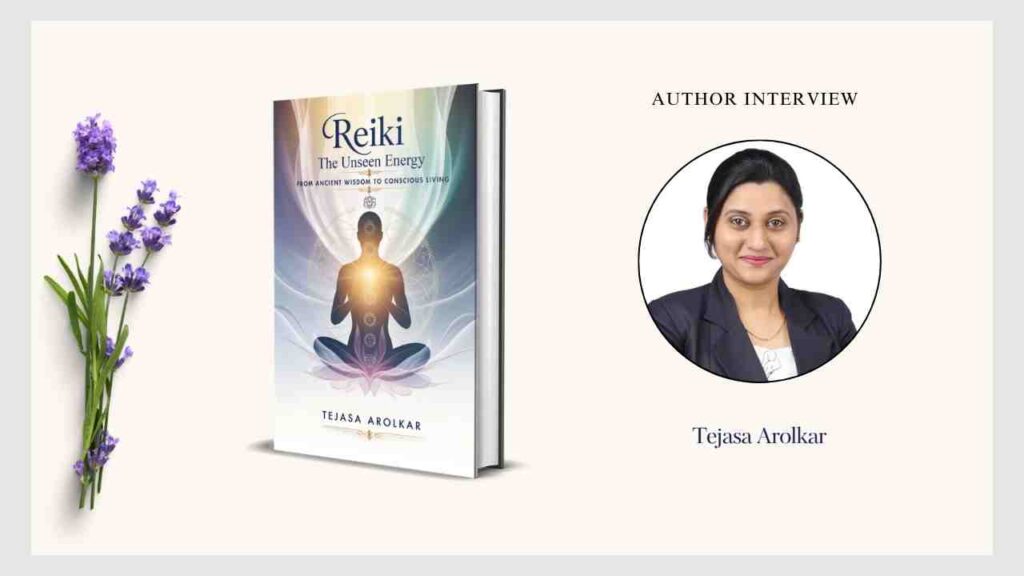
The Literature Times : What inspired you to write Reiki – The Unseen Energy, and why did you feel this message was important to share now?
Tejasa Arolkar :
I have been practicing Reiki for over nine years—first as a student and now as a teacher. During this journey, I realized that while there is a lot of information available, very little connects Reiki with Indian philosophy in a simple and relatable way. Many people today are curious about Reiki and explore different sources, but often find the content either scattered or difficult to understand.
I felt a need to bring everything together in a way that is easy, practical, and relevant to modern life. Reiki – The Unseen Energy is my effort to present this wisdom in a simple language, while still honoring its depth, so that anyone—regardless of background—can understand, connect, and benefit from it.
The Literature Times : Your book beautifully connects Reiki with concepts like karma and awareness. How did your personal experiences shape this perspective?
Tejasa Arolkar: When you begin learning Reiki—or any spiritual modality—you gradually start understanding deeper concepts like karma and awareness through your own experiences. It’s not something theoretical; it unfolds within you over time.
In my journey, I started noticing how every action and experience carries its own energy. What we call ‘karma’ is simply this continuous flow of cause and effect. Even being drawn to Reiki and finding the right teacher feels like part of that journey.
Traditionally, the right age to start learning Reiki is around 12, but in my case, it got delayed, and I learned it at 31. That delay itself became a realization—that everything unfolds at the right time, based on our readiness and life journey.
This understanding helped me shift from asking ‘why is this happening to me?’ to accepting situations with more awareness and grace. And when that shift happens, you don’t just understand karma—you start living with awareness. That’s the perspective I’ve tried to share in my book in a simple and relatable way.
The Literature Times : You describe Reiki as “not something we do, but something we allow.” Can you elaborate on this for readers who are new to Reiki?
Tejasa Arolkar : Reiki works on intention, but it is not about control. When we practice healing, we may set an intention—for example, to heal a particular issue—but we are not forcing a specific outcome.
Instead, we surrender to the energy with a feeling of trust. That’s why we say, ‘for the highest good of all concerned’ and allow Reiki to heal the root cause in its own way.
So, Reiki is not something we do with effort—it is something we allow with openness, where the energy flows where it is truly needed
The Literature Times : The book integrates ancient Indian wisdom with Reiki. How do you see the relationship between Reiki and traditional spiritual teachings like the Upanishads?
Tejasa Arolkar The relationship between Reiki and teachings like the Upanishads feels very natural to me. In my book, I’ve shared the idea that every action—good or bad—eventually has to be experienced. In daily life, we see how patterns keep repeating in areas like relationships, health, or career until we truly understand and accept them.
The Upanishads guide us to live with awareness and acceptance rather than resistance. They teach us to let go of attachment and trust the flow of life. This aligns closely with Reiki, where we don’t control the outcome but allow healing energy to flow for the highest good.
Both Reiki and the Upanishads, in their own ways, point to the same truth—that everything is connected through a universal energy or divine presence. When we move from control to trust, and from attachment to awareness, healing begins naturally
The Literature Times : Many people struggle with meditation. How does Reiki help bridge the gap for beginners trying to develop a meditation practice?
Tejasa Arolkar Meditation often feels difficult because it requires patience—and at the same time, it is meditation that helps us develop that patience. That’s where Reiki can support beginners.
Reiki gently helps calm the mind and body, making it easier to sit and be present. Instead of overthinking ‘how’ or ‘why,’ Reiki teaches you to surrender, trust the process, and simply allow.
For beginners, I always suggest starting small—fix a time and place, sit consistently, and even begin with guided meditations. It’s not about how long you sit, but how deeply you are able to be present, even if just for a few moments.
And if you miss a day, don’t blame yourself. This is a journey of self-growth, not a competition. Reiki helps you approach meditation with more ease, acceptance, and consistency.
The Literature Times : Your personal journey into Reiki is very powerful. Was there a defining moment when you realized this was your life path?
Tejasa Arolkar Yes, there were many moments, but a few stand out very strongly. The first was how effortlessly everything unfolded in the beginning. I learned Reiki Level 1 on 18th March 2017, and by 23rd May 2017, I had become a teacher and even conducted my first class within just two months. The entire journey felt very natural, as if I was being guided at every step.
The second realization came when I was still treating Reiki as a hobby and actively looking for a job. Interestingly, while job opportunities weren’t coming through, I started receiving more and more Reiki clients. That shift made me pause and reflect on where life was leading me.
And the third was during a challenging phase when I had almost decided to leave this path altogether. That experience, which I’ve shared in the book, became a turning point and strengthened my belief in Reiki as my life path. These moments together made me realize that this was not just something I do—it’s something I’m meant to live
The Literature Times : You emphasize ethics and responsibility in Reiki practice. Why is this aspect often overlooked, and why is it crucial?
Tejasa Arolkar I feel this aspect is often overlooked when the focus shifts more towards the commercial side of Reiki rather than its spiritual foundation. While growth and success are natural, we must remember that Reiki is not just a practice—it is also a responsibility.
When we work with energy and people’s well-being, ethics become very important. Qualities like honesty, integrity, and genuine intention should always come first.
Reiki is deeply connected to spirituality, and if we lose that awareness, the practice can become mechanical. That’s why staying grounded in ethics is crucial—it ensures that healing remains pure, respectful, and truly beneficial for everyone involved
The Literature Times : In today’s fast-paced world, how can someone practically incorporate Reiki and awareness into daily life?
Tejasa Arolkar
in today’s fast-paced world, the biggest challenge is not learning Reiki—it’s staying consistent. I’ve seen many people practice for a few days and then stop, mostly due to time constraints.
But the truth is, to live a healthy, balanced, and successful life, giving some time to your inner self is essential. Even 15 minutes a day can make a difference—5 minutes of meditation and 10 minutes of simple chakra healing.
We all have this time, but often it gets lost in scrolling or daily distractions. I’m not saying don’t relax or entertain yourself—but just mindfully set aside these 15 minutes for yourself.
Morning is the best time, because once the day begins, unexpected things can disrupt your routine. Starting your day with Reiki and awareness brings clarity, balance, and over time, you begin to see a real shift within yourself
The Literature Times : What are some common misconceptions about Reiki that you wanted to correct through this book?
Tejasa Arolkar
There are many misconceptions about Reiki that I wanted to address through this book, especially because they can limit a person’s understanding and growth.
For example, in terms of aura—many believe that having a strong aura means being emotionally closed, but in reality, a strong aura allows healthy emotional flow without feeling overwhelmed. Similarly, protection is often misunderstood as blocking energy, whereas true protection is about intelligent filtering. And aura cleansing is not something we do only when we feel low—it is a part of daily self-care.
There are also practical misconceptions in Reiki practice. Some believe that a short 5-minute healing is enough, but true healing requires proper time and presence. Another common belief is that after every healing or attunement, one will always feel happy—but in reality, it depends on individual karma and healing processes. Sometimes, people may even feel low before they start feeling better.
Lastly, many think spiritual awakening is a smooth journey, but it’s not—it can feel like a roller coaster, with ups and downs that ultimately lead to growth.
Through the book, I’ve tried to bring clarity to these misconceptions in a simple and grounded way, so people can approach Reiki with the right understanding and expectations.
The Literature Times : What message would you like readers to carry with them after finishing Reiki – The Unseen Energy?
Tejasa Arolkar
my message to readers is simple—if you feel called to learn Reiki, go ahead and learn it, but more importantly, practice it and live it.
I’ve observed that many people turn to Reiki when they face problems, and once things improve, they stop practicing. But Reiki is not just for difficult times—it is a way of life. When you practice it daily, you create balance within yourself, and many problems begin to resolve naturally, sometimes even without you realizing it.
And yes, you never know—this journey may even lead to a deeper spiritual awakening. But don’t practice with expectations. Simply go with the flow, trust the process, and allow the transformation to happen naturally





Your perspective matters
Share your thoughts respectfully. Comments are moderated.