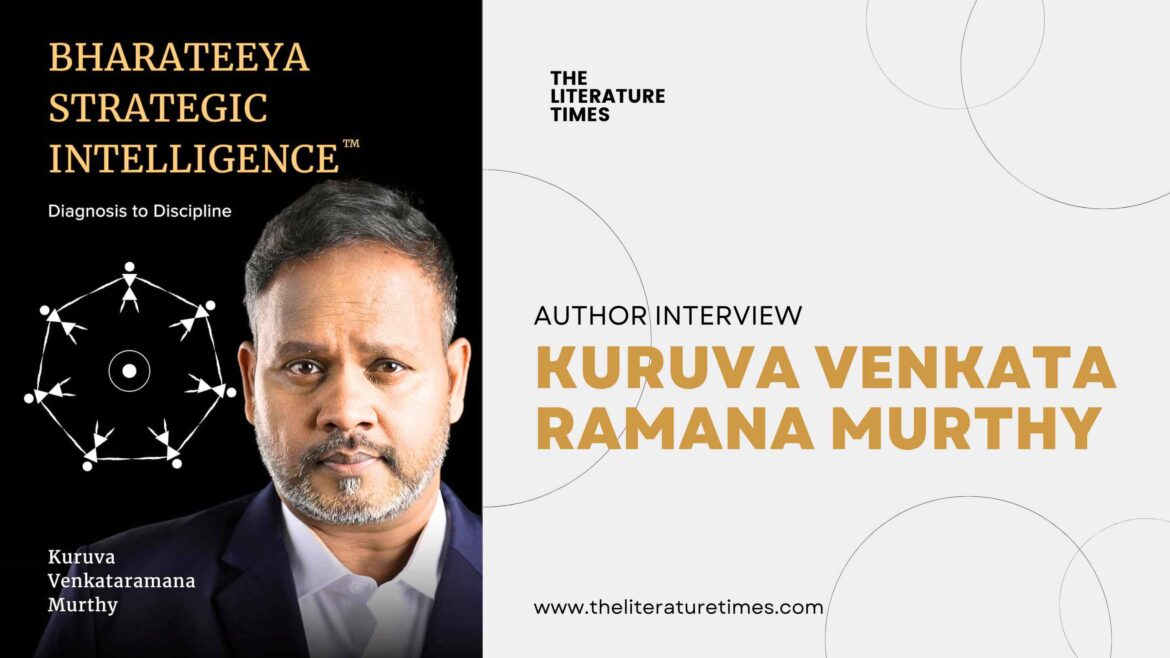
Kuruva Venkata Ramana Murthy is a TEDx speaker, entrepreneur, author, and strategic thinking practitioner dedicatedto helping individuals and organizations make better decisions. He is the Founder of ONEINTHEUNIVERSE (OIU) and the creator of the Bharateeya Strategic Intelligence (BSI) Framework, an indigenous decision-making systeminspired by the timeless strategic wisdom of Bharat. With over two decades of experience working with entrepreneurs, business leaders, professionals, and organizations, he has guided countless individuals from confusion to clarity,enabling them to transform challenges into opportunities through structured thinking and disciplined execution. Murthy is also the author of Inspire. Impact. Ignite. and other works on AI-driven leadership that blend modern management principles with Bharateeya strategic thought. His work is driven by a core belief that the quality of our lives, businesses,and institutions is ultimately shaped by the quality of the decisions we make.
The Literature Times: What inspired you to create the Bharateeya Strategic Intelligence (BSI) framework, and what gap did you see in existing strategic thinking models?
Kuruva Venkata Ramana Murthy: For over twenty years, I worked with entrepreneurs, business leaders, and professionals across different industries. What surprised me was that intelligent people kept making the same mistake. They weren’t failing because they lacked solutions. They were failing because they were solving the wrong problem.
That realization changed everything for me.
I began studying not just modern strategy, but also the strategic wisdom embedded in the Mahabharata, the Ramayana, the Bhagavad Gita, Chanakya’s Artha Shastra, and other Bharateeya traditions. I discovered a pattern. They did notbegin with action. They began with diagnosis. They first understood reality, then chose a direction, aligned people, leveraged strengths, validated assumptions, and finally executed with discipline.
Modern frameworks often start by asking, “What should we do?”
BSI begins with a different question.
“What are we failing to see?”
Because. “The world doesn’t need more strategies. It needs better diagnosis. Bharateeya Strategic Intelligence was born from that conviction.”
That is why I wrote this book.
The Literature Times: In the book, you state that most strategies fail because organizations solve the wrong problem. What led you to this realization?
Kuruva Venkata Ramana Murthy: For years, I believed strategy was about finding better solutions. Experience taught me otherwise.
I watched companies spend crores on marketing when the real problem was their product. I watched organizations invest in training when the real issue was leadership. I watched entrepreneurs work harder when the real issue was direction.
The pattern was always the same.
They were solving symptoms with great efficiency.
That’s when I realized something profound.
The fastest way to fail is to become exceptionally good at solving the wrong problem.
That single insight became the foundation of Bharateeya Strategic Intelligence. Before asking, “What should we do?” BSI asks a more fundamental question: “What is the maximum friction preventing progress?”
Because once you diagnose the right problem, the right strategy often becomes obvious.
Diagnosis doesn’t make strategy easier. It makes strategy possible.
The Literature Times: How does Bharateeya Strategic Intelligence differ from conventional business and management frameworks commonly used today?
Kuruva Venkata Ramana Murthy: Most management frameworks teach you how to solve a problem. BSI first teaches you how to discover the right problem.
That is a fundamental difference.
Traditional frameworks often begin with planning, analysis, execution, or optimization. BSI begins with diagnosis. Because if you diagnose the wrong problem, even brilliant execution takes you in the wrong direction.
The second difference is that BSI is not a collection of tools. It is a thinking discipline. It guides you through seven interconnected stages, from seeing reality clearly to executing with discipline.
Finally, BSI draws from Bharateeya strategic wisdom, not by quoting scriptures, but by extracting timeless principlesand making them practical for today’s leaders, entrepreneurs, and organizations.
I often say,
“Western management has taught us how to do things right. Bharateeya Strategic Intelligence asks whether we are doing the right thing in the first place.”
That question can change the future of an individual, a business, or even a nation.
The Literature Times: The seven stages—Drishti, Nischaya, Bodha, Swadharma, Margarekha, Pramaan, and Sadhana—form the foundation of your framework. Could you briefly explain how these stages work together?
Kuruva Venkata Ramana Murthy: I often tell people that BSI is like building a house.
You don’t begin with the roof. You begin with the foundation.
The seven stages follow the natural order in which every successful strategy should emerge. Drishti helps you see the real problem.
Nishchaya helps you choose one direction.
Bodha identifies the people who will help or hinder that journey.
Swadharma ensures you build on your natural strengths instead of copying others. Margarekha creates the sequence of action.
Pramaan validates whether your assumptions are actually true.
And finally, Sadhana ensures disciplined execution without losing focus.
Each stage answers one critical question. Skip one stage, and every stage that follows becomes weaker.
That’s why I call BSI a strategic discipline, not a checklist.
I want readers to remember just one sentence:
“First see. Then choose. Then align. Then build. Then validate. Then execute.” Strategy isn’t complicated.
The order is everything.
The Literature Times: The book draws inspiration from Bharateeya wisdom. How can ancient principles remain relevant in today’s fast-changing business environment?
Kuruva Venkata Ramana Murthy: Technology changes. Human nature doesn’t. Markets change. Industries change. Artificial Intelligence changes almost every month.
But fear…
greed…
ego…
trust… leadership… conflict…
decision-making…have remained the same for thousands of years.
That is why the Mahabharata is still relevant.
Not because it teaches us how to run a software company.
But because it teaches us how human beings think, choose, lead, and fail.
Bharateeya wisdom is not ancient because it is old.
It is timeless because it deals with what never changes.
BSI doesn’t ask leaders to go back in time.
It asks them to bring timeless principles into today’s boardrooms. I often say,
“AI can process information. Only human intelligence can transform it into wisdom.”
That is why I believe Bharateeya Strategic Intelligence is not about the past.
It is about preparing leaders for the future.
The Literature Times: Can you share a real-life example where correctly diagnosing a problem transformed the outcome for a business or leader?
Kuruva Venkata Ramana Murthy: One incident completely changed the way I think about strategy.
A business owner approached me because his sales had stagnated. He was convinced he had a marketing problem and was preparing to spend a significant amount on advertising.
Instead of discussing marketing, I asked him a simple question:
“What makes you so certain that marketing is the problem?” Over the next few hours, we discovered something unexpected. The issue wasn’t marketing.
It wasn’t pricing.
It wasn’t the sales team.
The real friction was that the business had lost clarity about who its ideal customer was. Marketing was only amplifying that confusion.
Instead of increasing the advertising budget, we first clarified the positioning and the customer. Only then did we scale marketing.
The result wasn’t just better sales.
It was a completely different business trajectory.
That experience reinforced a lesson I now carry everywhere.
Strategy is not about finding better answers. It’s about asking a better first question.
That’s why the first discipline in BSI is Drishti.
Because once you see reality clearly, many difficult decisions become surprisingly simple.
The Literature Times: You emphasize the importance of finding the “single point of resistance.” Why is identifying this point so critical to achieving meaningful results?
Kuruva Venkata Ramana Murthy: Because every system has hundreds of problems…
…but only one Maximum Friction. Most people try to improveeverything. The strategist asks,
“If I could solve only one thing, what would create the biggest shift?”
Think of a river.
You can remove leaves, mud, and branches all day.
But if a fallen tree is blocking the flow upstream, nothing downstream will change. Life is the same.
Business is the same.
Leadership is the same.
The single point of resistance is not always the biggest problem. It is the problem that is creating most of the other problems.
That’s why I call it Maximum Friction.
When you remove Maximum Friction, progress accelerates naturally. You don’t need more effort.
You need less resistance.
I believe that’s one of the biggest lessons in this book.
Extraordinary results rarely come from solving many problems. They come from solving the right one.
The Literature Times: Who do you believe will benefit most from reading Bharateeya Strategic Intelligence: Diagnosis to Discipline—entrepreneurs, corporate leaders, professionals, or students?
Kuruva Venkata Ramana Murthy: People often ask me who this book is for. My answer is very simple.
It is for anyone who has to make decisions.
Whether you’re an entrepreneur deciding where to invest… A CEO setting the company’s direction…
A manager leading a team… A student choosing acareer…
Or even a parent making decisions for a family…
The quality of your life is determined by the quality of your decisions.
And the quality of your decisions is determined by the quality of your diagnosis. That’s why BSI isn’t a business framework.
It’s a thinking framework.
Business is simply one place where thinking becomes visible.
I believe every school should teach students how to think before teaching them what to think. Every organization should teach leaders how to diagnose before asking them to execute.
If this book changes the way you see reality… It will naturally change the way you decide. And when your decisions change…
Your future changes.
The Literature Times: Every chapter includes practical worksheets. Why was it important for you to make the book highly interactive and application-oriented?
Kuruva Venkata Ramana Murthy: Because reading doesn’t change lives.
Reflection does. Application does.
I’ve seen people attend seminars, read dozens of books, and leave inspired… Only to return to the same decisions on Monday morning.
I didn’t want BSI to become another book that people admire and place on a bookshelf. I wanted it to become a book they work through.
That’s why every chapter ends with worksheets. They’re not exercises.
They’re conversations with yourself.
The answers aren’t in the book.
The answers are already within the reader.
The worksheets simply ask the questions most people never pause long enough to ask. I often say,
“Don’t read this book to finish it. Read it to discover yourself.”
If someone completes every worksheet honestly, they won’t just finish a book.
They’ll finish with a different way of thinking.
The Literature Times: If readers could take away just one lesson from this book and apply it immediately in their lives or organizations, what would you want that lesson to be?
Kuruva Venkata Ramana Murthy: I would want them to pause before asking,
“What should I do?”
And instead ask,
“What am I failing to see?”
That one question has the power to change everything. We live in a world obsessed with speed.
BSI reminds us that clarity is more valuable than speed.
Because once you see reality clearly, better decisions follow naturally.
And better decisions create better businesses, better leaders, better relationships, and ultimately, a better life.
If this book can change just one habit, let it be this:
Never rush to solve a problem until you’ve diagnosed the right one.
Because…
The quality of your future will never exceed the quality of your diagnosis.
If readers remember that one sentence long after they close the book… I’ll consider this book a success.
“I didn’t write this book to give people more answers. I wrote it to help them ask better questions. Because better questions create better decisions, and better decisions create better lives.”