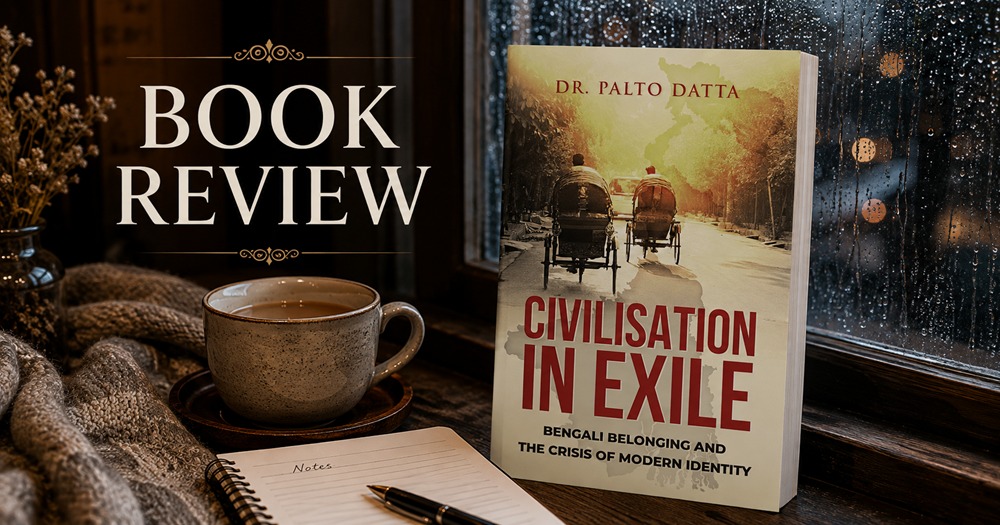
Dr. Palto Datta’s Civilisation in Exile: Bengali Belonging and the Crisis of Modern Identity is a thoughtful and intellectually engaging exploration of identity, migration, culture, and belonging in an increasingly globalised world. Rather than treating exile simply as the physical experience of living away from one’s homeland, Datta presents it as a deeper psychological and cultural condition. Through philosophical reflection, historical observation, and personal experience, the book examines what happens when individuals find themselves caught between inherited traditions and the rapidly changing realities of modern life.
One of the book’s greatest strengths is the relevance of its central question: what does it truly mean to belong? For members of the Bengali diaspora, particularly those living in Britain, geographical distance from the Motherland can create complex questions about identity and cultural continuity. Datta explores this tension with sensitivity, examining how migration can bring opportunity, education, mobility, and professional success while simultaneously creating feelings of cultural displacement. The book therefore avoids presenting migration as either wholly positive or negative, instead recognising its complicated emotional and intellectual consequences.
Datta’s discussion of Bengali identity is particularly compelling because it moves beyond simple definitions of nationality. Identity emerges as something shaped by language, memory, history, literature, family, place, and collective experience. For those living away from their cultural homeland, these elements can become both anchors and sources of conflict. The question is not simply whether one belongs to Britain or Bengal, but whether it is possible to inhabit both worlds without losing an essential part of oneself.
The book gains further depth through its engagement with major figures of Bengali intellectual and literary heritage, including Rabindranath Tagore and Michael Madhusudan Dutt. Their presence allows Datta to place contemporary questions of diaspora within a much longer history of Bengali cultural thought. Rather than treating heritage as something fixed in the past, he considers how cultural traditions evolve when they encounter new languages, societies, ideas, and economic realities.
The contrast between the vibrant streets of East London and the intellectual legacy of Bengal is especially effective in illustrating the book’s central tension. East London represents the contemporary multicultural environment in which diaspora communities build new lives, while Bengali literary and cultural traditions represent inherited connections to a civilisation that continues to shape collective consciousness. The meeting of these worlds creates both enrichment and uncertainty.
A particularly important argument in Civilisation in Exile is that modern exile can be psychological as much as geographical. A person may physically live in one country while emotionally remaining connected to another. Conversely, prolonged distance and cultural change can gradually create a sense of estrangement from the homeland itself. This makes belonging a fluid and sometimes uncomfortable experience. Datta captures this complexity by presenting exile not merely as separation from a place, but as a negotiation between different versions of the self.
The book is also critical of the pressures created by globalisation and the marketplace. In a world increasingly shaped by consumer culture, technological advancement, and rapid social change, traditional cultural values can become vulnerable to being reduced to commodities or nostalgic symbols. Datta questions what happens when cultural heritage survives only as performance or memory rather than as a living part of everyday consciousness. This gives the book a wider relevance beyond the Bengali diaspora, as many communities around the world face similar challenges.
Another strength is the combination of philosophical and personal perspectives. The book does not approach identity purely as an academic subject. Its reflections remain connected to human experience—the memories people carry, the traditions they inherit, the places they leave, and the communities they attempt to build elsewhere. This makes the discussion more accessible and emotionally resonant.
From a critical perspective, the book’s reflective and philosophical approach may appeal more strongly to readers interested in cultural studies, diaspora literature, identity, history, and social philosophy than to those seeking a conventional narrative. Its value lies in the questions it raises rather than in providing simple conclusions. Datta encourages readers to pause and reconsider assumptions about nationality, belonging, civilisation, and cultural continuity.
The author’s extensive academic and professional background also contributes to the book’s intellectual breadth. His experience across higher education, marketing, research, and contemporary social issues allows him to approach cultural questions from multiple perspectives. However, the book’s most important achievement is that its scholarship remains connected to a recognisably human concern: the desire to retain a sense of self while navigating a changing world.
Ultimately, Civilisation in Exile is a significant reflection on what happens when culture travels. It asks whether civilisation is something rooted in geography or something carried within memory, language, values, and consciousness. By focusing on the Bengali diaspora while addressing universal questions of identity and displacement, Dr. Palto Datta creates a work that extends beyond one community.
Thought-provoking, reflective, and culturally rich, Civilisation in Exile: Bengali Belonging and the Crisis of Modern Identity is a valuable contribution to conversations about migration and identity. Its central insight—that exile can exist within the mind as much as on a map—gives the book its lasting relevance. In a world where people increasingly cross borders while carrying multiple cultural identities, Datta’s work encourages readers to reconsider not only where they belong, but what they choose to preserve, remember, and become.