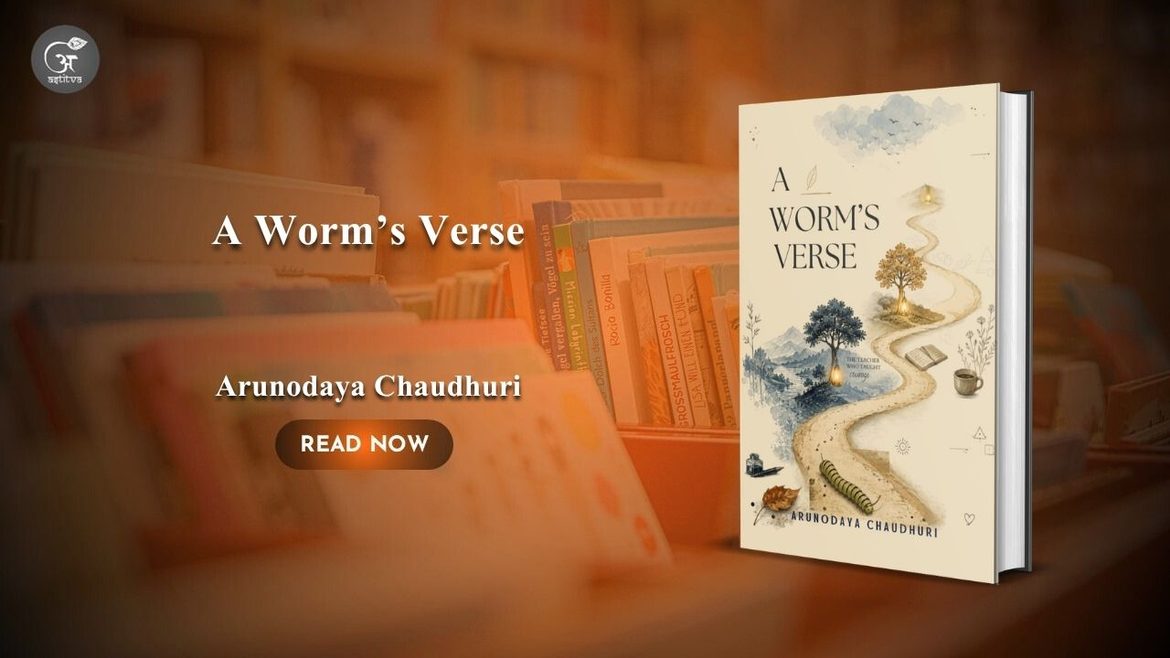
A Worm’s Verse by Arunodaya Chaudhuri is an unconventional literary work that brings together poetry, social observation, political consciousness, and a deeply personal engagement with form. Described as a novella in verse, the book emerges from the author’s desire to explore a literary structure that allows rhyme, rhythm, and conversation to coexist naturally.
The unusual form of A Worm’s Verse was one of the reasons Professor Ananda Lal encouraged the author to write about the work and explain his creative choices. Rather than following the conventions of prose fiction or traditional poetry, Chaudhuri deliberately chose a form that would give him the flexibility to tell a sustained story while retaining the musical and expressive qualities of verse.
The roots of this approach can be traced to three influential teachers who shaped the author’s understanding of language and literature. Rev. K.T. Grogan, S.J., his English teacher during school, was a strong advocate of simple prose. For a student who did not grow up in an English-speaking household, mastering such prose became a demanding and lifelong process. That early discipline appears to have influenced Chaudhuri’s decision to keep the language of A Worm’s Verse accessible, direct, and grounded in everyday words.
At St. Xavier’s College, Calcutta, Professor P. Lal encouraged him to explore his universe. Chaudhuri’s universe, however, is not limited to private emotions or personal experiences. It is predominantly social and political, shaped by the realities around him and by his refusal to remain detached from them. His writing therefore becomes an attempt to observe society through his own individual prism.
His education at the University of Calcutta brought another important influence through Dr. R.K. Sen, who introduced him to the idea that literature extends far beyond romanticism. Dr. Sen’s emphasis on neoclassical literature as fundamentally a search for form became another lasting influence. In A Worm’s Verse, these three strands of learning come together: simplicity of language, exploration of the surrounding universe, and a conscious search for literary form.
The result is a work that is deliberately conversational yet poetic, structured yet flexible. Chaudhuri uses rhyme without allowing it to restrict the movement of the narrative. The everyday quality of the language creates an approachable reading experience, while the social and political perspective gives the work greater depth.
Arun Chaudhuri brings to this literary experiment more than four decades of experience in advertising, having worked with leading agencies including Clarion, OBM, and Campaign. His professional writing includes Revaluation, ITC versus BAT, Indian Advertising 1780 to 1950, published by Tata McGraw Hill in 2009, and Indian Advertising: Laughter and Tears, published by Niyogi Books in 2014.
His literary work extends across poetry and theatre. He has published poetry collections including Talking Trees and Other Tales, Poems in Protest, and Don’t Ask Why. His plays include Eleven New Plays, Eleven More Plays, Faceless, and Canvas.
With A Worm’s Verse, Chaudhuri continues his exploration of literature through an original and carefully chosen form. The book invites readers to experience the world through the author’s distinctive prism—one that combines simplicity, observation, social awareness, humour, and an enduring curiosity about what literature can become when form itself becomes part of the story.