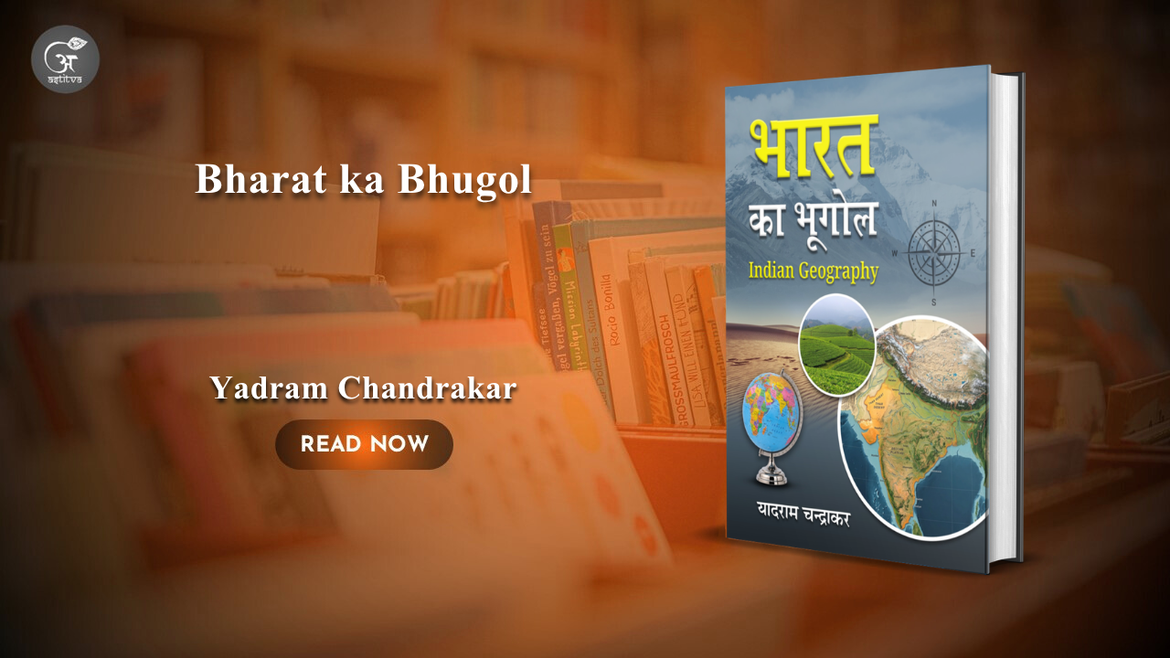
Understanding a nation begins with understanding its land, history, identity, and geographical character. Bharat Ka Bhugol, authored by Yadram Chandrakar, is an informative and educational work that brings together India’s historical identity and geographical foundations in a structured and accessible manner. The book offers readers an opportunity to explore Bharat not merely as a geographical territory, but as a land shaped by an ancient civilization, diverse landscapes, and a rich historical heritage.
One of the important aspects explored in the book is the origin and historical identity of the name India. Throughout history, the land has been known by several names, including Bharatvarsha, Jambu Dweep, Aryavarta, Hind, and Hindustan. Each name carries its own historical, cultural, and civilizational significance. The book introduces readers to these names and examines the references associated with the term “Bharat,” including its presence in the Vedic tradition and ancient scriptures.
By presenting these historical references alongside geographical information, Bharat Ka Bhugol encourages readers to understand the connection between India’s identity and its physical landscape. The book demonstrates how geography is not simply about maps, boundaries, rivers, mountains, and coordinates; it also contributes to understanding the historical development and character of a nation.
A significant portion of the book focuses on the physical and geographical dimensions of India. Readers are introduced to important information concerning India’s total area, geographical location, boundaries, coastline, and its position in the Northern and Eastern Hemispheres. The book also presents India’s remarkable geographical extent, from Ladakh in the north to Kanyakumari in the south, and from Arunachal Pradesh in the east to Gujarat in the west.
India’s geographical diversity is one of its defining characteristics. From the Himalayan region and northern plains to plateaus, deserts, coastal areas, and varied climatic zones, the country encompasses an extraordinary range of physical features. Understanding this diversity is essential for students preparing for competitive examinations as well as for readers seeking a broader understanding of the nation.
The book is particularly relevant for students, researchers, competitive-examination aspirants, and general readers interested in Indian geography, history, civilization, and national identity. Its balanced approach combines historical facts with geographical knowledge, making complex areas of study easier to approach and understand.
The author, Yadram Chandrakar, is an educator, author, and founder of Sanskar Sankalp UPSC CGPSC Online Classes. With a strong commitment to competitive-examination education and constitutional studies, he has dedicated his efforts to guiding students preparing for UPSC, state-level examinations, and other government competitive examinations.
His first published work, Bharatiya Samvidhan Evam Rajvyavastha, was developed with a strong focus on the NCERT syllabus from Classes 6 to 12, Previous Year Questions (PYQs), competitive-examination patterns, and current affairs. The book addresses important constitutional concepts such as constitutionalism, federalism, separation of powers, natural justice, constitutional amendments, and the structure of Indian governance.
Through both teaching and writing, Chandrakar seeks to make complicated subjects simple, systematic, and accessible to students. His approach reflects an understanding that effective education is not merely about collecting information but about developing clarity and a strong conceptual foundation.
With Bharat Ka Bhugol, the author continues this educational journey by turning his attention toward India’s geographical structure and historical foundations. The book adds another dimension to his contribution to competitive-examination preparation and knowledge building.
Ultimately, Bharat Ka Bhugol is an effort to help readers look at India through both geographical and historical perspectives. By exploring the names, heritage, location, boundaries, dimensions, and geographical diversity of the country, the book encourages a deeper appreciation of the land that has been home to one of the world’s oldest and richest civilizations.
For students, it can serve as a useful foundation for geographical learning; for general readers, it offers an engaging introduction to the physical and historical dimensions of Bharat. Most importantly, the book seeks to strengthen the reader’s understanding of how land, history, culture, and national identity come together to shape a nation.