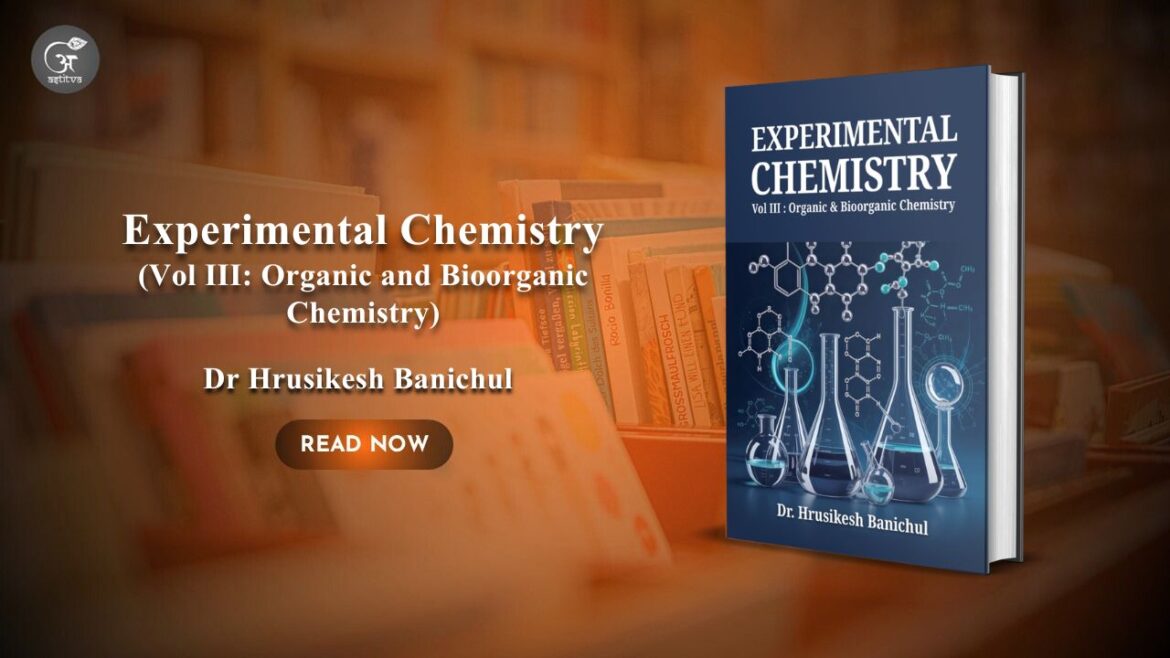
The release of Experimental Chemistry (Vol III: Organic and Bioorganic Chemistry) by marks another important milestone in chemistry education and laboratory training. Designed as a comprehensive laboratory guide, this volume provides students with a modern and systematic approach to organic and bioorganic chemistry, combining practical experimentation with advanced analytical understanding.
Organic chemistry is often considered one of the most fascinating yet challenging branches of science because it connects chemistry directly to life processes, pharmaceuticals, biomolecules, and modern industrial applications. Recognizing the need for a practical and application-oriented learning approach, Experimental Chemistry Vol III has been developed to help students move beyond theoretical learning and gain real laboratory expertise.
Unlike traditional recipe-based laboratory manuals, this book emphasizes scientific reasoning, systematic identification, and analytical interpretation. It provides students with a clear roadmap for detecting unknown organic compounds and preparing derivatives for characterization. This structured approach encourages learners to think critically, analyze carefully, and develop confidence in laboratory investigation.
One of the standout features of the volume is its focus on modern instrumentation and spectroscopic analysis. Dedicated chapters on IR (Infrared) and NMR (Nuclear Magnetic Resonance) spectroscopy help students understand how laboratory observations connect with advanced analytical data. These techniques are essential in modern chemical research, pharmaceutical analysis, and industrial quality control. By introducing these concepts in an accessible and practical format, the book prepares students for advanced academic and professional applications.
The integration of bioorganic and clinical analysis further enhances the uniqueness of the book. Students are introduced to experiments related to natural product isolation and clinical chemistry applications, making the volume highly valuable for learners in biochemistry, pharmacy, life sciences, and pre-medical studies. This interdisciplinary approach reflects the growing importance of chemistry in healthcare, biotechnology, and medical research.
Another major highlight of the book is its emphasis on Green Chemistry. In today’s world, scientific progress must go hand in hand with environmental responsibility. The dedicated chapter on sustainable synthesis teaches students how to minimize environmental impact while performing chemical experiments. By promoting eco-friendly laboratory practices, the book encourages a new generation of scientists to pursue innovation responsibly and ethically.
The language and structure of the book have been designed to support both undergraduate and advanced learners. Laboratory procedures are presented with clarity and precision while maintaining academic depth. Teachers, instructors, and institutions will also find the book highly useful as a teaching and reference resource.
As scientific education continues to evolve, practical competence and analytical skills have become essential for students pursuing careers in chemistry, pharmaceuticals, biotechnology, healthcare, and research. Experimental Chemistry Vol III equips learners with the technical knowledge, laboratory discipline, and scientific mindset required to excel in these fields.
The release of this volume represents an important contribution to modern chemistry education. By combining systematic experimentation, advanced instrumentation, bioorganic applications, and sustainable practices, the book provides a holistic laboratory learning experience for aspiring scientists and researchers.
With its innovative and student-focused approach, Experimental Chemistry (Vol III: Organic and Bioorganic Chemistry) is set to become an invaluable companion for learners seeking to master the practical and analytical dimensions of modern chemistry.