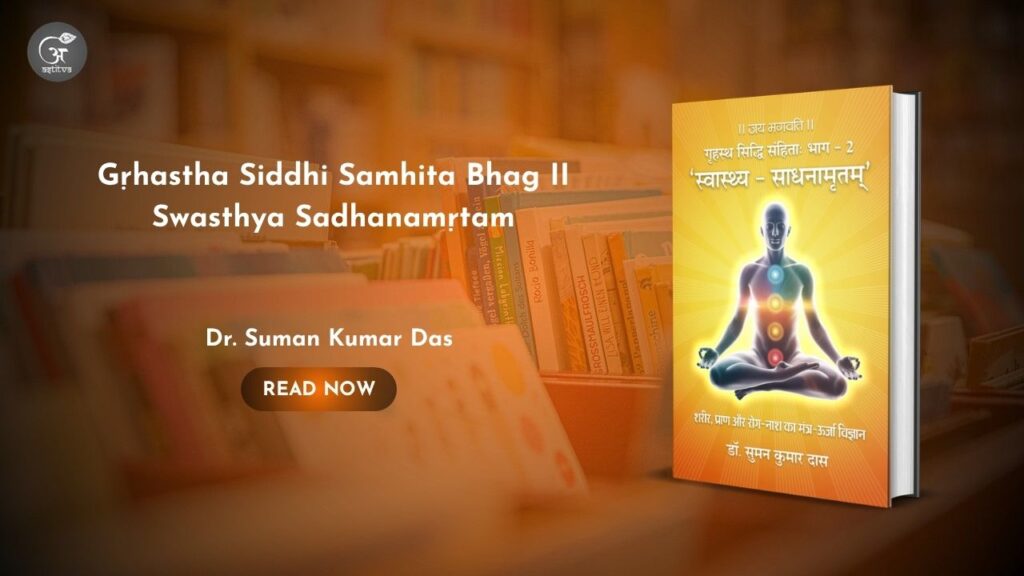
Gṛhastha Siddhi Samhita – Bhag II: Swasthya Sadhanamṛtam emerges as a remarkable contribution to the evolving dialogue between ancient Vedic wisdom and contemporary approaches to holistic well-being. In a world where health is often reduced to biochemical parameters and clinical interventions, this book reminds us that the human body is far more than a physical structure—it is a living field of energy, vibration, consciousness, and subtle rhythms. Through its deep exploration of Sharir, Prana, and Rog Naash, the text invites readers into a transformative understanding of health rooted in the science of mantra, intention, and inner alignment.
At the heart of this work lies the richly articulated concept of Mantra Urja Vigyan—a discipline that views mantras not as symbolic recitations or cultural traditions, but as potent tools of vibrational healing capable of influencing neurochemistry, pranic flow, cellular coherence, and emotional balance. Drawing on decades of research, sadhana, and lived experience, the author demonstrates how sound frequencies carry precise energetic signatures that can support healing when applied with awareness, discipline, and sincerity. Mantras, in this lens, become instruments that recalibrate both the gross and subtle layers of being.
The book also offers rare clarity on the interconnectedness of body and prana. It explains how every thought, emotion, breath, and intention shapes the energetic architecture of the human system. When prana is balanced, the body thrives; when prana is obstructed or depleted, disease manifests long before medical diagnostics can detect it. This understanding shifts the reader’s perspective from merely treating symptoms to recognizing and restoring the natural flow of vitality.
What makes this text especially valuable is its integration of ancient practices with contemporary scientific insights. Instead of treating traditional knowledge as mythology or metaphor, the author contextualizes it within the frameworks of neurophysiology, psychosomatics, and energy medicine. The result is a compelling bridge between worlds—where mantra japa is shown to affect neural pathways, pranic discipline influences hormonal stability, and meditation recalibrates the body’s bioelectrical fields. This synthesis makes the work accessible not only to spiritual seekers but also to researchers, therapists, and wellness practitioners seeking grounded, evidence-informed approaches.
The book is not conceptual alone—it is deeply practical. Readers will find structured protocols, guidance on mantra application, principles of pranic balance, and lifestyle frameworks designed specifically for householders who aspire to spiritual alignment while fulfilling worldly responsibilities. True to the essence of the Gṛhastha Siddhi Samhita, it empowers everyday individuals to cultivate health and inner stability without renouncing their lives, careers, or duties.
What distinguishes this work is its philosophical depth. Illness is described not as a punishment, failure, or merely a biological anomaly, but as a disturbance in the harmony of energy—an invitation to introspection, correction, and deeper alignment. Healing, then, becomes an act of returning to one’s natural state of coherence, where body, prana, and consciousness operate in unified rhythm. Through this lens, Swasthya (health) is not the absence of disease but the presence of integrated well-being across physical, mental, emotional, and spiritual dimensions.
Much like the ancient treatises that inspired it, the book encourages readers to not only treat ailments but also evolve. It guides one towards an internal journey—from imbalance to equilibrium, from restlessness to clarity, from suffering to self-realization. In this way, the text is not merely instructive; it is transformative.
Behind this profound work stands Dr. Suman Kumar Das, also known as Swami Sumananand Nath—a man whose life journey reflects an extraordinary synthesis of intellectual rigor, spiritual discipline, and innovative thought. With over thirty years of experience spanning international business, research, and intense sadhana, Dr. Das brings a rare multidimensionality to his writing. His return to India after an extensive global career marks the beginning of a deeper mission: to integrate Vedic wisdom with modern knowledge for the creation of conscious, sustainable, and spiritually aligned living systems.
As the Founder-Peethacharya of Lalita Divyashram in Khajuraho—an exceptional Mahavidya Siddha Peeth—his work extends across Mantra Yoga, Vibrational Healing, and regenerative agriculture rooted in cow-centric ecological principles. His initiatives have guided countless seekers toward inner healing, energetic balance, and higher awareness. A prolific author, Dr. Das continues to contribute significantly to discourses on spirituality, ecology, health, and holistic prosperity.
Together, the book and its author remind us that the pursuit of wellness is ultimately the pursuit of inner harmony. Gṛhastha Siddhi Samhita – Bhag II: Swasthya Sadhanamṛtam stands as a powerful guide for anyone seeking not only to understand health differently but to live differently—with deeper awareness, aligned energy, and awakened consciousness.







Your perspective matters
Share your thoughts respectfully. Comments are moderated.