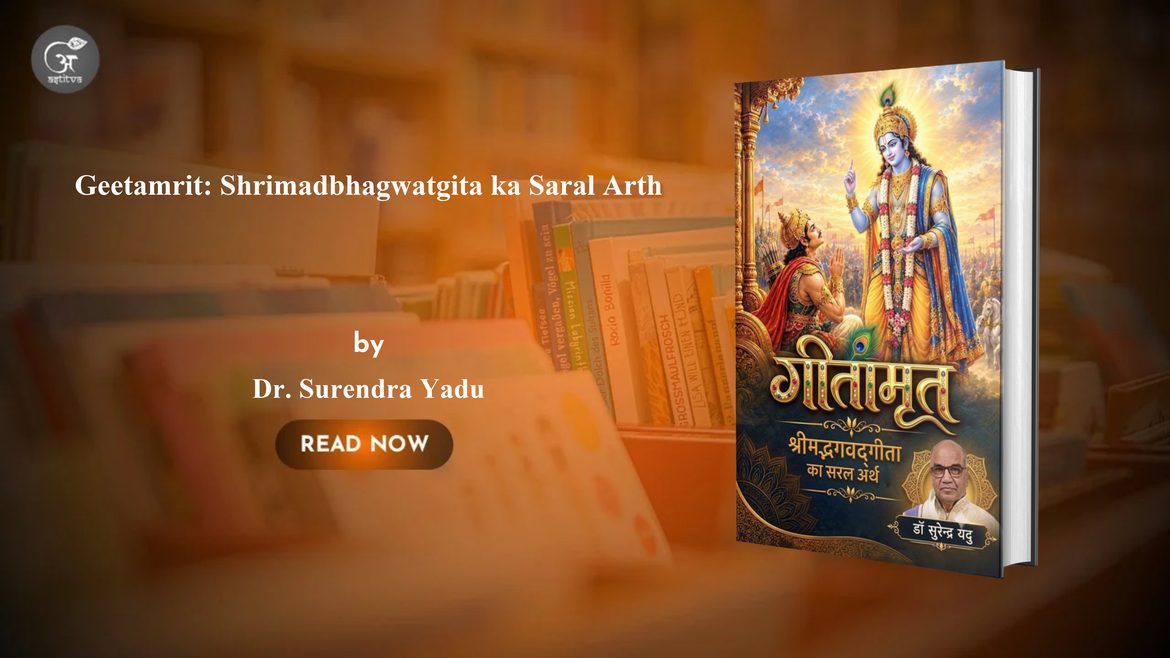
In a world increasingly shaped by competition, uncertainty, anxiety, and the relentless pursuit of material success, the search for inner peace and meaningful direction has become more important than ever. Addressing this universal human need, Dr. Surendra Yadu presents his thought-provoking book, Geetamrit: Shrimadbhagwatgita ka Saral Arth, an accessible interpretation of the timeless wisdom contained in the Shrimad Bhagavad Gita.
Written in simple and understandable Hindi, the book seeks to bring the profound philosophical teachings of the Bhagavad Gita closer to ordinary readers, including students, young adults, and individuals who may find traditional Sanskrit scriptures or scholarly commentaries difficult to understand.
More than a religious interpretation, Geetamrit presents the Bhagavad Gita as a practical philosophy of life, offering guidance on duty, courage, self-awareness, emotional strength, and the pursuit of a meaningful existence.
The Timeless Nectar of the Bhagavad Gita
The title Geetamrit beautifully represents the central philosophy of the book. The word combines Geeta, referring to the sacred teachings of Lord Krishna, and Amrit, meaning nectar or a life-giving essence.
The inspiration behind the book emerges from one of the most significant moments in the Mahabharata: the conversation between Lord Krishna and Arjuna on the battlefield of Kurukshetra.
Standing between two opposing armies, Arjuna finds himself overwhelmed by emotional conflict, uncertainty, grief, and moral confusion. Unable to reconcile his responsibilities with his personal attachments, he loses the determination to fight.
At this critical moment, Lord Krishna imparts the wisdom of the Bhagavad Gita, guiding Arjuna toward clarity, self-understanding, courage, and an awareness of his duties.
Through these teachings, Arjuna regains his inner strength and becomes capable of fulfilling his responsibilities in the great battle of the Mahabharata.
Dr. Surendra Yadu draws inspiration from this transformation, presenting the Bhagavad Gita as a source of wisdom capable of helping individuals confront their own struggles with greater confidence and understanding.
Why the Bhagavad Gita Matters in Modern Life
One of the central themes of Geetamrit: Shrimadbhagwatgita ka Saral Arth is the relevance of ancient philosophical wisdom in contemporary society.
Modern life is often characterised by intense competition, professional pressure, financial uncertainty, changing social values, and concerns about the future. These circumstances can leave individuals feeling confused, anxious, emotionally exhausted, or disconnected from their sense of purpose.
Young people, in particular, frequently encounter difficult questions concerning education, careers, relationships, personal identity, and social expectations.
The author expresses concern about the increasing vulnerability of young individuals to discouragement, misleading influences, and destructive coping mechanisms, including substance abuse.
Against this background, Geetamrit encourages readers to explore the teachings of the Bhagavad Gita as a means of developing self-discipline, emotional resilience, thoughtful decision-making, and a stronger sense of responsibility.
Rather than treating the scripture as a collection of abstract religious instructions, the book emphasises its potential application to everyday challenges.
Its central message is that the wisdom of the Gita can help individuals examine their circumstances, understand their responsibilities, and approach life’s difficulties with greater balance and clarity.
Making Profound Knowledge Simple and Accessible
Although the Bhagavad Gita is among the most widely studied philosophical and spiritual texts in the world, understanding its deeper meaning can be challenging for many readers.
Originally composed in Sanskrit, the scripture contains philosophical concepts, specialised terminology, and layers of meaning that are not always easily conveyed through literal translation.
Numerous translations and commentaries are available in Hindi and other languages. However, as Dr. Surendra Yadu observes, understanding the literal meaning of individual words does not necessarily lead to a complete understanding of the philosophical ideas behind them.
Many traditional commentaries, while intellectually valuable, employ complex language and detailed scholarly explanations that may discourage readers unfamiliar with philosophical or scriptural studies.
Recognising this difficulty, the author has developed Geetamrit with a clear objective: to make the essential teachings of the Bhagavad Gita easier to understand without losing sight of their philosophical depth.
The book explains important concepts in straightforward Hindi and uses familiar expressions to communicate ideas that might otherwise appear complicated.
Where necessary, examples and illustrations are incorporated to clarify the underlying meanings and demonstrate their relevance to practical life.
This thoughtful approach makes the book particularly valuable for readers seeking an introduction to the teachings of the Bhagavad Gita.
A Thoughtful Balance Between Language and Philosophy
A distinguishing feature of Geetamrit is its emphasis on linguistic simplicity and clarity.
Dr. Surendra Yadu has chosen a style that remains rooted in Hindi while avoiding unnecessarily complicated expressions. The language is intended to be grammatically sound, natural, and accessible to a broad readership.
At certain points, the author also incorporates familiar Urdu words commonly used in everyday conversation. This approach reflect