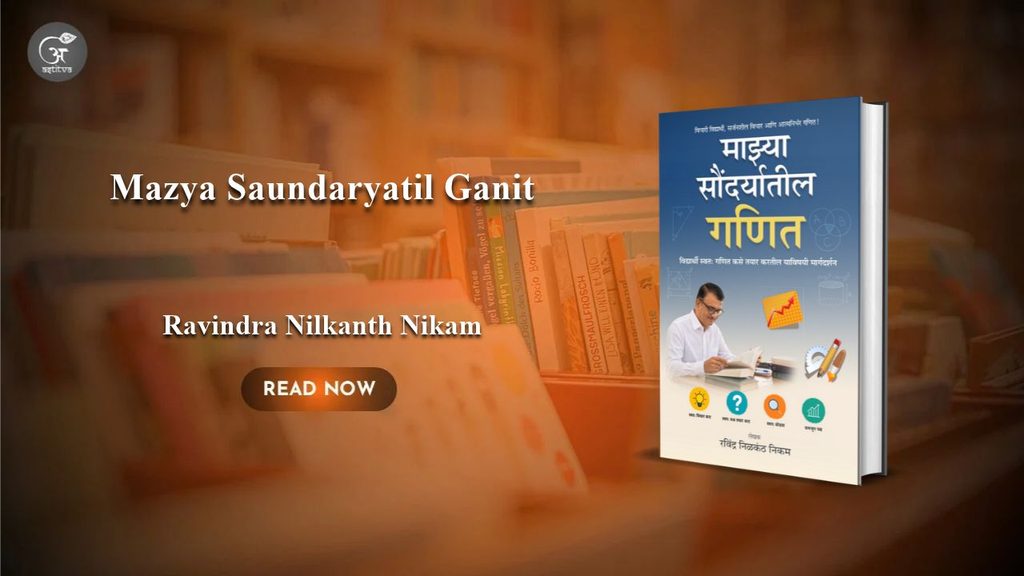
Mathematics is often viewed as a subject of numbers, formulas, calculations, and complex problems. Yet, beyond its academic applications, it has the power to shape the way we think, approach challenges, and understand the world around us. Mazya Saundaryatil Ganit by Ravindra Nilkanth Nikam explores this broader significance of mathematics, presenting it not merely as a school subject but as a source of inspiration, confidence, creativity, and practical knowledge.
At the heart of the book is the belief that mathematical thinking can help people overcome disappointment and develop a positive approach towards life’s challenges. When individuals face failure or uncertainty, they often reflect on their mistakes and search for a better way forward. The author suggests that mathematics can provide a valuable foundation for this process. By studying patterns, understanding principles, and exploring different solutions, people can strengthen their ability to think logically, approach difficulties with patience, and discover new possibilities.
The book encourages readers to look beyond isolated problems and recognise the larger picture. Its central thought is expressed through the idea that one should not focus on a single wave but explore the entire ocean. In a similar way, knowledge is not simply something to be created; it is something waiting to be discovered through observation, curiosity, and thoughtful exploration. This perspective inspires readers to move beyond routine thinking and develop a deeper interest in learning.
Another important theme is the relationship between mathematics and imagination. According to Nikam, mathematical study strengthens intellectual abilities, encourages research-oriented thinking, and helps individuals direct their mental energy towards meaningful goals. He draws attention to the role of mathematics in almost every aspect of human activity, including politics, business, employment, agriculture, education, and everyday decision-making. Through this wide-ranging perspective, the book demonstrates that mathematical understanding is not limited to classrooms or examinations; it has practical value throughout life.
The author also highlights the importance of learning through application. When people encounter a difficult task, mathematical principles can help them break it into smaller questions, examine possible solutions, and understand the reasons behind success or failure. His discussion of how the movement of a cannonball can be understood through intellectual and mathematical reasoning illustrates how the human mind can explore events without needing to experience them physically. Such examples encourage readers to appreciate the power of observation, reasoning, and scientific thought.
A distinctive aspect of Mazya Saundaryatil Ganit is its emphasis on developing mathematical problems inspired by human behaviour, daily activities, working methods, and nature. The author presents mathematical concepts and problems through simple approaches so that ordinary readers and students can understand them more easily. He also encourages students to develop problems of their own, moving from passive learning towards independent thinking and practical research. This approach aims to nurture curiosity, creativity, and the confidence to explore unfamiliar ideas.
Ravindra Nilkanth Nikam is a devoted admirer and student of the legendary Indian mathematicians <Entity value=”Srinivasa Ramanujan” category=”people” disambig=”Indian mathematician”/> and <Entity value=”Bhaskaracharya” category=”people” disambig=”Indian mathematician Bhaskara II”/>. Inspired by their mathematical contributions, he has studied their ideas, formulas, equations, and methods of developing mathematical problems. Through his own exploration and research, he has created mathematical problems that he presents with an emphasis on simplicity and practical understanding. His aim is to make mathematics approachable while encouraging learners to experience the satisfaction of discovering solutions themselves.
The book also recognises the important role parents can play in children’s mathematical education. By reading and applying its concepts, parents can support their children at home, help them solve problems, and create an environment where mathematics becomes an engaging learning experience rather than a source of fear or hesitation. Its emphasis on practical knowledge reflects the author’s belief that lessons learned through experience and research remain deeply rooted in the mind.
Mazya Saundaryatil Ganit invites readers to discover mathematics as a living part of human thought and everyday experience. It encourages students, parents, educators, and curious learners to develop confidence, strengthen their reasoning abilities, and approach challenges with a spirit of inquiry. Through his work, Ravindra Nilkanth Nikam shares a simple yet meaningful message: mathematics is not only about finding answers; it is also about learning how to think, explore, and move forward with confidence.






Your perspective matters
Share your thoughts respectfully. Comments are moderated.