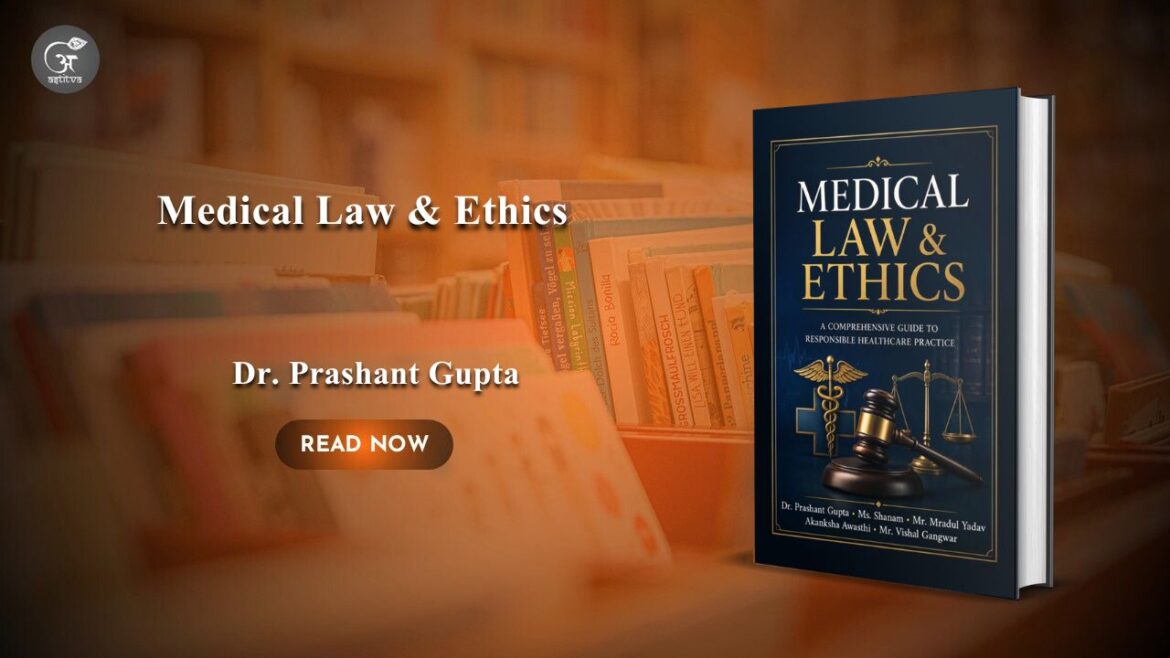
The healthcare education sector welcomes an important academic contribution with the release of “Medical Law & Ethics: A Comprehensive Guide to Responsible Healthcare Practice” authored by Dr. Prashant Gupta, Ms. Shanam, Mr. Mradul Yadav, Akanksha Awasthi, and Mr. Vishal Gangwar. This comprehensive work has been thoughtfully developed to help healthcare students and professionals understand the critical relationship between medicine, law, and ethics in modern clinical practice.
In today’s rapidly evolving healthcare environment, technical expertise alone is no longer sufficient. Healthcare professionals are expected not only to treat patients effectively but also to uphold ethical values, legal responsibilities, professional accountability, and compassionate care. This book addresses these essential aspects in a detailed yet easy-to-understand manner, making it a valuable learning resource for students and educators alike.
Specially designed for students of medical, paramedical, allied health sciences, nursing, physiotherapy, pharmacy, medical laboratory sciences, radiology, optometry, and other healthcare disciplines, the book provides both theoretical depth and practical understanding. The authors have ensured that complex legal and ethical concepts are presented in simple language while maintaining academic accuracy and relevance.
The book covers a wide range of crucial topics including informed consent, medical negligence, patient confidentiality, professional ethics, medical records, organ transplantation, reproductive ethics, mental health law, public health regulations, hospital administration, and future ethical challenges in healthcare. These subjects are highly relevant in today’s healthcare systems, where patient rights and professional responsibilities have become increasingly important.
One of the most remarkable features of the book is its focus on contemporary healthcare realities. It includes discussions on telemedicine, artificial intelligence in healthcare, patient safety, biomedical waste management, digital healthcare systems, ethical leadership, and professional registration. These topics prepare students and professionals to confidently adapt to the demands of modern healthcare institutions and emerging medical technologies.
Each chapter has been carefully structured with detailed explanations, summary points, and practice questions to enhance learning, revision, and examination preparation. This learner-friendly format ensures that the book serves not only as an academic textbook but also as a practical guide for real-world professional practice.
The authors emphasize that the true value of a healthcare professional lies not only in knowledge and clinical skills but also in honesty, empathy, respect, and ethical conduct. Through this book, they aim to nurture responsible healthcare professionals who understand the importance of humanity alongside medical science.
The statement, “Medicine is a profession of trust. Law protects that trust, and ethics gives it meaning,” beautifully captures the essence of the book. It reminds readers that healthcare is built upon responsibility, integrity, and compassionate patient care.
The collective expertise of the authors further strengthens the value of this publication. With extensive academic, clinical, and research experience in various healthcare fields, the authors bring practical insights and contemporary perspectives into the subject matter. Their dedication to healthcare education and evidence-based learning is reflected throughout the book.
“Medical Law & Ethics: A Comprehensive Guide to Responsible Healthcare Practice” is expected to become an essential reference for students, teachers, researchers, and healthcare professionals seeking a deeper understanding of ethical and legal healthcare practice. The book not only prepares readers for examinations but also equips them to become safe, ethical, and legally aware professionals in their future careers.
This release marks a meaningful contribution to healthcare education and professional development, encouraging future healthcare providers to practice medicine with competence, responsibility, compassion, and conscience.