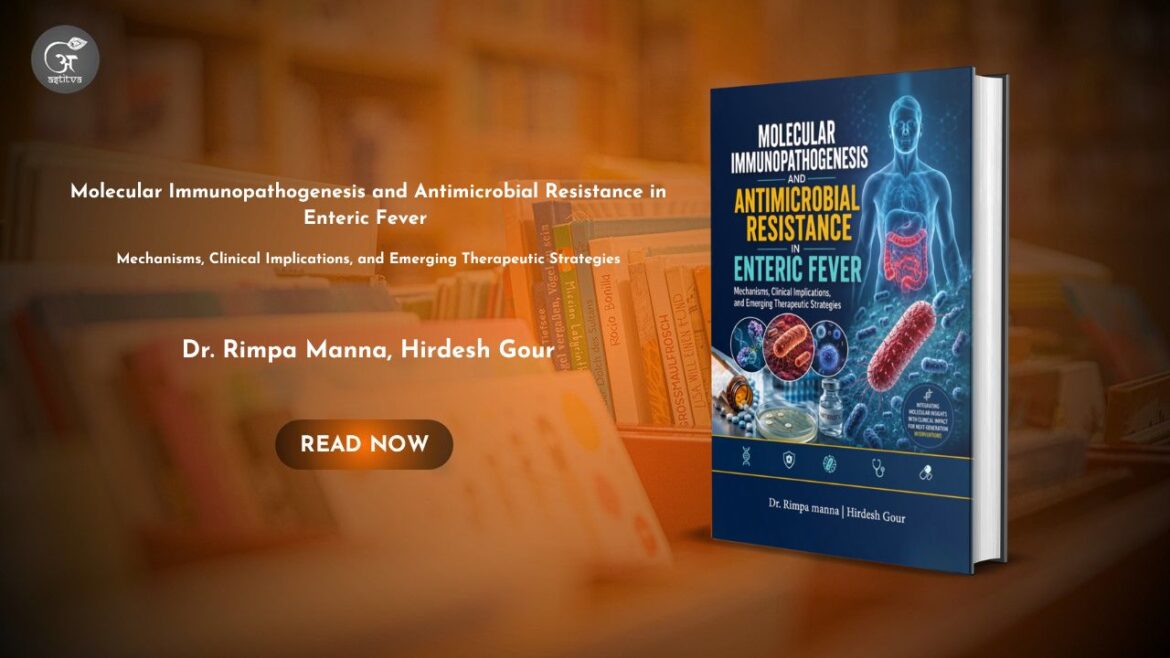
The world of infectious diseases continues to evolve with the emergence of new challenges, particularly the rapid rise of antimicrobial resistance and the growing complexity of host–pathogen interactions. Addressing these pressing global health concerns, Dr. Rimpa Manna and Hirdesh Gour present their latest scholarly work, Molecular Immunopathogenesis and Antimicrobial Resistance in Enteric Fever: Mechanisms, Clinical Implications, and Emerging Therapeutic Strategies. This comprehensive volume offers an evidence-based and multidisciplinary perspective on enteric fever, making it an invaluable resource for postgraduate students, researchers, clinicians, microbiologists, and public health professionals.
Enteric fever, caused primarily by Salmonella enterica serovars Typhi and Paratyphi A, remains one of the most significant bacterial diseases affecting millions of people worldwide, particularly in low- and middle-income countries. Despite advances in diagnostics and therapeutics, the increasing prevalence of multidrug-resistant and extensively drug-resistant strains has intensified the need for deeper scientific understanding and innovative treatment strategies. This book responds to that need by providing an extensive exploration of the molecular mechanisms underlying disease pathogenesis, immune responses, and antimicrobial resistance.
The authors meticulously explain the biology and virulence of Salmonella, highlighting how the pathogen invades host tissues, survives within immune cells, evades host defense mechanisms, and establishes systemic infection. The book presents detailed discussions on host–pathogen interactions and the intricate immunological processes that determine disease progression and clinical outcomes. By integrating concepts from microbiology, molecular biology, immunology, genomics, and clinical medicine, the work provides readers with a holistic understanding of enteric fever that bridges laboratory science with clinical practice.
A major strength of the book lies in its comprehensive examination of antimicrobial resistance. It explores the molecular basis of resistance development, including chromosomal mutations, plasmid-mediated gene transfer, efflux pump systems, and the emergence of multidrug-resistant (MDR) and extensively drug-resistant (XDR) Salmonella strains. The authors also discuss the clinical implications of resistance and emphasize the urgent need for effective antimicrobial stewardship and evidence-based therapeutic interventions.
Recognizing the rapid advancements in biomedical research, the book further introduces readers to cutting-edge technologies such as whole-genome sequencing, RNA sequencing, bioinformatics analysis, and molecular diagnostic approaches. It also explores emerging vaccine development strategies and host-directed therapeutic approaches that hold promise for improving disease prevention and management in the future. These discussions make the book not only a valuable academic reference but also a forward-looking guide for researchers working on next-generation infectious disease solutions.
Dr. Rimpa Manna, Associate Professor at RKDF University, Bhopal, is an accomplished academician and researcher with extensive expertise in medical microbiology, cytology, and molecular diagnostics. Her distinguished contributions to teaching and research have significantly advanced the understanding of microbial pathogenesis and cellular pathology. Through years of academic excellence, she has successfully integrated classical microbiological principles with modern molecular techniques, enabling more accurate disease diagnosis and improved research methodologies. Her dedication to medical education and scientific innovation is clearly reflected throughout this publication.
Co-author Hirdesh Gour serves as an Assistant Professor at RKDF University, Bhopal, bringing over six years of experience in microbiology, clinical laboratory practice, and higher education. Holding a Master’s degree in Microbiology and currently pursuing a Ph.D. in the same discipline, he possesses strong expertise in microbial sciences, diagnostic technologies, and infectious disease research. His academic interests encompass microbial pathogenesis, host–pathogen interactions, antimicrobial resistance, and emerging therapeutic strategies. His practical clinical experience, combined with his academic pursuits, has contributed significantly to the comprehensive and application-oriented nature of this work.
Together, the authors have produced a timely and authoritative reference that addresses one of the most critical challenges in modern infectious disease research. Their collaborative effort not only enhances scientific understanding of enteric fever but also provides practical insights into diagnosis, treatment, prevention, and future research directions. The book successfully combines rigorous scientific evidence with clinical relevance, making complex molecular concepts accessible to readers from diverse academic and healthcare backgrounds.
Molecular Immunopathogenesis and Antimicrobial Resistance in Enteric Fever: Mechanisms, Clinical Implications, and Emerging Therapeutic Strategies stands as a significant contribution to contemporary medical literature. As antimicrobial resistance continues to threaten global healthcare systems, this publication serves as an essential guide for those seeking to understand the evolving biology of enteric fever and the innovative strategies required to combat it. It is a valuable addition to academic libraries, medical institutions, research centers, and healthcare organizations committed to advancing infectious disease research and improving patient care.