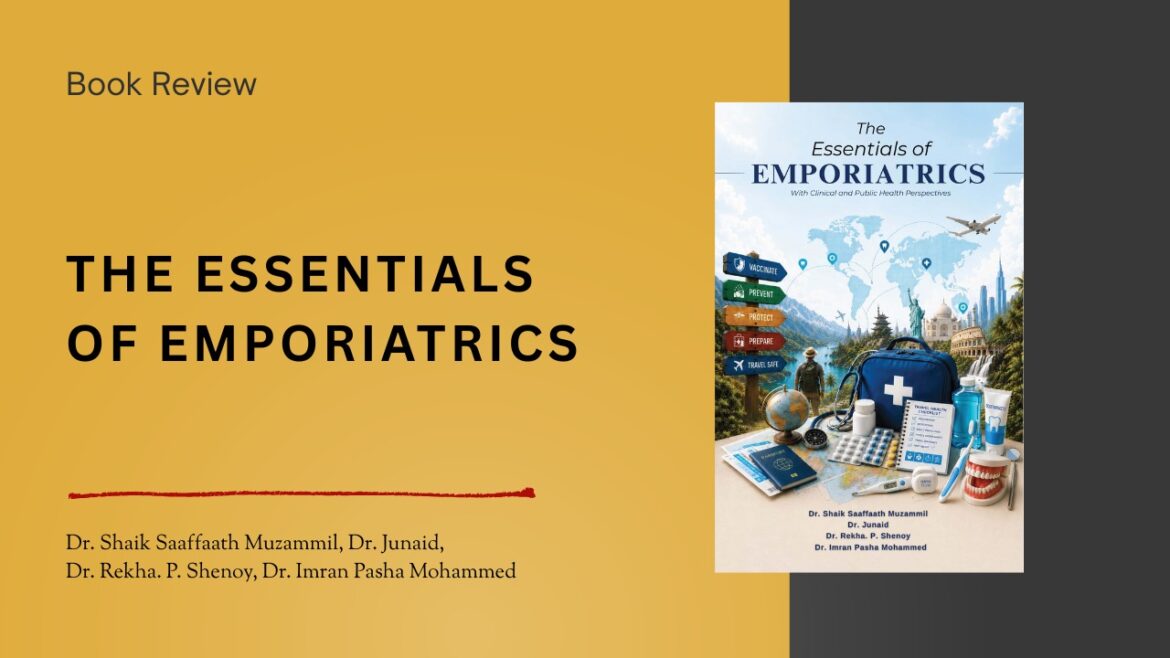
Title: The Essentials Of Emporiatrics
Author: Dr. Shaik Saaffaath Muzammil, Dr. Junaid, Dr. Rekha. P. Shenoy, Dr. Imran Pasha Mohammed
ISBN: 9789373351063
Publisher: Evincepub Publishing
In an age where travel has become almost inseparable from modern life, medicine too has had to evolve to keep pace with human mobility. The Essentials of Emporiatrics arrives as a timely and relevant contribution to this evolving discourse, offering readers an in-depth exploration of travel medicine – an area that has become increasingly significant in the wake of global pandemics, climate change, and expanding international movement.
At first glance, the subject may appear highly specialized, even niche. But what makes this book remarkable is how it broadens the understanding of travel medicine beyond vaccines and prescriptions. It presents emporiatrics as a multidisciplinary field that sits at the crossroads of public health, epidemiology, environmental science, psychology, and preventive medicine. This wider perspective is what gives the book both its academic weight and practical relevance.
One of the strongest aspects of the book is its ability to contextualize travel medicine historically. By tracing its roots back to ancient trade routes like the Silk Road and early pilgrimages, the author demonstrates that the relationship between travel and disease is far from new. This historical lens adds depth, showing how movement has always shaped health outcomes – from the spread of the Black Death to the global reach of COVID-19. The narrative reminds readers that the health of travellers has long been linked to the health of societies at large.
The book’s discussion on anticipatory prevention is particularly compelling. Rather than focusing solely on treatment, it emphasizes preparedness – an approach that feels both sensible and necessary. The detailed sections on vaccinations, malaria prophylaxis, food and water safety, and region-specific disease risks make it clear that travel medicine is not about fear, but informed caution. This is perhaps the book’s greatest achievement: it transforms complex medical protocols into a coherent philosophy of prevention.
What also stands out is the breadth of its coverage. The author does not limit the discussion to infectious diseases alone. Road accidents, altitude sickness, mental health challenges, environmental hazards, and behavioural risks such as unsafe sexual practices or alcohol misuse are given equal attention. This holistic approach makes the book feel grounded in the realities of travel rather than confined to textbook theory.
The epidemiological sections are among the most insightful. By introducing surveillance networks such as GeoSentinel and GTEN, the book illustrates how data collection and disease monitoring shape modern travel health strategies. It effectively demonstrates that travel medicine is not merely an individual concern but part of a much larger global surveillance system. In a world where one infected traveller can trigger widespread outbreaks, this interconnectedness becomes impossible to ignore.
Stylistically, the writing is clear, structured, and accessible, even when dealing with technical subjects. The explanations are systematic, making it useful not only for healthcare professionals but also for medical students and informed readers interested in public health. The inclusion of contemporary examples such as Zika, mpox, dengue, and COVID-19 makes the content feel immediate and grounded in current realities.
What makes The Essentials of Emporiatrics especially relevant today is its recognition of how travel itself has changed. The modern traveller is no longer a uniform category. Children, elderly people, pregnant individuals, immunocompromised patients, migrant workers, and humanitarian volunteers all have distinct vulnerabilities. The book’s sensitivity to these differences reflects a progressive understanding of healthcare that prioritizes individual context.
Another noteworthy strength is its attention to mental health – an area often neglected in travel-related medical literature. By acknowledging culture shock, loneliness, jet lag, and psychological strain, the book expands the definition of “healthy travel” to include emotional well-being. This inclusion feels both modern and necessary.
If there is one minor limitation, it lies in the density of information. At times, the book reads more like an academic handbook than a narrative-driven medical text. Readers unfamiliar with medical terminology may find certain sections demanding. However, for its intended audience, this depth is less a drawback and more a strength.
Ultimately, The Essentials of Emporiatrics is more than a medical guide – it is a reflection on how deeply interconnected health and mobility have become. It reminds us that in an increasingly borderless world, health risks do not remain local, and preparedness is no longer optional.
For healthcare professionals, students of medicine, public health researchers, and even frequent travellers, this book serves as both an educational resource and a practical companion. It is an important reminder that travel, while liberating, also carries responsibility – and that the best journeys begin with awareness.
In a world still recovering from the lessons of COVID-19, this book feels not only relevant but essential.
Buy on Amazon: https://www.amazon.in/Essentials-Emporiatrics-Shaik-Saaffaath-Muzammil/dp/9373351060
Review by Sameer Gudhate
For www.theliteraturetimes.com