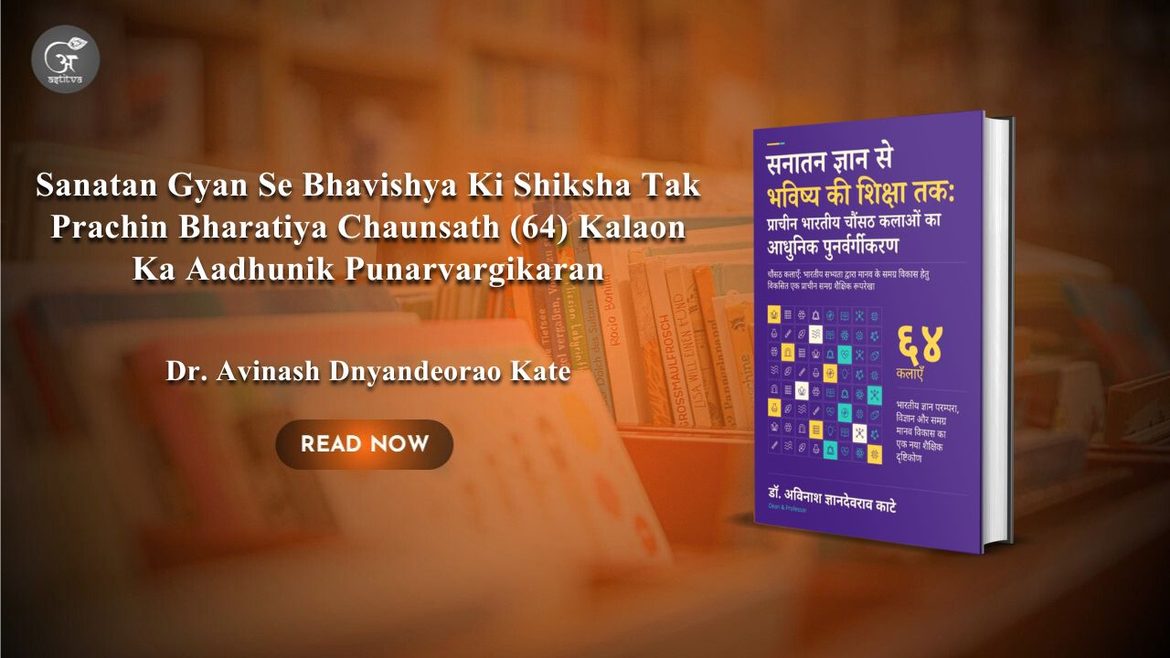
Sanatan Gyan Se Bhavishya Ki Shiksha Tak: Prachin Bharatiya Chaunsath (64) Kalaon Ka Aadhunik Punarvargikaran by Dr. Avinash Dnyandeorao Kate presents a thought-provoking educational vision rooted in India’s rich knowledge traditions. Exploring the ancient Indian concept of the Sixty-Four Arts, the book seeks to establish a meaningful connection between traditional wisdom and the evolving demands of modern education. It invites readers to reconsider the relevance of India’s cultural and intellectual heritage in shaping a more comprehensive, creative, and value-oriented educational framework for the future.
At the heart of this work lies the understanding that education should extend beyond the acquisition of academic knowledge and professional skills. True education, as envisioned through the Sixty-Four Arts, encompasses the holistic development of human beings, integrating creativity, practical abilities, intellectual growth, cultural awareness, ethical values, and inner consciousness. By examining this ancient educational framework through a contemporary lens, the book encourages a broader understanding of learning as a lifelong process that nurtures multiple dimensions of human potential.
The modern reclassification of the Sixty-Four Arts forms a central theme of the book. Rather than viewing these traditional disciplines merely as historical or cultural concepts, Dr. Kate explores their potential significance within contemporary educational thought. The work opens up possibilities for connecting Indian knowledge systems with modern scientific perspectives, technological advancements, artificial intelligence, artistic practices, and emerging educational methodologies. This approach encourages readers to discover how traditional wisdom can contribute to present-day discussions on creativity, innovation, skill development, and holistic learning.
The book also highlights the importance of preserving and reinterpreting India’s intellectual heritage in ways that remain relevant to changing social and technological realities. As education systems increasingly focus on specialised knowledge and measurable outcomes, the idea of comprehensive human development offers an important perspective. By bringing cultural knowledge, scientific inquiry, artistic expression, and value-based learning into conversation, the work proposes a broader foundation for educational transformation.
Dr. Avinash Dnyandeorao Kate brings a multidisciplinary perspective to this subject through his work as an artist, researcher, and academic thinker. He currently serves as Dean and Professor at SAMVED – School of Art, Music, Visualisation, Entertainment and Design, G. H. Raisoni International SkillTech University, Pune. His professional and intellectual interests encompass Indian art and culture, education, research, scientific spirituality, modern technology, artificial intelligence, and the possibilities of integrating traditional knowledge with contemporary learning.
Inspired by the teachings of Yugrishi Pandit Shriram Sharma Acharya, Dr. Kate views art as more than a means of expression. For him, it is a vehicle for cultivating values, awakening consciousness, and contributing to human welfare. His educational philosophy emphasises the relationship between artistic practice, spiritual development, social responsibility, and individual self-reliance.
Through this book, the author advances a vision of education that respects India’s civilisational heritage while engaging constructively with the opportunities of the future. His approach encourages educators, researchers, students, and cultural practitioners to explore how indigenous knowledge traditions can inform more inclusive and meaningful learning experiences.
Sanatan Gyan Se Bhavishya Ki Shiksha Tak ultimately invites readers to recognise the Sixty-Four Arts as a valuable starting point for reimagining education. By bringing ancient Indian wisdom into dialogue with modern science, technology, creativity, and human values, Dr. Avinash Dnyandeorao Kate presents a vision in which knowledge becomes a means of personal growth and collective progress. Guided by the philosophy of awakening through art, values through education, and human welfare through knowledge, the book contributes to an ongoing conversation about the future of education and the enduring relevance of India’s knowledge heritage.