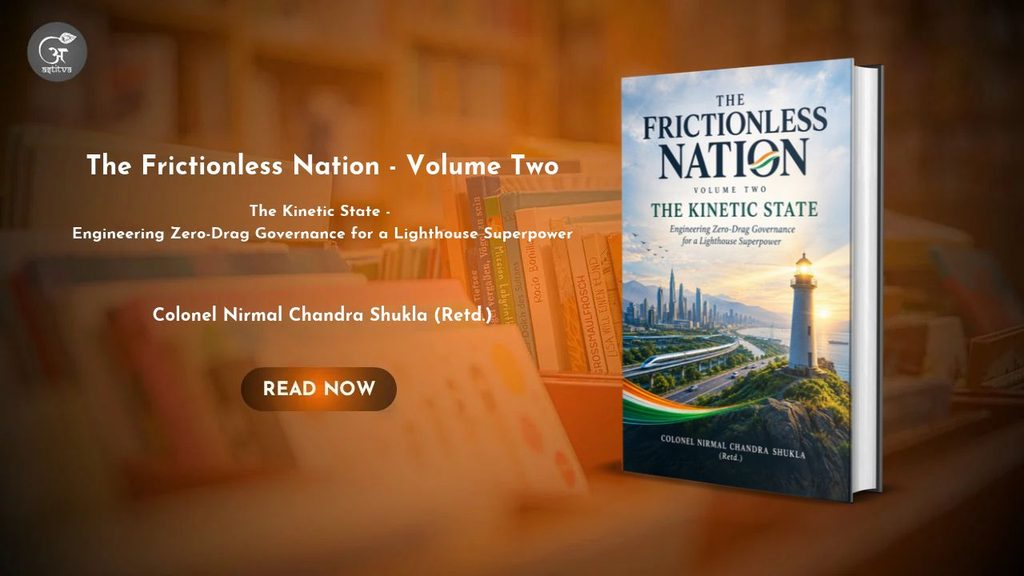
The Frictionless Nation – Volume Two: The Kinetic State – Engineering Zero-Drag Governance for a Lighthouse Superpower, authored by Colonel Nirmal Chandra Shukla (Retd.), presents a comprehensive and thought-provoking vision for transforming India’s governance architecture and preparing the nation for its next phase of development. Building upon the ideas introduced in Volume One, which focused on removing friction from India’s fiscal architecture, this volume addresses a fundamental question: how can the machinery of governance evolve to effectively administer a modern, efficient and frictionless economic system?
The book introduces the concept of a “Kinetic State,” an innovative framework for re-engineering governance to make institutions more efficient, responsive, accountable and capable of delivering measurable outcomes. The author argues that modernising the tax system alone is not sufficient if the administrative machinery responsible for implementing it continues to operate through outdated structures and practices. A fast-growing nation requires a governance system that can move with equal speed, precision and purpose.
At the heart of the book lies a comprehensive governance framework built around three major pillars and two foundational structures. The first pillar proposes a constitutional upgrade through carefully designed amendments rather than an entirely new constitutional framework. It explores the possibility of synchronised national elections and a constructive no-confidence mechanism to promote political stability and continuity in governance. The second pillar envisions an algorithmic state powered by a National Digital Twin, outcome-bound budgeting and sovereign agentic artificial intelligence, creating a technology-enabled administrative ecosystem focused on transparency, efficiency and measurable performance. The third pillar advocates a neutral and capability-building state, addressing reforms such as a transition towards a universal Uniform Civil Code and programmable welfare systems designed to empower citizens by strengthening their capabilities rather than creating long-term dependency.
Supporting these three pillars are two essential foundations: a capable human institutional framework comprising the administrative cadre, constabulary and judicial bench, and a strong constitutional safeguard system that functions as the Republic’s immune system through institutional counterweights and a clearly defined failure doctrine. Together, these elements establish a governance model that seeks to balance technological advancement, institutional accountability, constitutional principles and human capability.
One of the most distinctive aspects of the book is its guiding philosophy of treating nature as the ultimate and unforgiving auditor. Through this perspective, the author examines governance not merely as an exercise in administration but as a system that must continuously adapt, correct inefficiencies and deliver sustainable results. The book emphasises that nations which remain dependent on outdated structures, patronage and administrative inefficiencies risk falling behind in an increasingly competitive world.
Going beyond theoretical discussions, The Kinetic State offers practical reform proposals, including draft statutes, a transition matrix and a structured implementation calendar covering the period from 2026 to 2033. These elements provide a roadmap for translating the proposed governance architecture into actionable institutional reforms. By combining constitutional restructuring, digital transformation, administrative modernisation and accountability mechanisms, the volume attempts to bridge the gap between policy vision and practical execution.
Colonel Nirmal Chandra Shukla (Retd.) brings to this work a distinctive combination of military experience, academic engagement and sustained study of India’s economic, constitutional and administrative institutions. A former officer of the Indian Army Educational Corps, he was commissioned in 1983 and served as a Regular Commissioned Officer until his retirement in 2010. During his military career, he was associated with teaching, training and education across various staff and field appointments. These experiences shaped his intellectual approach, which he describes as that of a “Thinker-Soldier” — someone trained to act decisively under uncertainty while also examining the deeper conditions that determine the necessity and effectiveness of action.
Following his retirement, Colonel Shukla devoted himself to studying the institutional structures that influence India’s economic progress and national development. His thinking is guided by a principle inspired by Japanese philosophy: larger correctness is achieved through the continuous endeavour of cancelling small incorrects. This philosophy of constant correction, institutional improvement and intellectual discipline is reflected throughout his approach to governance reform.
The Frictionless Nation is envisioned as a multi-volume series for policymakers, scholars, administrators, researchers and citizens interested in practical, specific and sustainable national reforms. While Volume One examines the transformation of India’s fiscal architecture, Volume Two shifts attention towards the governance machinery required to operate that transformed system. Together, the volumes present a broader vision of a nation that seeks to combine economic efficiency with institutional excellence.
Through The Kinetic State, Colonel Nirmal Chandra Shukla (Retd.) invites readers to rethink the foundations of governance and examine how India’s institutions can become more agile, accountable and future-ready. The book is not simply an exploration of administrative reform; it is an ambitious attempt to develop a structured roadmap for building a capable state that can translate national potential into tangible progress.
Residing in Kanpur with his wife, Rashmi, the author continues his intellectual pursuit with a clear purpose: to ensure that his proposals are read, critically examined, tested and, wherever they prove effective, adopted for the greater good of the nation.
The Frictionless Nation – Volume Two: The Kinetic State stands as a significant contribution to contemporary discussions on constitutional reform, digital governance, institutional transformation and India’s long-term national development. It presents a compelling proposition that India’s journey towards becoming a lighthouse superpower will depend not only on the strength of its economy but also on the efficiency, adaptability and integrity of the institutions that govern it.







Your perspective matters
Share your thoughts respectfully. Comments are moderated.