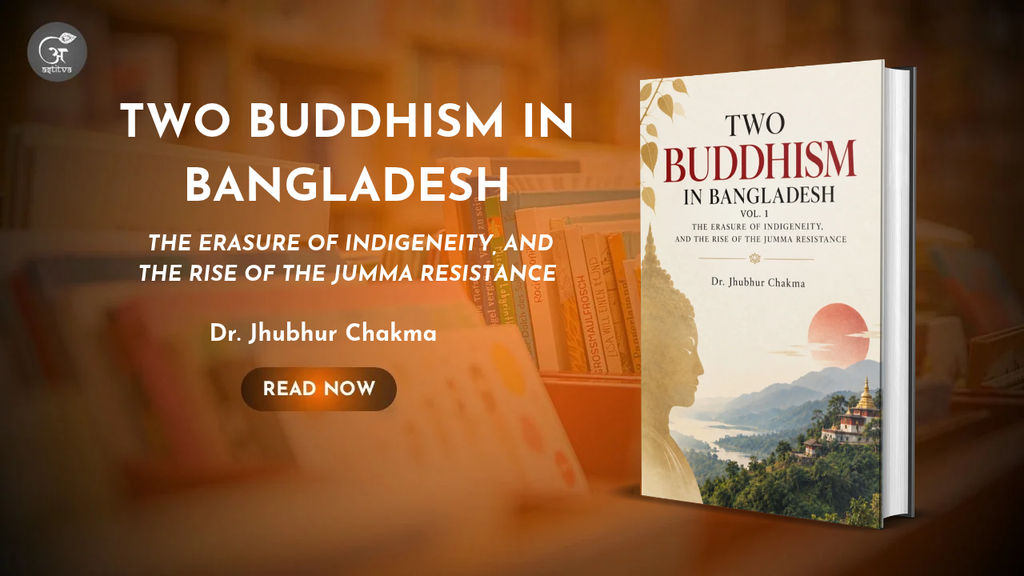
Bangladesh’s Buddhist communities share a religious heritage, yet their experiences of identity, belonging and political recognition differ profoundly. In Two Buddhisms in Bangladesh: The Erasure of Indigeneity and the Rise of the Jumma Resistance, Dr. Jhubhur Chakma examines these contrasting realities, uncovering the historical, political and religious forces that have shaped the lives of Bengali-speaking Barua Buddhists and Indigenous Jumma Buddhists.
The book explores how nationalism, constitutional identity, state policies and unequal access to political recognition have influenced the experiences of these communities. Through historical documents, constitutional analysis, Buddhist scholarship and qualitative fieldwork, it investigates the systematic erasure of Indigenous identities and the emergence of Jumma as a collective identity of resistance. It brings attention to pressing concerns such as land dispossession, militarization, cultural assimilation, religious vulnerability and the continuing challenges surrounding the implementation of the 1997 Chittagong Hill Tracts Peace Accord.
Beyond examining political and structural injustices, the book highlights the role of Indigenous Buddhist monasteries, monastic leadership, religious education and community networks in preserving cultural heritage, fostering solidarity and encouraging nonviolent responses to adversity. It challenges the notion of Buddhism in Bangladesh as a homogeneous religious tradition, demonstrating how Buddhist communities experience citizenship, religious freedom and recognition under significantly different political conditions.
Dr. Jhubhur Chakma is an early-career Buddhist studies scholar from the Chittagong Hill Tracts of Bangladesh. He holds a bachelor’s degree in Buddha Dhamma from the International Theravāda Buddhist Missionary University, Yangon, a master’s degree in Religious Studies from Mahidol University, Thailand, and a PhD in Buddhist Studies from the International Buddhist Studies College, MCU, Thailand. A 2024 research fellow of the Robert H. N. Ho Family Foundation in Buddhist Studies, administered by the American Council of Learned Societies (ACLS), his research spans Buddhist philosophy, human rights, Indigenous studies, Buddhist education and the socioreligious experiences of Buddhist communities in Bangladesh. His scholarly contributions include publications in international journals and edited volumes, including Scopus-indexed outlets.
Connecting Buddhist studies with Indigenous studies, nationalism and human rights scholarship, Two Buddhisms in Bangladesh offers a critical reinterpretation of Bangladesh’s Buddhist history and contributes to broader conversations on religion, indigeneity, identity formation and resistance in contemporary South Asia.
Discover the histories, identities and struggles behind two distinct Buddhist communities. Explore Two Buddhisms in Bangladesh: The Erasure of Indigeneity and the Rise of the Jumma Resistance, Volume 1, and engage with a powerful scholarly perspective on identity, justice and resilience.





Your perspective matters
Share your thoughts respectfully. Comments are moderated.