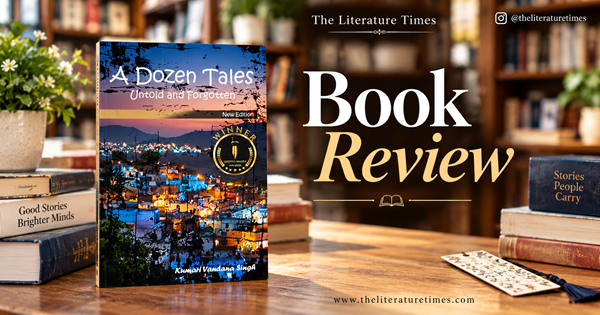
Every individual carries a story, yet not every story finds an audience. Some experiences remain hidden beneath the responsibilities of daily life, while others disappear into the silence created by social expectations, inequality, and indifference. Literature has the remarkable ability to recover these overlooked experiences and transform them into meaningful reflections on human existence. Kumari Vandana Singh’s A Dozen Tales: Untold & Forgotten embraces this literary purpose through a collection of twelve short stories exploring the emotional complexities, social struggles, and quiet realities of ordinary people. The book draws attention to lives that may appear unremarkable from a distance but contain experiences worthy of understanding, recognition, and remembrance.
The collection brings together the contrasting environments of rural and urban India, presenting a literary landscape shaped by different traditions, opportunities, and challenges. The crowded streets of cities and the peaceful surroundings of villages may seem worlds apart, yet the individuals inhabiting these spaces frequently share similar emotional concerns. Dreams, disappointments, responsibilities, relationships, and the desire for dignity remain fundamental aspects of human existence regardless of geographical location. By connecting these environments, Singh encourages readers to recognise the common emotional threads that unite people across social and economic boundaries.
One of the most compelling ideas behind the collection is that ordinary lives possess extraordinary significance. Society often celebrates individuals who achieve public recognition, accumulate wealth, or demonstrate exceptional accomplishments. Meanwhile, the struggles of farmers, labourers, homemakers, children, and countless others frequently remain unnoticed. Singh’s literary focus challenges this imbalance by suggesting that human worth cannot be measured through visibility or achievement alone. Every individual experiences moments of courage, vulnerability, sacrifice, and hope that deserve consideration.
The book’s engagement with social realities gives its themes particular relevance in contemporary society. Economic inequality, cultural expectations, gender discrimination, and the tension between tradition and personal freedom continue to influence individual experiences. These concerns become more accessible when approached through storytelling rather than abstract discussion. Fiction allows readers to imagine circumstances beyond their own and consider the emotional consequences of social attitudes. Through its emphasis on overlooked voices, the collection invites reflection on the responsibilities individuals and communities share toward one another.
The experiences of women form an especially meaningful part of the collection’s thematic concerns. Across different communities, women often navigate expectations that require them to balance personal aspirations with family responsibilities and established traditions. Their ambitions may be restricted by conventions that define acceptable behaviour and discourage independent choices. Literature addressing such circumstances creates opportunities to question inherited assumptions and recognise the emotional complexity of women’s experiences. Singh’s broader creative engagement with gender inequality strengthens the relevance of these concerns within her literary vision.
Childhood represents another important dimension of the book’s exploration of human life. Young individuals encounter the world with curiosity and innocence, but their experiences are not always free from disappointment, uncertainty, or emotional hardship. The impressions formed during childhood can influence relationships, beliefs, and decisions throughout adulthood. By acknowledging the significance of children’s experiences, the collection encourages readers to recognise the lasting consequences of seemingly ordinary events.
The title A Dozen Tales: Untold & Forgotten carries considerable symbolic importance. The words “untold” and “forgotten” suggest two different forms of absence. Some experiences remain untold because individuals lack the opportunity or confidence to express themselves. Others are forgotten because society fails to preserve their significance. Together, these ideas raise questions about whose experiences become part of collective memory and whose voices disappear with time. The collection’s central premise therefore extends beyond entertainment, presenting storytelling as a means of acknowledging neglected human realities.
The short story format complements this purpose. Unlike novels, which generally develop an extended narrative, short fiction allows writers to concentrate on distinct experiences, emotional turning points, and individual perspectives. A collection of twelve stories offers opportunities to explore different situations while maintaining a shared thematic identity. Such a structure is particularly suitable for examining the diversity of human experience, where no single narrative can adequately represent the complexity of society.
Kumari Vandana Singh’s creative background provides valuable context for understanding the collection. Born in Uttar Pradesh, India, she is a business educator whose artistic interests include poetry, storytelling, and painting. Her earlier Hindi poetry collections, Kavya Shrinkhala and Kavya Silsila, engage with subjects such as corruption, politics, gender inequality, childhood, nature, and education. These concerns reflect her sustained interest in the relationship between personal emotions and social circumstances.
Her experience as a visual artist also contributes to the broader understanding of her creative philosophy. Painting and storytelling both depend upon observation and interpretation. Where an artist uses colours and forms to express emotion, a writer uses characters, language, and narrative situations. Singh’s belief that life resembles a blank canvas shaped by individual experiences corresponds closely with the collection’s emphasis on the distinctiveness of every human journey.
Published in August 2025, A Dozen Tales: Untold & Forgotten marks an important contribution to Singh’s English-language literary work. Its availability in paperback and eBook formats on Amazon, together with distribution through international bookselling platforms, creates opportunities for readers beyond India to engage with its themes.
Ultimately, the collection invites readers to reconsider the meaning of an ordinary life. It reminds us that behind familiar faces and everyday routines exist stories shaped by sacrifice, memory, ambition, and resilience. Through its attention to overlooked experiences, A Dozen Tales: Untold & Forgotten presents a literary vision grounded in empathy and social awareness. For readers who appreciate reflective fiction exploring the emotional realities of human existence, Kumari Vandana Singh’s collection offers a meaningful invitation to listen more carefully, judge less quickly, and recognise the stories that deserve to be remembered.