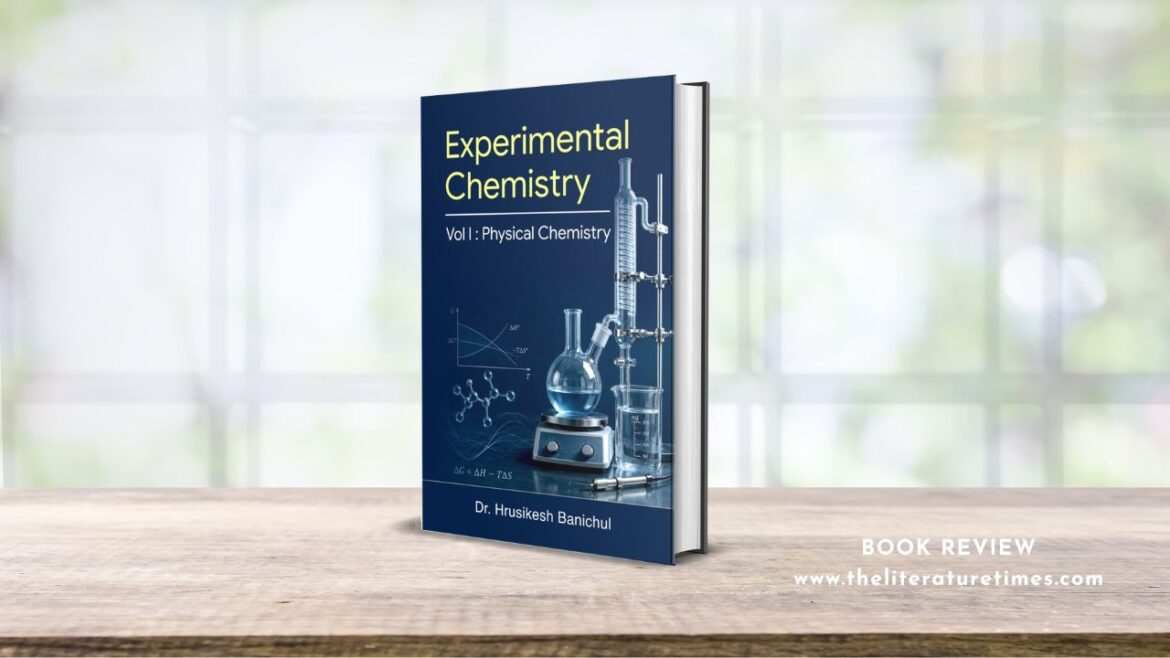
Experimental Chemistry, Vol I: Physical Chemistry by Dr. Hrusikesh Banichul is a thoughtfully designed laboratory manual that serves as an essential guide for students seeking to understand the practical dimensions of physical chemistry. In a discipline often dominated by equations, theories, and mathematical derivations, this volume successfully bridges the gap between classroom learning and laboratory application, helping students develop both technical competence and scientific insight.
Physical chemistry is the backbone of many scientific disciplines, providing the principles that explain how chemical systems behave and interact. However, mastering these concepts requires more than theoretical knowledge. It demands hands-on experience with experimental techniques and analytical instruments. This is precisely where Experimental Chemistry, Vol I excels. The book transforms complex scientific principles into practical laboratory experiences that encourage active learning and critical thinking.
One of the most commendable aspects of the book is its structured approach. The experiments are carefully organized to guide students through the fundamental measurable properties of chemical systems. Topics such as fluid dynamics, thermodynamics, electrochemistry, reaction kinetics, and surface phenomena are presented with clarity and precision. Rather than overwhelming readers with excessive complexity, the author focuses on developing a strong conceptual foundation while simultaneously building laboratory skills.
The sections dedicated to measuring physical constants are particularly valuable. Detailed procedures for determining viscosity and surface tension provide students with a deeper understanding of intermolecular forces and fluid behavior. These experiments demonstrate how abstract theoretical concepts can be observed, measured, and analyzed in real laboratory settings.
Electrochemistry is another area where the book shines. Comprehensive discussions and practical exercises involving pH meters, potentiometers, and conductometers introduce students to some of the most widely used analytical tools in modern chemistry. By learning how to operate these instruments and interpret their results, students gain practical skills that are highly relevant to academic research and industrial applications.
The exploration of reaction kinetics and distribution coefficients further enhances the educational value of the volume. These experiments allow students to investigate reaction rates, equilibrium behavior, and molecular interactions, helping them appreciate the dynamic nature of chemical processes. Such studies not only strengthen theoretical understanding but also cultivate analytical and problem-solving abilities.
Another notable feature is the book’s focus on thermochemical investigations. Through carefully designed experiments, students are introduced to energy changes, heat transfer, and the principles governing thermodynamic systems. These practical experiences make complex concepts more accessible and memorable.
What sets this laboratory manual apart is its emphasis on precision, accuracy, and scientific methodology. Students are encouraged to approach experiments systematically, record observations carefully, and interpret results critically. This educational philosophy prepares learners not only for examinations but also for future careers in scientific research, industry, and higher education.
The writing style is clear, professional, and student-friendly. Dr. Banichul effectively balances scientific rigor with accessibility, making the content suitable for undergraduate chemistry students while also serving as a valuable reference for advanced learners. The practical orientation of the book ensures that students develop confidence in laboratory environments and become familiar with modern experimental practices.
Overall, Experimental Chemistry, Vol I: Physical Chemistry is far more than a standard laboratory manual. It is a comprehensive educational resource that fosters scientific curiosity, technical proficiency, and analytical thinking. By combining theoretical principles with hands-on experimentation, Dr. Hrusikesh Banichul has created a work that significantly contributes to chemistry education.
For students, educators, and institutions seeking a reliable and comprehensive guide to physical chemistry experiments, this volume is a highly recommended addition to the laboratory and classroom alike.