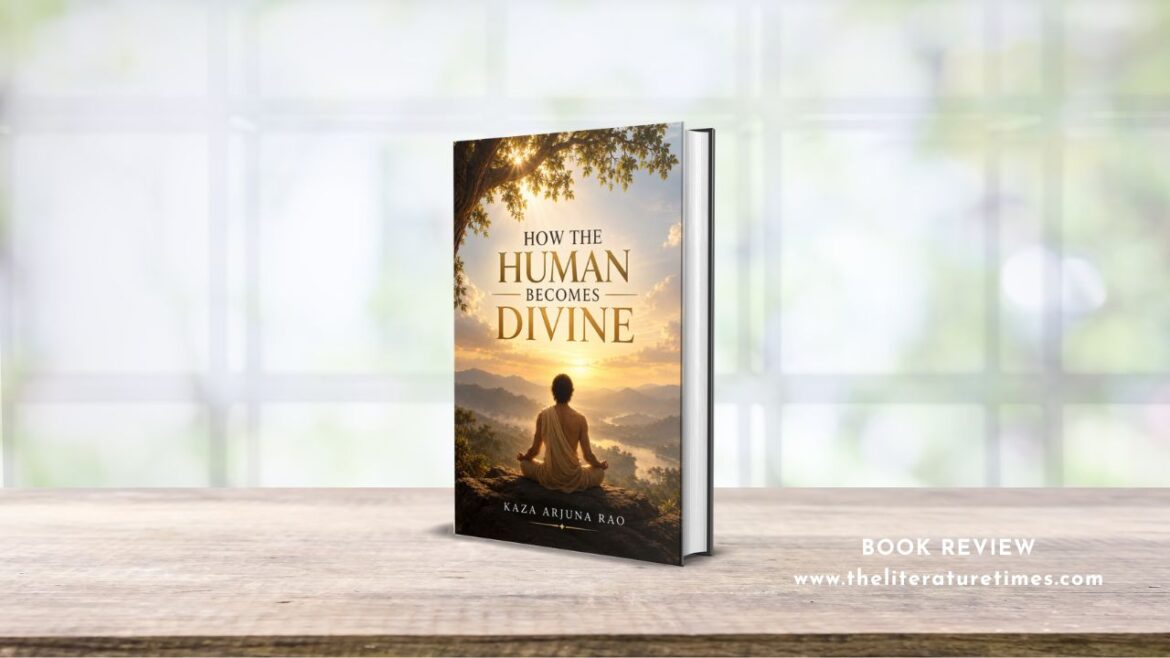
The most compelling proposition in How the Human Becomes Divine is that human progress must be judged by the quality of consciousness it reveals. Kaza Arjuna Rao places intelligence within a larger account of development, one that gives wisdom, morality and compassion an essential role. The result is a philosophical premise with an ethical centre: the capacity to know more acquires its deepest significance through the kind of person that knowledge helps us become. For readers interested in the relationship between spiritual possibility and human responsibility, this is a substantial starting point. It gives the book’s ambitious title a recognisable human concern.
The title itself creates a useful tension. To become divine appears to suggest movement towards a condition that humanity does not yet possess. Rao’s central idea complicates that expectation. He proposes that a divine spark already exists within every living being, and that evolution gradually reveals an underlying potential. Becoming, in this account, concerns the emergence of what is present but incompletely expressed. That distinction matters because it changes the meaning of aspiration. The human being is understood as someone capable of disclosure and development, with a depth that cannot be measured solely through present behaviour or visible achievement.
This is also the point at which the book’s proposition invites careful philosophical reading. A claim about a divine presence within life belongs to a spiritual understanding of existence. Its meaning should be considered on those terms, without confusing it with an established scientific explanation of evolution. The idea offers a way to interpret development, purpose and value; readers may find that interpretation persuasive while continuing to question its foundations. Holding those possibilities together makes for a more rewarding encounter with the book. Agreement need not be immediate for the underlying question about unrealised human capacity to deserve serious attention.
The distinction between intelligence and wisdom gives this inquiry a particularly strong ethical direction. Intelligence can help a person understand a problem, calculate consequences or pursue a goal. Wisdom introduces a further concern about which goals deserve pursuit and what their consequences mean for others. By tracing a movement towards morality and compassion, Rao places human development within this wider field of judgement. The appeal of the argument lies in its refusal to let intellectual accomplishment stand as a complete account of maturity. Readers are asked to consider whether the growth of ability is accompanied by a corresponding growth in responsibility.
Education therefore carries considerable weight in the book’s account of evolving consciousness. Read alongside experience and reflection, it suggests a process of formation extending beyond the possession of information. There is a valuable question here for anyone concerned with learning: what changes when understanding becomes part of a person’s character? The philosophical interest lies in that relationship between knowing and living. Rao’s framework encourages attention to the uses of knowledge, including its capacity to deepen awareness of other lives. This gives the subject relevance beyond explicitly spiritual discussion, reaching into the purposes for which people educate themselves and one another.
The relationship among the book’s ideals also deserves examination. Wisdom, morality, compassion and harmony can reinforce one another, but they are not interchangeable. Harmony, for example, may describe an absence of conflict without establishing that a relationship is fair. Compassion may sometimes require disagreement with what a community accepts. These are questions raised by bringing the ideals together, rather than objections to the value of any one of them. Rao’s framework is intellectually engaging because it invites readers to think through such relationships. It asks for a considered understanding of human maturity, one capable of recognising ethical difficulty within the aspiration towards unity.
Compassion is especially important because it gives an outward direction to the language of inner development. An account of higher awareness becomes ethically significant when it affects how another being is regarded. Since Rao locates the divine spark in every living being, his premise invites a broad consideration of dignity and moral attention. This is an implication of the idea, rather than a claim that every practical question has been settled. It opens space to ask how spiritual aspiration should influence conduct, and whether a person’s understanding of the self can remain credible without an accompanying concern for life beyond the self.
The book also moves across two scales of inquiry: the development of an individual and humanity’s ultimate destiny. Connecting these scales gives the subject ambition, though it raises questions that deserve to remain visible. Individual insight does not automatically establish a shared direction for humanity, and the possibility of moral growth differs from the certainty of eventual harmony. Rao’s vision is most productive when approached as a proposition to examine. It offers hope through the idea of latent potential, while leaving readers with the responsibility of thinking about the conditions under which that potential might become evident in human relationships.
As a subject for reflective nonfiction, this combination of creation, consciousness and ethical growth offers considerable scope. Its attraction lies in the connections it asks readers to make between fundamental beliefs and ordinary judgement. The author is a retired engineer with a continuing interest in precision and practical inquiry, alongside decades of spiritual reflection. That background provides context for the questions he pursues without serving as proof of the answers. Readers who value considered discussion of existence may find the book’s premise particularly engaging; those seeking empirical confirmation will need to distinguish the philosophical proposal from scientific demonstration.
How the Human Becomes Divine deserves attention for placing moral becoming at the centre of a discussion often dominated by intellectual power. Its strongest invitation is to consider what fuller humanity would require of us, and whether the potential we attribute to ourselves is visible in our dealings with others. The central proposition remains open to debate, as an ambitious proposition should. Yet its emphasis on wisdom and compassion provides a clear basis for meaningful engagement. Rao gives readers a question with lasting ethical force: what would it mean to recognise human possibility through the quality of the life one chooses to lead?