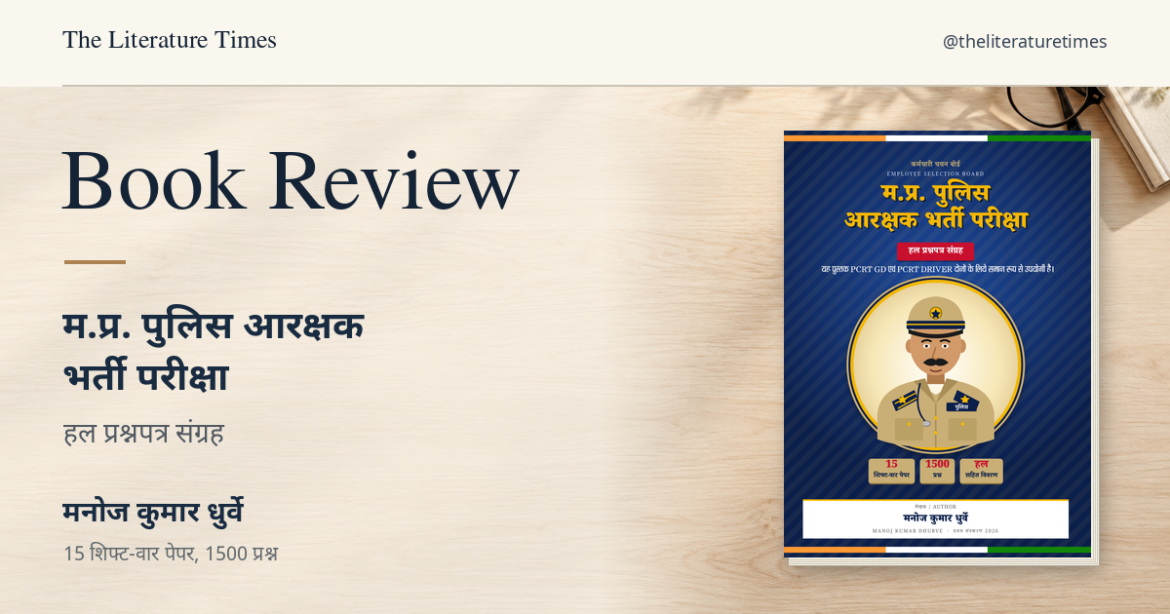
Manoj Kumar Dhurve’s M.P. Police Aarakshak Bharti Pariksha subtitled Hal Prashnapatra Sangrah, presents a focused proposition for Hindi-speaking recruitment-exam aspirants: use a structured collection of solved papers to make practice more deliberate. Its strongest feature, as described, is the relationship between complete papers and subject-based revision. Candidates are offered a way to attempt questions in an examination context, then return to areas that need attention. That is a sensible educational purpose for a practice collection. The available description supports an assessment of this approach, while the quality of its execution would require examination of the book itself.
According to the supplied material, the collection covers 15 shifts of the MP ESB Police Constable Recruitment Test held between 30 October and 1 December 2025. Each paper is described as containing 100 questions, making approximately 1,500 questions overall. The papers are arranged by date and shift, with subject divisions also identified. This proposed organization gives the collection a clearer identity than an undifferentiated bank of questions. Readers should be able to distinguish one paper from another and revisit a particular set after an initial attempt. The dates and scope here remain claims from the supplied description, rather than an independently verified account of the examination.
The listed subjects include general knowledge, Madhya Pradesh general knowledge, reasoning, mathematics, physics, chemistry and biology. This breadth suggests a resource intended for mixed-subject practice, with room for more targeted revision. A learner could use a complete paper to identify where progress slows, then examine mistakes within a subject. Such use depends on treating errors as information: an incorrect answer may reflect a forgotten fact, a misunderstood method or an avoidable reading mistake. The collection’s described structure could support that distinction, although the description alone cannot establish how thoroughly individual topics are represented. A large question count does not, by itself, demonstrate comprehensive coverage.
The most consequential promise concerns the solutions. The description states that every question has an answer and that many questions include explanations or worked solutions in simple Hindi. That distinction matters. An answer key allows a candidate to check a response, while a sufficiently clear explanation can help the reader understand how to approach a similar problem. The choice of Hindi is therefore central to the book’s intended use, particularly for students who prefer to reason through unfamiliar material in that language. Whether the explanations consistently achieve this clarity remains untested here. The supplied information also does not justify describing every question as having a detailed, step-by-step solution.
The proposed physical presentation deserves attention because a practice book is handled repeatedly. The description specifies an 8 × 11-inch format, a two-column layout and clear illustrations for questions that use figures. A larger page can provide useful room for question text and diagrams; a consistent layout can make it easier to find a particular item during revision. Yet these are design intentions, not established qualities of the finished pages. Column width, type size and the relationship between an illustration and its question would all affect actual usability. Without interior pages, it would be premature to praise the typography or certify the diagrams as legible.
Dhurve’s supplied biography offers relevant context for this emphasis on explanation and organization. He is described as a teacher, poet and author with an engineering and programming background and postgraduate qualifications in Hindi and Sanskrit. It also records his selection in ESB and Madhya Pradesh Public Service Commission examinations, alongside technical training and work as an NPTEL translator. These details help explain the educational perspective presented with the book: subject knowledge, language and structured reasoning are all part of its stated background. They should not substitute for scrutiny of the material. Credentials can establish context, but a preparation book ultimately has to earn a learner’s confidence through accurate answers and explanations that can be followed.
The clearest intended audience is the candidate preparing for the ESB police constable recruitment examination who wants to work through past papers and assess progress. The brief also identifies students preparing for other police and government recruitment examinations. For that wider audience, usefulness would depend on the overlap between the questions and their own preparation needs. The collection should not be assumed to match every examination or to replace the underlying study of a subject. Its described strength lies in practice and review. Readers who need extensive lessons before attempting questions would have to judge whether the explanations provide enough support for their current level.
A practical way to use a collection of this kind is to attempt a paper before consulting its solutions, record the questions that caused difficulty and return to those topics before trying another set. Repeating a paper can also be informative if the reader checks whether the method is understood, rather than simply recognizing the answer. These are suggested study approaches, not claims about results achieved by this book. They follow from its emphasis on self-assessment and repeated practice. The value of approximately 1,500 questions would then come from the care given to reviewing them, including the questions answered correctly through uncertain reasoning or guesswork.
On the evidence available, Hal Prashnapatra Sangrah has a coherent and potentially useful purpose: bringing a defined set of examination papers into a Hindi-language resource organized for repeated use. Its described strengths are a manageable shift-by-shift framework, a substantial practice pool and explanatory support for many questions. The important unanswered questions concern accuracy, consistency and the depth of that support. A judgment about those matters must wait for the manuscript or finished book. For now, this is a promising description of a focused practice companion whose eventual value rests on how reliably it helps candidates understand their mistakes and plan the next stage of their study.